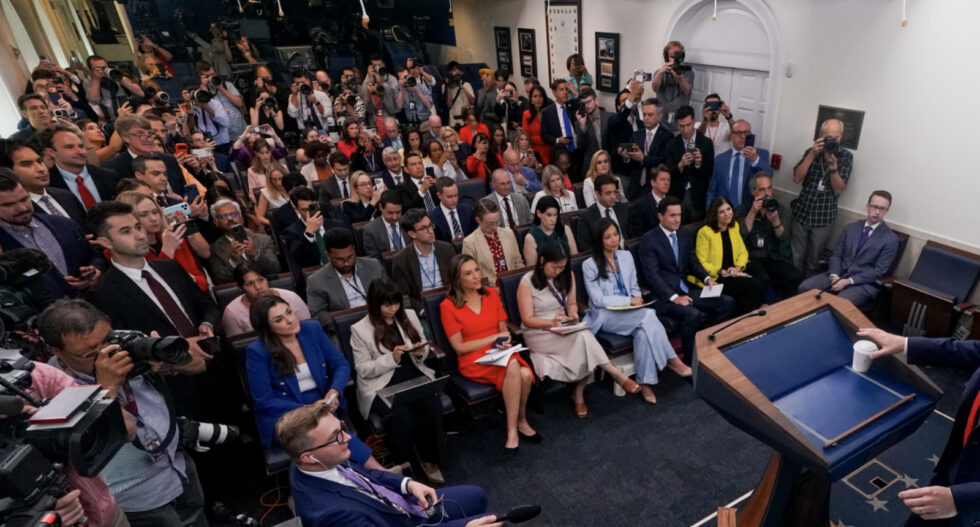
Another top-ranking official from the Trump administration took over press briefing responsibilities at the White House on Wednesday as the search for former Press Secretary Karoline Leavitt continues.
Attorney General Todd Blanche briefed reporters in the White House Rose Garden and touched on a variety of topics.
Advertisement
Blanche said that the DOJ intends to release additional records concerning possible Saudi connections to the September 11 attacks while protecting genuinely classified information.
“The one thing that we are not doing, we’re not protecting people,” Blanche said.
Blanche also noted the DOJ’s efforts to go after fraud in America.
Advertisement
Blanche appeared with Vice President JD Vance in Missouri on Monday to announce federal action involving people suspected of stealing millions from taxpayers through pandemic-era small-business relief programs.
Blanche used the briefing to emphasize DOJ’s fraud and public-corruption enforcement agenda.
Beyond the briefing, Blanche and the DOJ have been busy lately.
Meanwhile, the Justice Department announced Friday that an Afghan woman accused of supporting an ISIS-inspired plot to carry out a mass shooting around Election Day 2024 has been deported from the United States in the first case ever brought before the nation’s never-used Alien Terrorist Removal Court.
Nazira Haji Zada, 47, who had been living in Fort Worth, Texas, was returned to Afghanistan after agreeing to be removed and conceding for purposes of the proceeding that she qualified as an “alien terrorist” under federal law.
The Alien Terrorist Removal Court issued its removal order Aug. 20. The order remained under seal until Friday, when the Justice Department announced that Zada had been sent back to Afghanistan.
The case marked the first time the federal government has used the specialized court since Congress created it three decades ago.
Congress established the tribunal as part of the Antiterrorism and Effective Death Penalty Act of 1996 following concerns about how the government could remove noncitizens accused of terrorism without publicly revealing highly sensitive classified intelligence.
Advertisement
The court consists of five federal district judges selected by the chief justice of the United States from five different judicial circuits.
Unlike a normal immigration court proceeding, the Alien Terrorist Removal Court can consider classified evidence under special procedures intended to protect national-security information.
That structure has also drawn criticism from civil-liberties advocates and Zada’s attorneys, who argued that defendants may be unable to fully examine or challenge some of the evidence being used against them.
Zada was a lawful permanent resident when the government sought to remove her.
Advertisement
She was not criminally charged in connection with the Election Day plot.
Instead, the Justice Department filed an application July 15 asking the specialized court to order her removal based on allegations that she supported members of her family who were planning an ISIS-inspired attack.
She was arrested later that month and appeared before Chief Judge Joan Ericksen in Washington.
The alleged plot itself had already resulted in criminal convictions.
Zada’s son, Abdullah Haji Zada, and her son-in-law, Nasir Ahmad Tawhedi, were arrested Oct. 7, 2024, after purchasing two AK-47-style rifles, ammunition and magazines from an undercover FBI agent.
Federal authorities said the weapons were intended for a mass-casualty attack planned for on or around Election Day, Nov. 5, 2024.
Advertisement
According to court records, Tawhedi communicated with an ISIS facilitator while preparing for the attack and discussed whether 500 rounds of ammunition would be sufficient.
He later admitted that between June and October 2024 he conspired with at least one other person to obtain weapons and carry out an attack on behalf of ISIS.
Tawhedi pleaded guilty in June 2025 to conspiring and attempting to provide material support to ISIS and to firearms offenses connected to a federal crime of terrorism. He is awaiting sentencing.
Zada’s son Abdullah was 17 at the time of his arrest but entered a guilty plea as an adult.
He was sentenced to 15 years in federal prison.
As part of his plea agreement, Abdullah agreed to be removed to Afghanistan after serving his sentence and waived most avenues for appealing that removal.
This article may contain commentary which reflects the author’s opinion.