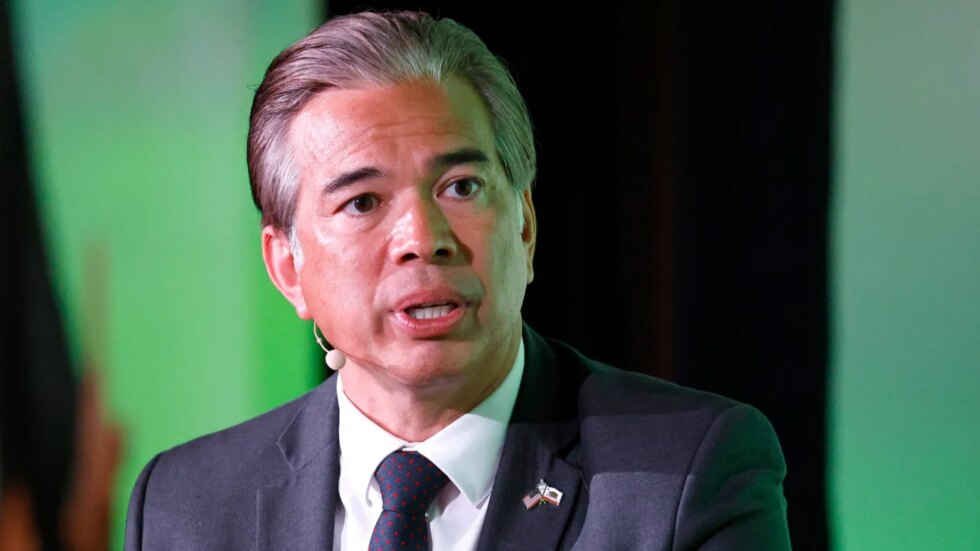
After all of that sound and fury, that’s it? “I don’t think these two companies should merge,” said California attorney general Rob Bonta in unveiling a settlement with David Ellison to allow the mogul to do just that with Paramount and Warner Bros. Discovery.
Paramount’s C-suite must have been popping bottles of champagne as the press office engines of the major studio and 12 state attorney generals typed up the settlement term boilerplate language of what ended up being a stern finger-wave to Ellison’s team.
When Bonta held his presser on Monday he made a point to note multiple times that he personally was not in favor of the merger while rattling off that Paramount would invest $1.5 billion in domestic production over five years, Paramount and Warner Bros. need to keep their studio lots as is in Los Angeles and CBS News and CNN would have independent editorial boards.
Additionally, the Paramount and Warners cable channels (think: Comedy Central-MTV-BET-Nick and HGTV-Food Network-TNT-Discovery, respectively) will have to negotiate affiliate agreements separately. The studios also need to invest $9.5 million a year in workforce training and career development in film and TV production communities. And the megastudio will start a $5 million annual fund to bankroll indie movies. (Not to mention Paramount will also pay $40 million to reimburse the 12 states who sued it for attorneys’ and economic expert fees.)
A five-year commitment for 30 films does up the three-year pledge Ellison had earlier signed on to. And if the studios fail to meet that threshold, they would be hit with a $30 million penalty per film. Bonta says that $1.5 billion figure represents $300 million more annually than the combined studios spent last year.
In the fine-print consent degree, there’s a lot of rules-of-the-road language on potential divestitures (like selling, say, Miramax Studios or Comedy Central or VH1) if Paramount fails to follow through on its commitments (Notably, blue-chip assets like CNN or New Line Cinema are not even on the table to divest in that scenario). But the commitments themselves don’t appear to be that high of a bar to achieve.
Now the 43-year-old Ellison can go about the business he was ready to begin a year ago when he took Paramount off of Shari Redstone’s hands and paired it with his own company Skydance Media. At the time, he said he wanted to run Hollywood studios for the next two decades while pushing them toward a vaguely tech-driven future where entertainment giants can slug it out with the major platforms in the attention economy. That entire narrative went on pause as Ellison put a pin in telling the story of his Paramount overhaul and pushed all of his chips in to chase Warner Bros. Discovery.
To his credit, he’s been counted out more than a few times along this rollercoaster ride. But it didn’t hurt having a father, Oracle mogul Larry Ellison, who’s worth around $200 billion and holds the keys to TikTok’s U.S. subsidiary, to backstop his chase. That allowed him to keep the focus on acquiring the entire Warner Bros. Discovery (yes, including those cable channels like CNN, HGTV and Food Network that would’ve been spun out), even if Warners honcho David Zaslav was hoping to hold two auctions instead of one.
Despite Ted Sarandos and Netflix closing a deal and touring the Warner Bros. lot in December, Ellison ultimately outlasted his rivals by upping the price, forcing the Warners board to concede that in dollar figures Paramount offered the better deal. Then he wooed Donald Trump’s administration to speed along the deal in the U.S. and courted governments abroad to greenlight his $111 billion merger with minor concessions made.
Throughout all the overseas regulatory scrutiny, Paramount’s arguably biggest compromise abroad was to exit a distribution joint venture with Universal in order to win European Union approval. This likely did not keep up Team Paramount at night. The Brendan Carr-led FCC, which has been warring with Disney, just waved through last week a flotilla of Middle East sovereign wealth funds as backers of the megamerger.
Then came Rob Bonta and the California attorney general’s posse of 12 states who filed suit in July with plans to block the deal, as the last obstacle. The states had argued that Paramount’s devouring of Warner Bros. Discovery was a monopoly concern (the Writers Guild, in its own suit, brought up the monopsony issues — i.e. one fewer buyer for scripts around town, one less place to shop a project to, etc.)
And for a time it seemed like the states had leverage, especially in getting a court to push back an antitrust trial over the deal until March 2027, dragging out the sale process and igniting all that talk about the $7 million-per-day ticking fee that Paramount would have to pay starting in October. On Monday, Bonta said sometimes you win, sometimes you lose in court and added that the solution that his office is presenting addresses antitrust concerns.
So what did Rob Bonta and his coalition end up securing from this fight? The AG has been on a media blitz vowing not to strike a deal unless there’s real “structural remedies.” That has played into the hopes of the Hollywood notables who’ve campaigned against the merger, call it the Jane Fonda wing of the industry. Fonda herself bemoaned the megadeal this way: “As a creative, the fewer studios there are, the fewer places that we can take our products. We lose bargaining power. Unions lose their power. There’s a very robust and growing movement to stop the mergers.” She added, “It’s sad for me because I like David Ellison very much,” noting that Skydance had financed Grace and Frankie on Netflix.
That sort of measured logic is what you’d hear all across town since July. And that’s why, perhaps, the Fonda wing of Hollywood that represented the “Block the Merger” voices would be disappointed with what Bonta eventually showed up with. The remedies that the AG discussed for Paramount were more behavioral, arguably, than structural. Bonta made a reference to how this deal would be more closely monitored than when Disney devoured 21st Century Fox during the first Trump administration. And there is more spelled out commitments.
But the guardrails also seem like they may not alter what Ellison’s team may have been already planning for. On the 30-film a year number, for example, Warner Bros. distributed 11 wide release movies in 2025 while Paramount put out 10 features, per an economic report published by Los Angeles County in June, but both studios had been expected to increase output regardless given the industry pivot by studio executives away from COVID-era thinking that gave streaming-only releases for coveted titles.
Combined, Warner Bros. and Paramount have 22 films on the calendar for 2026 and 30 for 2027, per L.A. County’s report. The consent decree outlines that 20 percent of those 30 pledged Paramount-Warner Bros. features each year be budgeted at $50 million or more and be released on 3,000 screens, which does glance at critics’ contentions that the studios could just release smaller titles to fulfill a release quota.
And to the political football of owning major news channels: Does an independent oversight board matter for CBS News and CNN when the goal, likely, for those news outlets is not adding or changing their editorial focus but could be cost savings and synergies? It’s difficult to see how these planned committees about ethics in journalism and standards and practices will have any effect on the dollars and cents structural changes that are likely to be made in consolidation. Nor would an editorial board, it seems, have any impact on number of journalists employed overall.
And after all that talk about packing up Paramount and Warner Bros. into moving trucks and hightailing it out of California, the studio lots will need to stay as is — for now. Per the consent decree, the lots in Los Angeles County can’t be sold during the commitment period, which is five years. Does that render all that talk about moving to Tennessee and Texas as a massive bluff by Ellison’s team? Maybe or maybe not. There’s a lot of office and studio space outside of the lawsuits in the sprawling empire of Paramount and Warner Bros. Discovery. Keeping the studio lots as is leaves a lot of flexibility on the rest of the portfolio.
While the deal terms are not about Bonta, surely the AG realizes that his reputation in Hollywood was on the line too. What he just announced will likely be cheered by Paramount and WBD shareholders and the three major theater chains that all eventually backed a settlement with Ellison. But it doesn’t align with the stark terms that he framed this legal battle against Paramount in just a few short months ago.