Republicans have another encouraging sign in the battle for Senate control, with a fresh projection pointing toward a commanding advantage.
Advertisement
The numbers offer conservatives reason for confidence as campaigns enter their closing stretch and voters continue returning ballots before November.
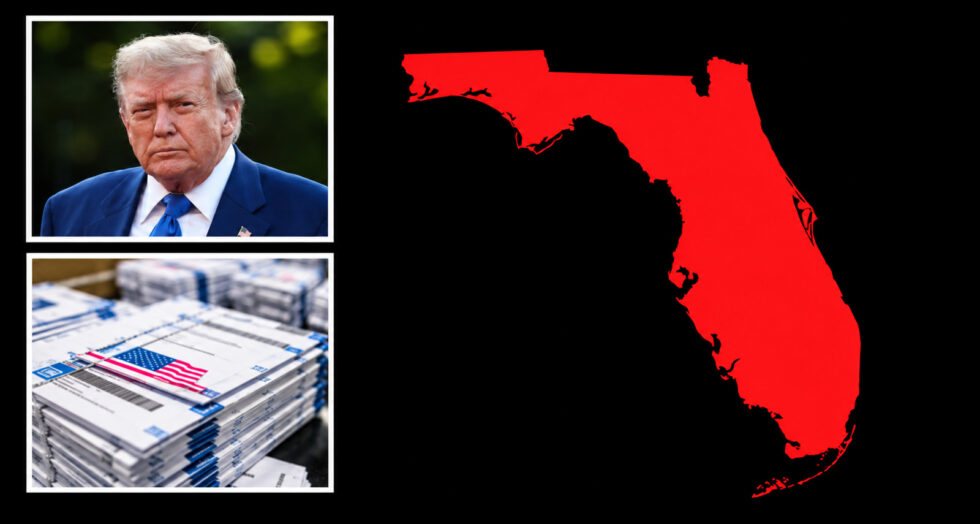
An Election Data Guy graphic dated October 29 identifies Republicans as the current leader in its Florida Senate election model.
Its projected Republican vote range runs between 56% and 62%, placing the GOP above majority support throughout that entire interval.
Advertisement
The Democratic range stretches from 37% to 43%, leaving a substantial separation between the two parties in this particular projection.
Even the lowest Republican estimate exceeds the highest Democratic estimate by 13 percentage points, illustrating the model’s distinctly favorable outlook.
The graphic lists 4,013,781 early and mail ballots, providing a sizable participation snapshot ahead of the final statewide election results.
Its red category contains 1,616,839, compared with 1,555,888 in blue, producing the displayed Republican early voting advantage of exactly 60,951.
A third category accounts for 841,054, and those three figures reconcile precisely with the total displayed prominently above the breakdown.
The graphic estimates final turnout at 50%, an assumption that remains important when interpreting its forecast of the eventual electorate.
These figures describe an election model and early participation, rather than an official tally showing how voters marked Senate ballots.
Republican Senator Ashley Moody faces Democrat Angie Nixon, with public polling also giving the GOP incumbent an advantage approaching November.
RealClearPolling lists Moody at 49.4% and Nixon at 43.2%, putting the Republican ahead by 6.2 percentage points in its average.
That polling advantage is narrower than the graphic’s projected ranges, but both sources place Republicans in the stronger position statewide.
Stetson University’s October survey separately placed Moody ahead 52% to 41% among modeled likely voters, including respondents leaning toward candidates.
Advertisement
For Republicans, those favorable indicators arrive alongside a formidable national money operation capable of supporting congressional campaigns throughout the country.
FLORIDA 🗳️
Florida has crossed 4 million early and mail votes (4,013,781), with Republicans holding a 60,951 firewall.
The party mix sits around 40% R / 39% D / 21% other — still softer for Republicans than 2024 (42.9%) and 2022 (42.9%), with Democrats running above both years.
Day-over-day added about 295k votes, and the Republican firewall grew by roughly 14k.
— E_DataGuy (@E_DataGuy) October 29, 2026
Federal records show Trump’s flagship super PAC still retained approximately $164.3 million through October 14, even after substantial campaign spending.
That reserve belongs to MAGA Inc., an outside political committee supporting Trump’s agenda, rather than the president’s personal bank account.
Advertisement
The Associated Press reported that MAGA Inc. had deployed nearly $277 million since September began, including transfers to allied committees.
Transfers included $200 million for No Going Back PAC and $25 million for Safety & Affordability PAC, according to filings.
The same report said Trump intended his operation to spend more than $400 million by Election Day supporting Republican efforts.
Those plans followed a formidable starting position, with MAGA Inc. entering September holding nearly $416 million available in its accounts.
The strong Republican financial advantage extends beyond Trump’s operation, reaching the committees responsible for defending and expanding congressional representation nationwide.
The National Republican Congressional Committee announced $50 million raised during the third quarter, entering October with $61 million available nationally.
Advertisement
Its September fundraising reached $28.5 million, including a $14 million transfer from the Republican National Committee to support House efforts.
According to the NRCC, that September haul exceeded the Democratic Congressional Campaign Committee’s fundraising by more than $2 million overall.
These figures document Republican fundraising strength, although transfers between allied committees should never be counted twice when calculating combined resources.
Earlier federal filings also illustrated the scale of Republican outside support, with Senate Leadership Fund reporting substantial reserves through June.
That group reported $253.7 million raised overall and $238.6 million remaining, according to a compilation citing Federal Election Commission records.
Congressional Leadership Fund, another major Republican outside group, previously reported $163.2 million raised and $141.8 million available through June 30.
Those earlier balances are historical snapshots, rather than current reserves, but demonstrate the enormous financial foundation Republicans assembled this cycle.
This article may contain commentary which reflects the author’s opinion.