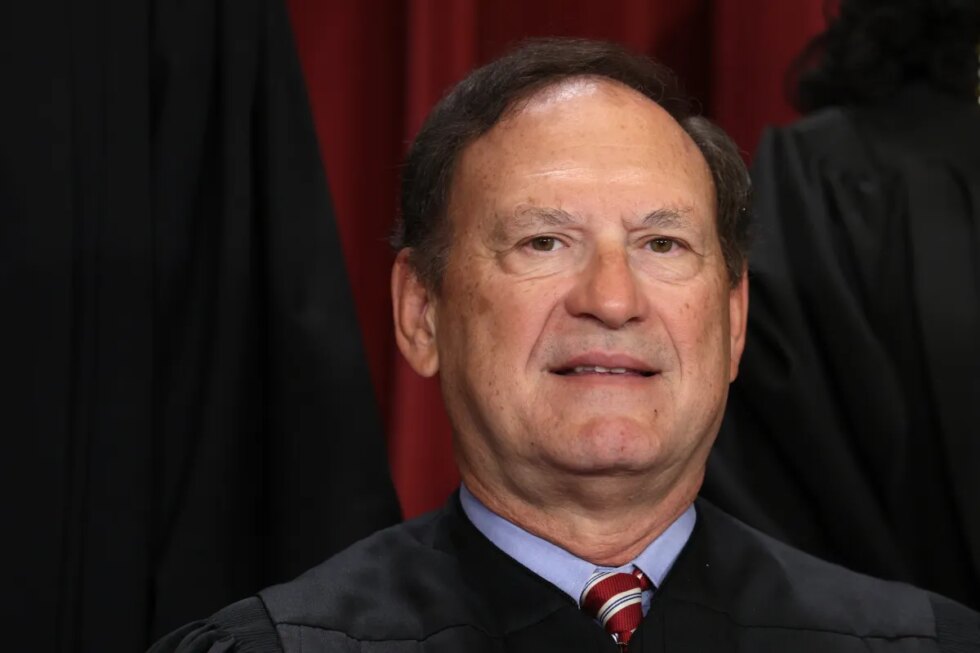
Supreme Court Justice Samuel Alito sees his work — and the role of his clerks — as part of a broader ideological fight, according to a friend who spoke on the condition of anonymity for a new biography that was just released. In Alito, a book by conservative author Mollie Hemingway, the justice is described as urging his clerks to view their jobs not as résumé‑building exercises but as participation in what he sees as an existential struggle over the Constitution and the country’s future.”Sam wants clerks to recognize that this is war, that they’re on the same page and fighting for America, not their future careers,” one of Alito’s friends told Hemingway for the book. Each Supreme Court justice is typically assigned four law clerks per term, elite young lawyers who assist with nearly every stage of the Court’s work — from screening thousands of petitions for review to researching legal questions, preparing bench memos, drafting opinions, and honing questions for oral arguments. Clerks, most of whom previously served for federal appeals court judges or come from top law schools, also help circulate draft opinions, respond to dissents, and manage the intense internal back‑and‑forth that shapes final rulings, giving them significant behind‑the‑scenes influence over how cases are analyzed and resolved. The Alito biography depicts his use of clerks as minimal, but also that he expects the clerks that he chooses to be aligned with and dedicated to advancing conservative values. Hemingway repeatedly depicts Alito’s chambers in martial terms. One former clerk or Court insider likens the operation to an elite military unit, describing Alito’s office as the “Green Berets” of the Supreme Court — an elite team expected to strengthen any position it joins.Alito, the book says, is known for blunt directives and military metaphors. When he tells clerks, “I don’t think we need to take point on that one,” the meaning is clear: the issue isn’t worth the risk, the book says.One of the “most important battles” for Alito, according to Hemingway, is protecting religious freedom. In a recent case, Alito defended a Muslim inmate’s right to have a beard while incarcerated, despite it going against state prison rules. Alito also defended Hobby Lobby’s ability to deny certain health care plans to employees because they’re a Christian organization.The book also portrays Alito as believing the Court is under sustained assault from politicians, activists, and the media—forces he sees as attempting to pressure justices into abandoning legal principle in favor of political outcomes. In that worldview, the Court is no longer merely an arbiter of disputes but a contested stronghold in a larger struggle over constitutional authority.The conflict, as Alito understands it, is not about disagreement over legal reasoning but about efforts to coerce the Court itself. Hemingway documents how Alito interprets threats of court-packing, impeachment, and public intimidation as deliberate tactics designed to bend justices’ votes. In his view, such pressure campaigns represent a direct challenge to judicial independence, undermining the constitutional structure that insulates judges from politics through lifetime tenure.That sense of siege intensified dramatically after the leak of Alito’s draft opinion in Dobbs v. Jackson Women’s Health Organization, the 2022 case that overturned Roe v. Wade. Hemingway describes the leak as an institutional trauma that shattered trust inside the Court and reinforced Alito’s belief that internal and external actors were willing to violate longstanding norms to influence outcomes. The unprecedented disclosure, followed by protests at justices’ homes and escalating threats, is portrayed as confirmation that the Court had entered a new and more dangerous phase of conflict.It’s still unclear who leaked the decision, but it put the Court’s clerk under heightened scrutiny with some people thinking it was a conservative clerk who wanted to lock in the decision and others thinking it was a liberal clerk who hoped public backlash would change people’s minds. Clerks are a vital piece of the Supreme Court’s ability to handle its workload, although former clerks of Alito told Hemingway the justice is a hands-on boss. However, one area that Alito does rely on his clerks for is identifying conflicts of interest.Alito has become a central figure in the Supreme Court’s ethics crisis following reporting that he accepted luxury travel and hospitality from wealthy conservative donors with business before the Court. ProPublica revealed in 2023 that Alito took an undisclosed 2008 private‑jet trip and luxury fishing vacation in Alaska with billionaire hedge‑fund founder Paul Singer, whose firm later appeared before the Court multiple times. Alito did not recuse himself from those cases and voted with the majority in a 2014 ruling that ultimately resulted in a multibillion‑dollar payday for Singer’s fund, prompting ethics experts to say the justice appeared to have violated federal disclosure rules and basic recusal norms.Alito has forcefully rejected claims of impropriety, arguing in a Wall Street Journal op‑ed that he was unaware Singer had business before the Court at the time of later cases and that mandatory disclosure forms made it “utterly impossible” for justices to identify such conflicts. Critics, however, say the episode underscores how Supreme Court justices largely police themselves on ethics matters, with no binding code of conduct and no independent enforcement mechanism. The controversy intensified calls from Democrats to impose new ethics rules, particularly as similar reporting has implicated other conservative justices.The scrutiny of Alito has expanded beyond travel to questions about political signaling and recusal. In 2024, reports that flags associated with the “Stop the Steal” movement and Christian nationalist causes were flown at his houses. It raised new demands that he step aside from cases involving the 2020 election and President Donald Trump. Alito refused, writing to congressional Democrats that the flags did not reflect his judicial views and did not require recusal. Hemingway wrote in her book that Alito would rather keep his family’s investments in mutual or index funds, but his wife’s stocks, which she got from her parents, hold “sentimental value” so she doesn’t want to sell them.Alito’s clerks are responsible for identifying those conflicts of interest, and Hemingway wrote in the book that when cases slip through that he should have recused himself from, Alito tells the clerks they have to “be more diligent.”
Source link