Researchers are examining an object at Nikumaroro that could offer clues to the aviator’s 1937 disappearance.
Thanks in large part to a recent viral video about the strength and savagery of coconut crabs, a less popular vision of Amelia Earhart’s ultimate fate has resurfaced.
A new investigation is underway to find Amelia Earhart’s missing plane as scientists attempt to uncover one of history’s greatest aviation mysteries.
On Wednesday, researchers began an underwater survey in Nikumaroro’s lagoon for what could be remains of Earhart’s Lockheed Electra 10-E, according to Purdue University, which is leading the expedition efforts with the Archaeological Legacy Institute. A remote atoll in the South Pacific located halfway between Hawaii and Australia, Nikumaroro lies about 400 miles southeast of Howland Island, the planned destination of Earhart’s flight.
Work began Wednesday, Oct. 14, with an underwater survey at the heart of an investigation into an anomaly that could be what remains of Amelia Earhart’s Lockheed Electra 10-E. The Taraia Object expedition, a joint effort between the Archaeological Legacy Institute, Purdue Research Foundation and Purdue University, is pursuing clues to one of aviation’s biggest mysteries. (Courtesy of Purdue University)
Purdue University
The 17-person team is searching for evidence of the “castaway hypothesis,” the theory that Earhart and her navigator Fred Noonan landed on the uninhabited island during the later part of her 1937 around-the-world flight. Specifically, the researchers are focused on investigating the Taraia Object, a “visual anomaly” that was first seen in satellite imagery in 2020 and confirmed in aerial photos as far back as 1938, one year after Earhart went missing.
Team members arrived in Nikumaroro after a five-day boat journey from Tarawa, Kiribati, before establishing operations on Tuesday, Oct. 13. After clearing a trail and reaching the Taraia Peninsula, they conducted an initial search for surface artifacts and assessed the conditions of the lagoon.
During the first day of the underwater survey, scientists used a magnetometer to detect metals from the plane and sonar technology to look for objects under sediment on the lagoon floor. This data will lay the groundwork for further investigation.
Image of the island shore of Nikumaroro, where an expedition team is searching for Amelia Earhart’s missing Lockheed Electra 10-E. (Courtesy of Purdue University)
Purdue University
Researchers also set up a solar-powered tech system onshore that will provide connectivity for monitoring devices. The tools, a water level transducer and a remote camera, will provide new information about the island’s weather and tides.
“We’re following our game plan,” Executive Director of the Archaeological Legacy Institute Rick Pettigrew said in a recent update. “It’s too early to reach conclusions as we’ve got a lot of science left to apply.”
Operations were temporarily paused on Thursday due to winds and rough seas in the South Pacific preventing team members from traveling ashore by boat. However, the expedition remains on schedule with two more days of field operations planned, according to Purdue.
The final two days will involve using a hydroprobe and a water injection dredge to remove sediment from the object so scientists can visually assess it. The team expects to have more information to share by Sunday, Oct. 18.
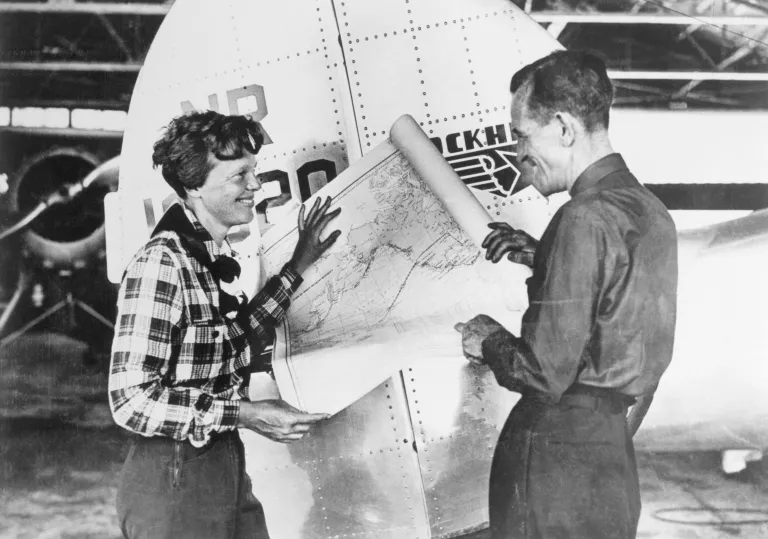
Pilot Amelia Earhart and her navigator, Fred Noonan, with a map of the Pacific that shows the planned route of their last flight. (Bettymann/Getty Images)
Earhart was attempting to become the first woman to fly around the world and set a record for long-distance flight, flying out of Oakland, California, in May 1937. Her plane went missing over the Pacific Ocean, and she was declared lost at sea after a 16-day search. Her mysterious disappearance has led to several conspiracy theories, though the U.S. government believes Earhart and Noonan crashed into the Pacific after the plane ran out of fuel.
Purdue described Earhart as an “aviation legend.” She was the first woman to fly solo over the Atlantic Ocean, broke numerous aviation records and has been an ongoing source of public fascination.
Prior to her final flight, Earhart worked for two years at Purdue as an advisor in the university’s aeronautics department and a women’s career counselor. She planned to return the plane to the university upon completion.