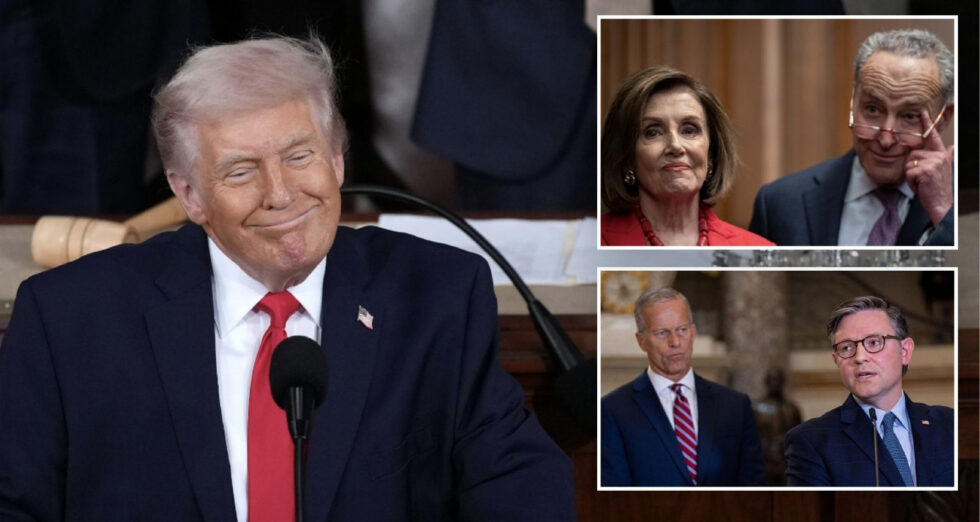
Senate Republicans rallied behind President Donald Trump late Wednesday night, decisively rejecting a Democratic-led war powers resolution aimed at tying his hands in the ongoing conflict with Iran.
The vote, held shortly before midnight, came hours after a tense closed-door meeting at the Capitol where Trump directly confronted GOP senators over a similar measure that had narrowly passed the day before.
Advertisement
The resolution failed 47-50 with one senator voting “present,” reversing Tuesday’s 50-48 passage of a nearly identical House-approved measure.
Four Republicans — Sens. Bill Cassidy of Louisiana, Susan Collins of Maine, Lisa Murkowski of Alaska, and Rand Paul of Kentucky — had crossed party lines on Tuesday, joining nearly all Democrats.
By Wednesday night, Cassidy and others shifted, delivering a clear victory for the president’s authority as commander-in-chief.
The dramatic turnaround followed a heated lunchtime meeting in which Trump berated senators for undermining his negotiations with Tehran.
According to multiple accounts, Trump singled out Cassidy, exchanging sharp words in a confrontation that escalated when the Louisiana senator pressed for more transparency on the war’s progress and costs.
Advertisement
Cassidy later recounted standing up and telling the president: “You have not told the American people what’s going on. It was supposed to last four weeks, it’s lasted four months. Our original objectives have not been achieved.”
Trump reportedly pushed back forcefully, emphasizing the need to prevent Iran from obtaining a nuclear weapon.
Following the meeting, Cassidy received a White House briefing alongside Vice President JD Vance and envoy Steve Witkoff, after which he changed his position and voted against the resolution.
President Trump celebrated the outcome on Truth Social, writing: “Wow! The Senate just changed its vote on Iran from 50-48 against, to 50-47 for… This vote puts Iran on notice!”
He had earlier blasted the Tuesday vote, calling the four Republicans “losers” who “made my job more difficult” and provided “aid and comfort to the Enemy.”
Senate Majority Leader John Thune and other GOP leaders framed the reversal as necessary unity behind the president’s decisive leadership.
Supporters argued the resolution was a dangerous Democratic attempt to weaken America’s negotiating position at a critical moment when Trump is pressing Iran on its nuclear program and regional aggression.
The War Powers Resolution, while largely symbolic and subject to veto even if passed, was designed to force the withdrawal of U.S. forces from hostilities unless Congress explicitly authorized them.
Its defeat preserves Trump’s flexibility to conduct operations, maintain leverage in talks, and ensure Iran never acquires nuclear weapons.
The meeting and vote change also came after Trump had a heated Senate luncheon on Wednesday afternoon.
Trump called off a scheduled signing ceremony on a housing bill that passed both chambers overwhelmingly this week and that GOP lawmakers were touting as an election-year achievement.
Republican senators were eager for a conciliatory meeting with the president after escalating tensions in recent weeks.
But Trump upended their plans when he declared on social media just beforehand that he wouldn’t sign the legislation until they sent him the SAVE America Act, his bill to require proof of citizenship for all voters.
North Carolina Sen. Thom Tillis said he doesn’t know why Trump is holding the housing bill “hostage” for the voting bill that “will never pass in this Congress.”
“It makes no sense to me,” Tillis said as he walked into the luncheon.
Thune said the housing legislation, which aims to lower costs, is “an affordability issue,” and that ”eventually I hope he finds a way to sign it.”
It’s unclear if Trump might veto the legislation or if the late Wednesday night vote will change his outlook.
But by rejecting a public bill signing, Republicans worry that Trump is indicating a level of indifference to voters’ affordability concerns heading into November’s midterm elections.
This article may contain commentary which reflects the author’s opinion.