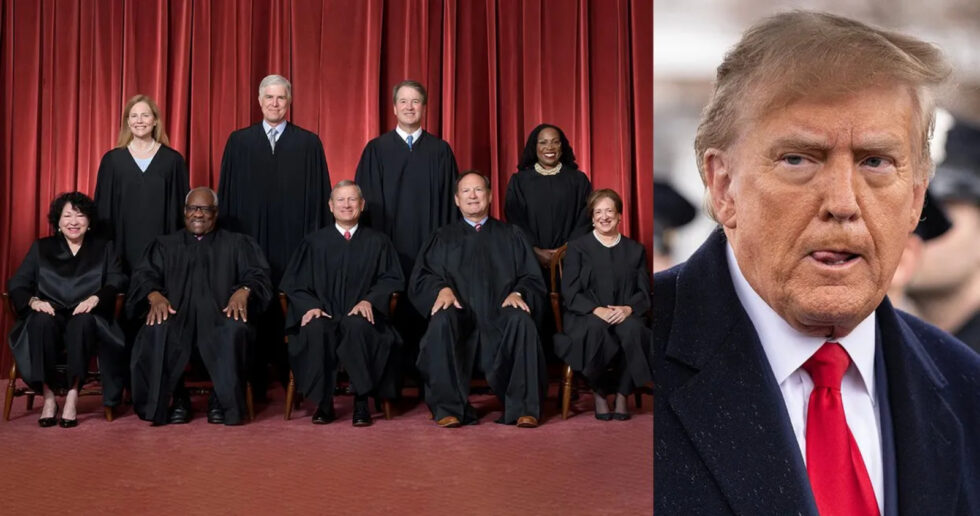
Several closely watched cases involving gun rights and immigration policy remain pending before the U.S. Supreme Court as the justices enter the final stretch of their current term, which is expected to conclude by July.
The high court still has more than 20 decisions left to issue, including rulings that could have major implications for Second Amendment protections and key elements of the Trump administration’s immigration agenda.
Advertisement
Both issues have emerged as major legal and political battlegrounds. States across the country continue to debate and enact gun-control measures that face constitutional challenges, while the administration’s efforts to strengthen immigration enforcement have generated a wave of litigation that is now making its way through the federal courts, The Center Square reported.
One of the most closely watched Second Amendment cases still awaiting a decision is Wolford v. Lopez, which the Supreme Court heard in January.
The case centers on whether Hawaii can prohibit concealed-carry permit holders from bringing firearms onto a wide range of private properties—including restaurants, bars, gas stations, and retail establishments—unless the property owner has explicitly granted permission.
The legal challenge stems from the Supreme Court’s landmark ruling in New York State Rifle & Pistol Association v. Bruen, which significantly expanded gun-rights protections by striking down New York’s requirement that applicants demonstrate a special need for self-defense before obtaining a concealed-carry permit.
Advertisement
Gun-rights advocates argue that Hawaii’s restrictions effectively undermine the protections recognized in Bruen by designating vast areas as off-limits to lawful firearm owners, the outlet reported.
“The Second and Fourteenth Amendments protect an individual’s right to carry a handgun for self-defense outside the home,” Justice Clarence Thomas wrote in the court’s 2022 decision.
The high court will also decide whether regular drug users, including of marijuana, can possess firearms in U.S. v. Hemani.
The Supreme Court is also weighing two closely watched immigration cases involving Temporary Protected Status, or TPS, for immigrants from Haiti and Syria who are living in the United States.
The cases, Trump v. Miot and Mullin v. Doe, challenge the Trump administration’s 2025 decision to terminate TPS protections for nationals of those countries.
Temporary Protected Status is granted to immigrants from nations affected by armed conflict, natural disasters, or other extraordinary conditions that make returning unsafe.
The administration argued that conditions in both countries had changed sufficiently to justify ending the designation.
Attorneys representing Haitian and Syrian immigrants, however, contend that the Department of Homeland Security failed to follow required procedures before terminating the protections.
They argue that former DHS Secretary Kristi Noem did not adequately consult relevant agencies or provide proper notice before ending the programs.
Representing the administration, Solicitor General John Sauer argued that continuing TPS indefinitely would undermine efforts to recognize improving conditions abroad.
“If we don’t terminate TPS, it will send a sense of doubt about that decision,” Sauer argued before the court in April.
The court is also considering a major immigration case that could help define when and where migrants become entitled to seek asylum protections under U.S. law.
The case, Mullin v. Al Otro Lado, stems from a dispute between the Trump administration and an immigration advocacy organization over policies implemented at the U.S.-Mexico border.
The advocacy group alleges that the Department of Homeland Security adopted practices designed to prevent migrants from reaching locations where they could formally request asylum and begin the legal process for entering the United States.
The Trump administration has defended its border policies as necessary measures to maintain order, reduce unlawful entry, and ensure that immigration laws are enforced consistently, The Center Square reported.
Supporters argue that the case raises fundamental questions about the government’s authority to regulate access to the border and manage asylum claims.
This article may contain commentary which reflects the author’s opinion.