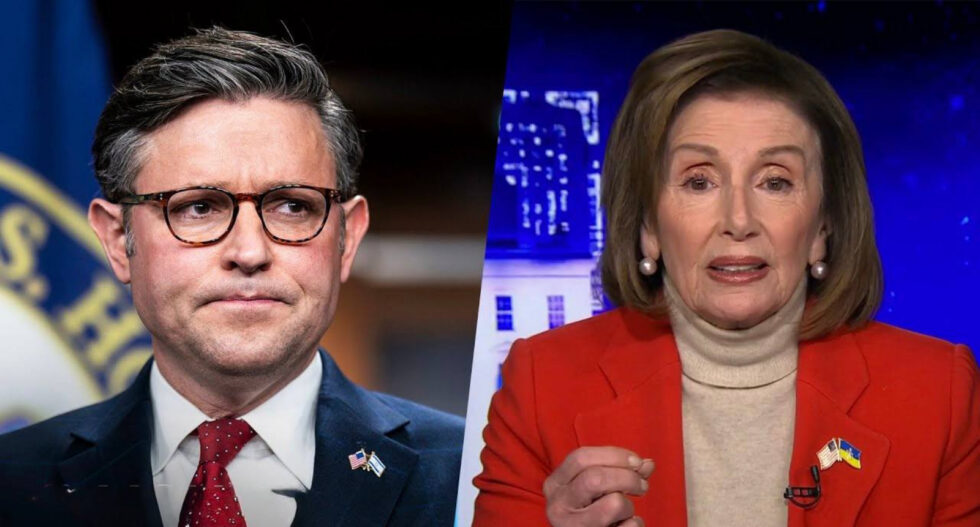
House Speaker Mike Johnson is spending the August recess traveling across the country as Republicans confront a fight to protect their House majority in November.
The Louisiana Republican campaigned with vulnerable GOP incumbents and candidates as economic concerns, high prices, and the continuing conflict with Iran threaten to complicate the party’s midterm message.
Over the past three weeks, Johnson has appeared alongside more than a dozen candidates, according to the Washington Examiner.
Advertisement
His travels have taken him into competitive contests in Pennsylvania, Michigan, Wisconsin, Arizona, Virginia, and Colorado, where Republicans are working to prevent Democrats from flipping crucial seats.
Johnson has also traveled into Democratic-held districts where Republicans believe new congressional maps or competitive recruits could create opportunities for GOP gains.
The aggressive campaign schedule reflects the narrow margin separating the parties.
Republicans have little room for setbacks, and losing the chamber could dramatically reshape the final two years of President Donald Trump’s term, including opening the door to Democratic impeachment efforts.
Advertisement
The Cook Political Report rated 19 House contests as Toss Ups as of Aug. 10.
Fifteen are held by Republicans, while just four are held by Democrats, leaving the GOP defending more vulnerable territory.
Cook has also shifted several Republican districts toward Democrats, citing a national political environment that has grown more challenging for the GOP.
Advertisement
Johnson, however, is attempting to sharpen the choice facing voters.
Republicans are campaigning on what they describe as their “Contrast for America,” framing November as a decision between Republican “common sense” and a Democratic Party they argue has moved toward hard-left socialism.
The speaker is highlighting the Trump administration’s domestic legislation while trying to turn individual congressional races into broader referendums on Democratic candidates and their policies.
President Donald Trump issued one of his most sweeping warnings yet Wednesday as the administration dramatically escalated its campaign against a foreign adversary.
The president said countries around the world now face a choice, declaring that governments attempting to undermine the new American operation could themselves face enormous consequences.
Trump announced what he called an “Economic D-Day” against Iran, promising unprecedented economic isolation while warning countries against providing Tehran with any financial or commercial lifeline.
“Today, I am announcing the MOST CRUSHING ECONOMIC OPERATION EVER TAKEN AGAINST ANY COUNTRY!” Trump wrote on Truth Social.
“This will be Economic Warfare and Isolation on an unprecedented scale,” he continued.
Trump then expanded the warning beyond Tehran, putting governments and businesses around the world on notice that assisting Iran could expose them to American economic retaliation.
“I am also announcing that ANY country that allows its financial institutions, businesses, airports, or government entities to provide any type of lifeline to Iran will itself face TREMENDOUS Economic Consequences,” Trump said.
The president specifically identified several methods that he said countries and businesses must prevent Iran from using to evade the growing economic pressure.
“Oil smuggling, swap lines, cash transfers, exchange houses, ship registries, front companies — It all needs to stop NOW,” Trump declared.
“You know who you are,” he added.
Advertisement
Trump then called upon American allies to participate in an effort he compared to the historic Allied invasion of Normandy during World War II.
“This will be an ECONOMIC D-DAY, and we need all of our Allies to stand with the United States of America to isolate, and defeat, the Iran threat,” Trump said.
“These maniacs are on the ropes, and these HISTORIC MEASURES will cripple them and their ability to project terror worldwide,” he added.
The president said Iran’s navy and air force have been destroyed while its production facilities have been reduced to “rubble.”
Trump also described Tehran’s currency as “worthless” and claimed the country itself “is hanging by a thread.”
The announcement represents another escalation in Washington’s pressure campaign, which has included a naval blockade as the administration attempts to force Tehran to capitulate.
Advertisement
Iranian Foreign Ministry spokesperson Esmail Baghaei accused the United States earlier this week of having an “addiction” to economic sanctions when diplomatic efforts fail, according to Yemen’s state-run news agency.
Iranian leaders also warned neighboring Gulf countries Wednesday against assisting the American military campaign.
But one of Iran’s important regional economic relationships suffered a major blow the same day.
The United Arab Emirates severed all financial and economic ties with Iran Wednesday, citing Tehran’s military escalation and incoming missile fire.
The president has also intensified pressure surrounding the Strait of Hormuz, the strategically critical waterway through which a substantial portion of global oil supplies traditionally travels.
On Monday, Trump threatened military action against Oman if the country acts as an obstacle to reopening the strait.
Advertisement
Trump nevertheless left open the possibility that negotiations with Tehran could eventually resume.
“Maybe at some point,” Trump said when discussing whether the United States could return to talks with Iran, Fox News reported.
Sources inside Iran tell me the U.S. blockade is starting to have a serious impact. I’m told it is not only choking Iranian oil sales, but that disruption to supply chains to China is beginning to cause friction, which in turn is triggering a degree of panic.
— Kasra Aarabi (@KasraAarabi) August 19, 2026
CNN is finally admitting that Trump beat Iran and America controls the Strait of Hormuz:
“Despite the risk, most ships have recently chosen to ignore Iran’s demands and cross the strait with the promise of protection from US naval forces.”
Iran lost. Trump won. https://t.co/lsfmaRHBAT pic.twitter.com/bDSuNvoMCV
— Matt Forney (@mattforney) August 19, 2026
The president also argued that the Strait of Hormuz may become “not going to be quite as important as it was in the past” as countries search for alternative sources and routes for energy.
This article may contain commentary which reflects the author’s opinion.