The Supreme Court on Monday declined to immediately allow President Donald Trump to remove Federal Reserve Governor Lisa Cook from office, leaving her in her position while the legal dispute continues.
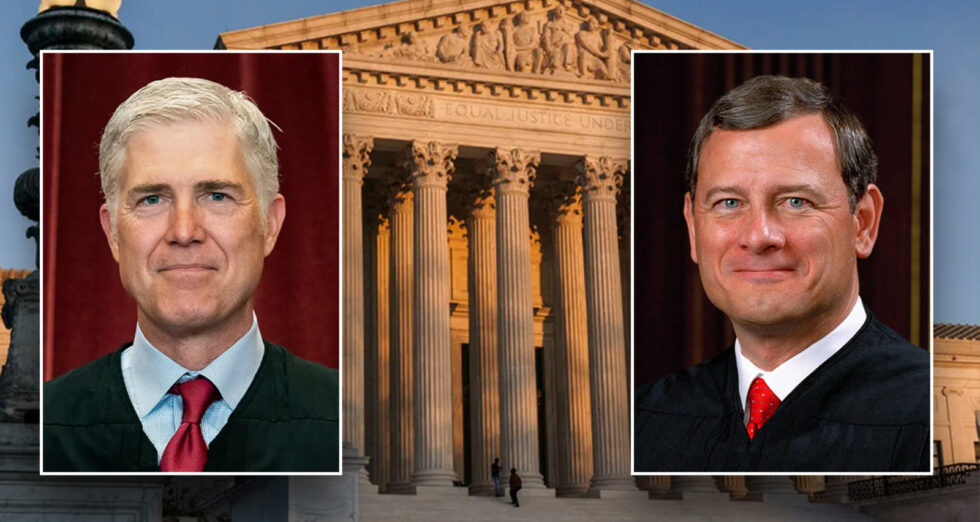
Chief Justice John Roberts authored the court’s 5-4 majority opinion.
Advertisement
The decision marks a significant ruling on the independence of the Federal Reserve, preserving the status quo as the case moves forward.
It also follows the court’s earlier decision striking down Trump’s emergency tariff authority, adding to a series of high-profile rulings defining the limits of presidential power.
Advertisement
“Under our precedents, Cook was entitled to notice and some opportunity to respond prior to her termination. That comes down to the words Congress chose, first in 1913, and then again in 1935,” Roberts wrote.
“Of course, that is not to say that a Federal Reserve Governor is entitled to an audience with the President or a full-blown judicial trial,” he went on.
Advertisement
“Instead, all that is required is notice ‘to the officer of the charges made against him’ and ‘an opportunity to be heard in his defense,’” the chief justice continued.
Roberts then noted that the “ultimate question of whether the president can remove Cook for cause will depend in part on the underlying facts.”
In the Monday ruling, Roberts also wrote that “we have not addressed the facts, as they have yet to be found or analyzed under the relevant legal standards.”
Rather, he said, “we have simply addressed the parties’ arguments about the appropriate legal standards under which the facts must be evaluated.”
Meanwhile, the Supreme Court on Monday upheld Trump’s dismissal of a member of the Federal Trade Commission, handing the administration a significant victory in its effort to expand presidential authority over executive branch agencies.
In a 6-3 decision, also authored by Roberts, the court ruled in favor of the administration.
The ruling is expected to have broad implications for independent federal agencies whose leaders have traditionally been protected from removal except under limited circumstances established by Congress, CNN reported.
In other actions, the nation’s highest court ruled against the Republican National Committee in a case involving late-arriving mail-in ballots. The RNC sued the state of Mississippi over a law allowing ballots postmarked by election day to be counted if they arrived up to five business days after election day.
The RNC argued that the Constitution and federal law delineate just one day for ‘election day,’ but a majority of justices in a 5-4 ruling disagreed and overturned the Fifth Circuit Court of Appeals, which sidedc with the GOP.
After the ruling was announced, President Trump again pressed for Congress to pass the “SAVE America Act.”
Advertisement
“In light of the tremendous loss in the Supreme Court today concerning Voter’s Rights, and the fact that ‘people’s’ votes are allowed to be counted LONG AFTER an Election is over, it is more important than ever to pass THE SAVE AMERICA ACT,” he wrote on Truth Social.
He went on to list three provisions of the bill that he said are necessary to ensure fair and secure elections:
1. ALL VOTERS MUST SHOW PHOTO I.D. (IDENTIFICATION!).
2. ALL VOTERS MUST SHOW PROOF OF CITIZENSHIP.
3. NO MAIL-IN BALLOTS (EXCEPT FOR ILLNESS, DISABILITY, MILITARY DEPLOYMENT, OR TRAVEL!).
He added: “There is no excuse for a politician, or otherwise, to be against the above three requirements. There is only one reason to oppose — CHEATING! The House of Representatives has approved this vital Act, THREE TIMES.
“The United States Senate seems unable to do so. In a time when there is a powerful Communist Movement taking place in our Country, one more dangerous than World War I, World War II, Pearl Harbor, or September 11th, all Dumocrats, and our five Republican Senate Hold Outs, Lisa Murkowski, Susan Collins, Thom Tillis, Bill Cassidy, and Mitch McConnell must vote to SAVE OUR COUNTRY. There can be no more excuses!” Trump concluded.
This article may contain commentary which reflects the author’s opinion.