In July 2012, the UN Human Rights Council (UNHRC) unanimously adopted a landmark resolution affirming a simple proposition: “The same rights that people have offline must also be protected online, in particular freedom of expression, which is applicable regardless of frontiers and through any media of one’s choice.” Writing in The New York Times, Carl Bildt, Sweden’s foreign minister [at the time], hailed the vote as a “breakthrough of fundamental importance,” insisting that “the free flow of information on the Internet is a global call and not something pushed only by a few Western states.” For a brief moment, it seemed as if the world’s democracies had accepted that the open Internet would be the nervous system of modern liberty. (The End of the Open Internet)
Until 2015, an optimistic and liberal (in the best sense) ethos pervaded the Internet. Major Internet platforms were open and had little content policy beyond bans on real-life criminal activity (stalking, selling illegal goods, child pornography, etc). Aside from these narrow and reasonable explicit exceptions, anyone could go online and converse with interested people around the world about whatever they wanted in public. These platforms had no real means to control what people talked about on them even if they wanted to, which they didn’t; to the extent an organization can have views all believed in free and open online discourse, which promised to make censorship impossible and end the hegemony of 20th century broadcast media.
In this, they were backed up by major non-tech institutions, such as the UN, the EU, the US State Department, and the New York Times, all of which saw Internet freedom as a corollary of offline freedom, and one which would liberalize the world’s remaining non-democratic states in time. These institutions both supported Internet freedom rhetorically and spent hundreds of millions of dollars creating and disseminating technical tools to evade Internet censorship and preserve online anonymity.
But in just a few years, every single major platform had created strict, but incredibly vague and opaque, ideological content rules backed up by a colossal moderation/censorship apparatus with tens of thousands of human moderators and an entire new field of machine learning created from nothing. The Internet went from a space for people without institutional backing to get their views out to one with regular purges and demonetizations of heterodox figures and those associated with them, encouraged by those very same non-tech organizations that formerly championed Internet freedom. This was justified as a response to (massively overblown and mostly fictitious) Russian influence campaigns, and as fighting nebulous “hate,” the definition of which could be shifted at will to cover whatever views or ideas the organizers classifying it wanted it too and to exclude those they didn’t, and “misinformation.”
The closure of the Internet occurred in two distinct phases: 2015-2019 (associated with the 2015 migrant crisis, Brexit, Donald Trump’s election, and the so-called alt-right) and 2020-2022 (associated with the lockdowns and the 2020 election). Almost all of the technical and organizational infrastructure and conceptual justifications were built out in the first phase, which successfully decapitated and destroyed the previously-independent, but by definition fringe, online ecosystem of ideas. In the second phase, the same weapons that previously targeted heterodox online discourse were turned against opposition to the COVID measures du joure and mainstream conservatives. The scale of censorship has no precedent; tens of millions of accounts suppressed or banned, billions of posts removed.
These purges are usually framed as a direct response to particular events or atrocities. For example Amazon ostensibly removed all Confederate flag merchandise from their web store in response to Dylan Roof’s 2015 massacre of black churchgoers. This is a mistake. Atrocities without a propaganda campaign from the press and political pressure from an opaque network of governments and quasi-government NGOs lead to no changes. There were no mass purges after Audrey Hale’s 2023 murder of elementary schoolers in Nashville motivated by anti-white hatred or the 2016 murder of five Dallas police officers by an ex-marine motivated by the BLM movement. On the other hand, press campaigns not centered around an atrocity, such as the mass deplatformings of YouTube personalities, lead to the same types of purges as the atrocity-based ones. It is not the atrocity that causes the changes, but the media and behind-the-scenes pressure campaign.
The late 2010s also featured suppression of heterodoxy offline as well. This combined physical attacks on the streets, as happened to Charles Murray, and the firing of public figures with non-Internet platforms, as with Bo Winegard and Bryan Pesta. Even moderates and liberals in already left-wing institutions were not immune, as the purges of those who valued pluralism in objectivity within the New York Times, ACLU, and many progressive activist organizations showed. As such, the closure of the Internet shut down all avenues for heterodox discourse during the Great Awokening. If you spoke from an institutional platform, you would be fired. If you spoke in person, you would be beaten or shot. And if you spoke online, you would be censored, suppressed, demonetized, and doxxed.
The closure of the Internet is the most important social phenomenon of the late 2010s. Most young people live online. More than half of American adults under 50 say they use the Internet “almost constantly”. Globally, almost 70% of people are online, and the average Internet user spends almost seven hours a day there. Cyberspace is where most couples meet, where most friend groups hang out, and where most people have fun. There is no alternative for even semi-serious intellectual or hobbyist discussion outside of a handful of low-capacity and carefully gatekept institutions. The word “censorship” does not go far enough; online went from almost completely open and free to a series of “closely monitored playpens,” like going from the American frontier to East Germany in just a few years.
First they came for the Nazis, and I did not speak out—
Because I was not a Nazi.
The clearest pattern across all of these platforms was one of very rapid escalation. The closure of the Internet is one of the clearest examples of the slippery slope (or “no limiting principle”) in action; it only took a few years to go from deplatforming the fringe neo-Nazi website Stormfront to the entirely mainstream New York Post, from banning books on Holocaust denial to banning those opposing transgender maximalism, and from banning honestly discussing the effects of immigration in Europe to banning honestly discussing the lab leak hypothesis of COVID origins. It is one thing to defend freedom of speech or freedom to create a website in the abstract and quite another to defend Andrew Anglin calling to exterminate the Jews. And even the most unpopular political or intellectual expression is easier to stomach than something like r/watchpeopledie. But the free speech maximalists were right. Once the conceptual and technical architecture for identifying, deplatforming, suppressing, and censoring “hate” and “disinformation” was built, the institutions defining these terms quickly extended them to as many inconvenient facts, ideas, and positions as they could.
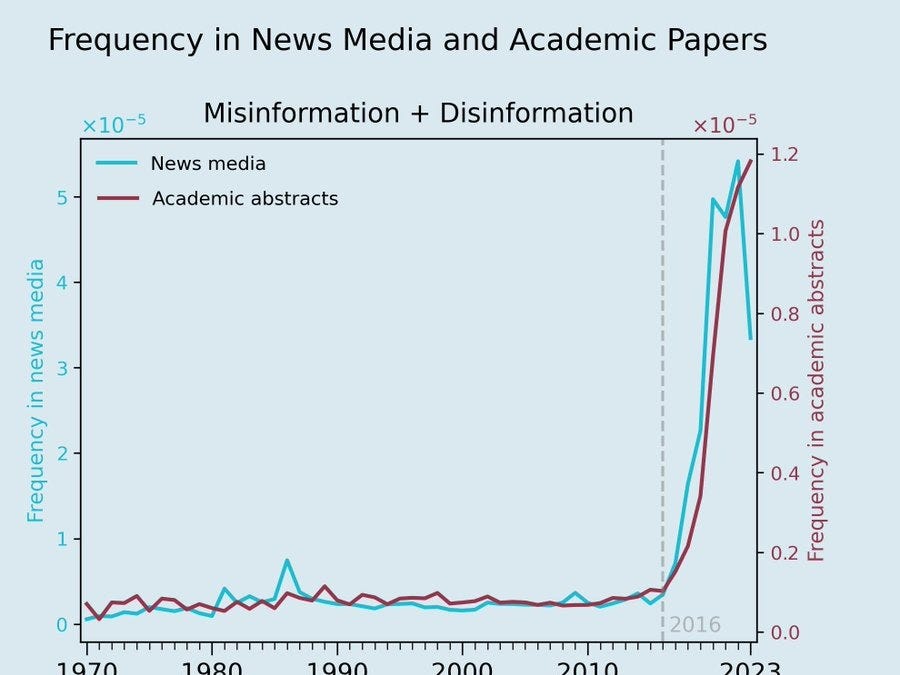
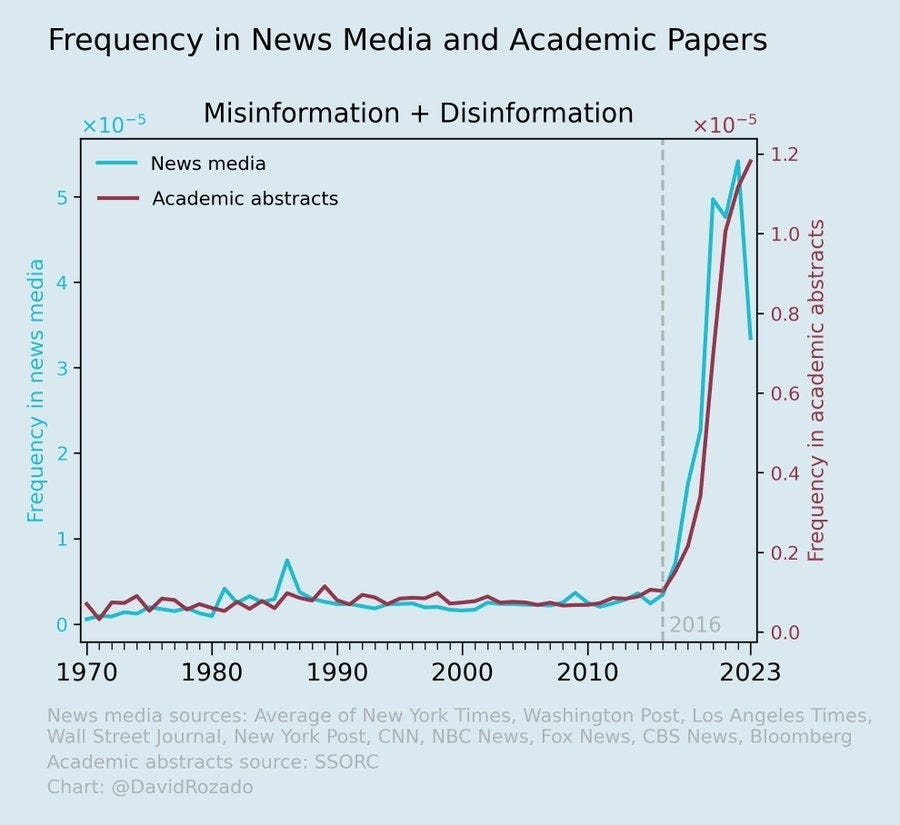
A whole new conceptual universe was constructed to justify and organize the closure of the Internet. For example, the words “disinformation” (false information shared maliciously), “misinformation” (false information shared inadvertently), and “malinformation” (information that is true but misleading) practically did not exist until 2016, when in response to Trump’s election they were rustled into existence by a coterie of governments, academics, and nonprofits.
The meaning of the term “online safety” shifted from concerns about people using the Internet to physically attack, stalk, and harass people in real life to horror at the idea of users seeing marginalized ideas and information. This led to the Orwellian naming of so-called “Online Safety Acts,” which rather than focus on preserving anonymity and pseudonymity, which protect the physical safety of people online, instead work to eliminate them. A similar definition shift occurred with “harassment and abuse” and “violence.” This reached its apogee with the slogan “silence is violence,” the totalitarian idea that one must not simply not oppose orthodoxy but actively and enthusiastically propagate it or be treated as a murderer and therefore legitimate target.
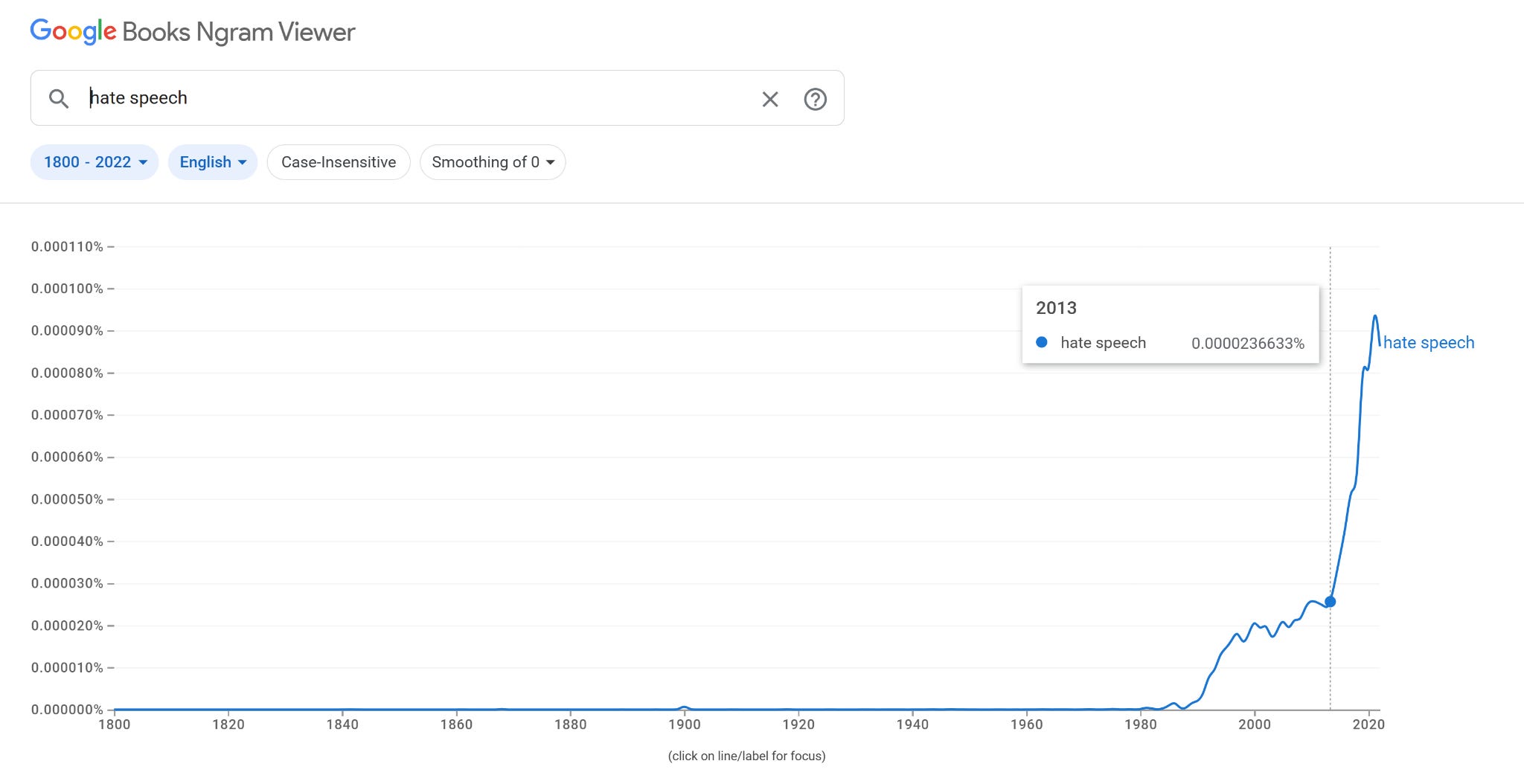
The Soviet concept of “hate speech”, first imported at scale to the West during the 60s revolution, went from fringe to a common term in everyday discussion.
Relatedly, the definition of the word “toxic” was changed from a synonym of “poison” to a descriptor of to-be-marginalized, but not illegal or against formal platform policies, online discourse, and an entire subfield of natural language processing, automated moderation/suppression of “toxic” discourse spun up from almost nothing in 18 months in 2016 and 2017.
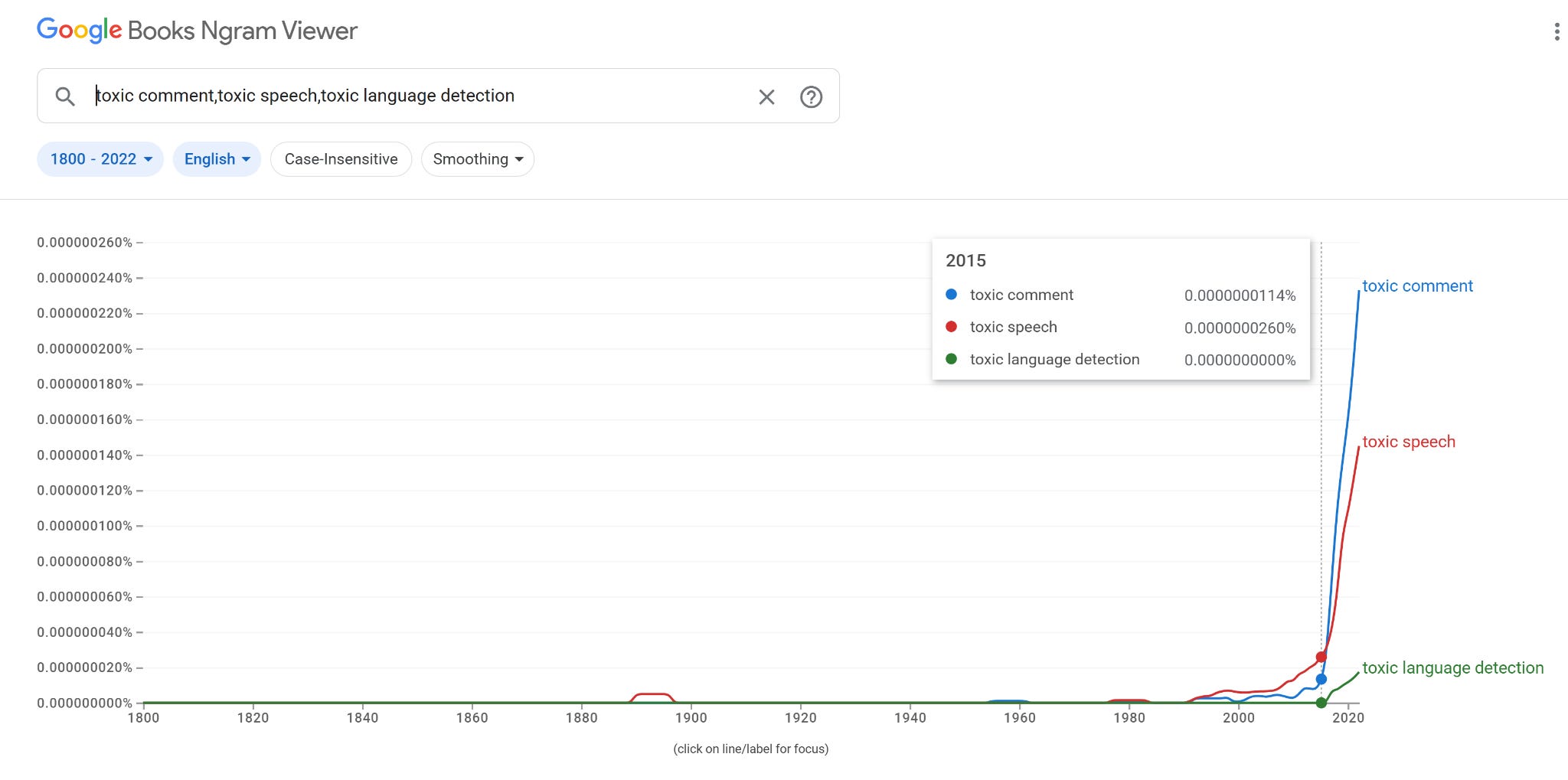
Until mid-2016, this field of machine learning, “toxic language detection,” did not exist.
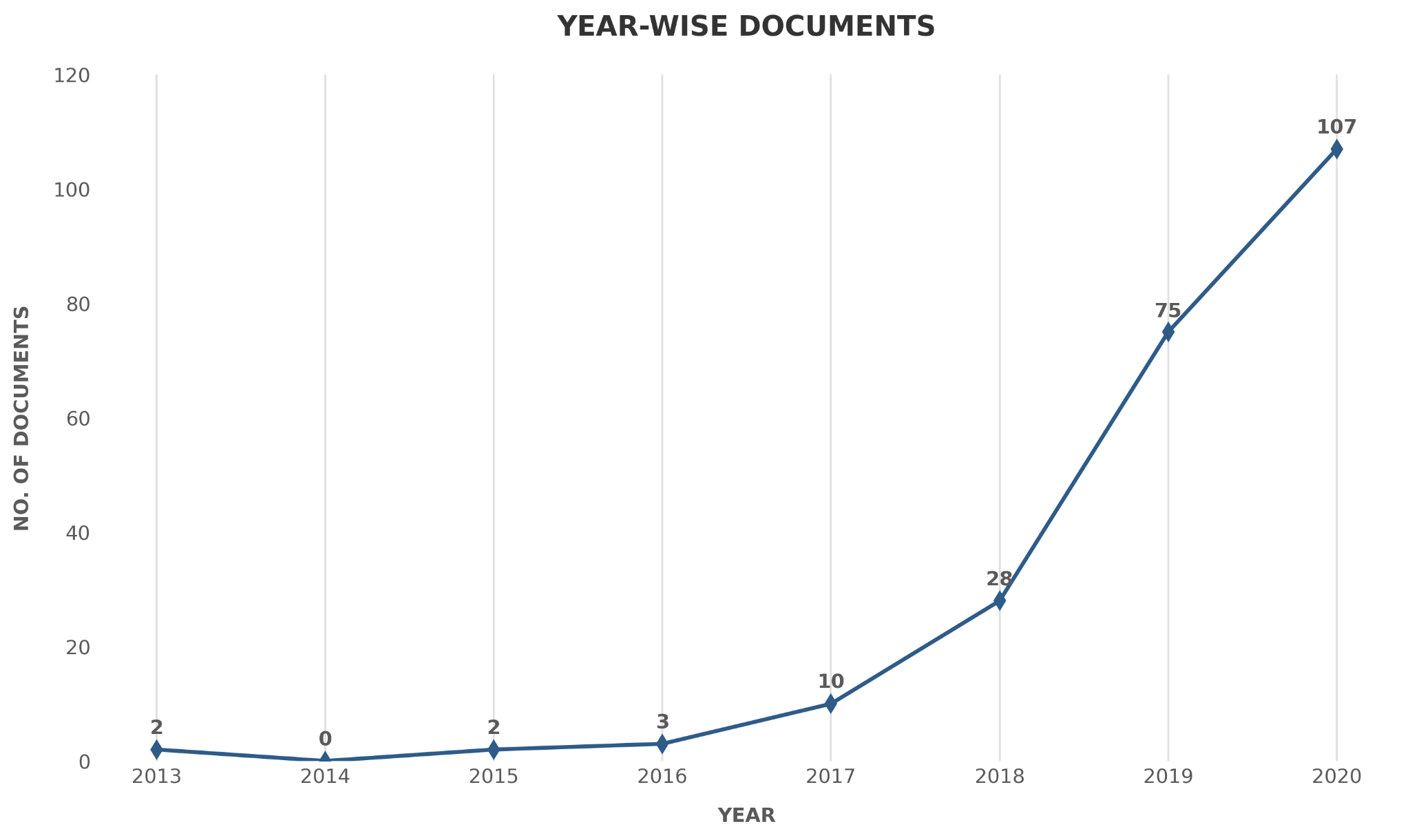
The first big foundational dataset in the field (using “a list of criteria founded in critical race theory”) was published in June 2016 by Zeerak Waseem and Dirk Hovy. Along with academia, Google Jigsaw spearheaded this creation of this field, publishing a much larger Wikimedia dataset in October 2016 and launching Perspective API as a baseline for the rest of the moderation/censorship industry (“empowering moderators to identify and address toxicity in comments”) to build on in February 2017. The first academic workshop on “Abusive Language Online” was held in August 2017. By December 2017, the field was fully institutionalized, with Kaggle and Jigsaw launching the “Toxic Comment Classification Challenge,” which received over 4000 entries.
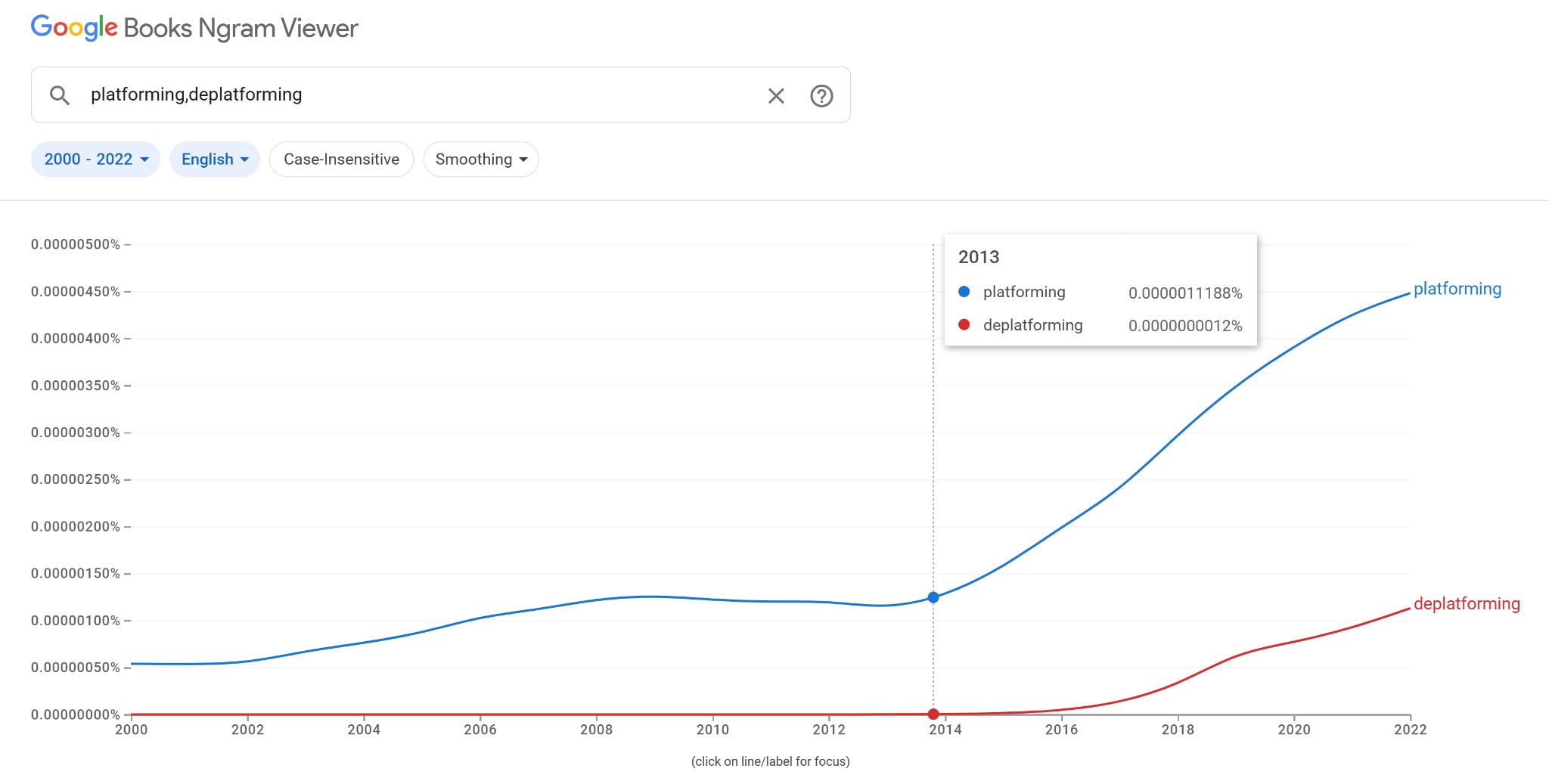
The last major piece of this conceptual universe was the word “platforming.” This word shifts the burden of action; rather than exchange of ideas being the default and censorship something that must be justified, censorship becomes the default and permission to speak the exception that must be argued for. A person or group or idea is no longer “censored” or “banned” but “platformed.”
The closure of the Internet can be described in broad strokes, but it is worth tracing the specific dynamics on each of the major platforms circa 2015, when it began in earnest. Every major platform that existed in 2015 went through the same transition from almost entirely open to almost entirely closed in just a few years, while platforms that have risen to prominence since 2015, such as Instagram and TikTok, had this content control infrastructure built in from the start.
Almost every particular case referenced here is of a high profile political figure, institution, or topic. This is because these are the cases that had high-profile sources written about them that could be referenced years later, not because high profile figures were disproportionately targeted. If anything the reverse is true. It’s important to understand that for every Alex Jones getting deplatformed there were hundreds of thousands of ordinary people.
Of all the platforms that were closed in this period, the most important was YouTube. YouTube is the most used social media platform in the United States and dominates long-form video. Until 2017, YouTube allowed for easy monetization. Any channel could get a cut of ad revenue with minimal requirements and the sheer scale of YouTube made YouTube content creator a viable career path independent of major institutions if you were engaging, disciplined, and productive enough. There were almost no barriers to entry, and the YouTube algorithm was content-neutral. If YouTube’s recommendation algorithm predicted a video would appeal to viewers, it would be shown.
What changed this was a combined media and political campaign originating in Great Britain. In March 2017, The Times of London and the Guardian published articles juxtaposing racist videos—often cherrypicked videos with very few views—with advertisements on YouTube. The nominally conservative British government promptly boycotted advertising on YouTube on March 16, a boycott later joined by many British corporations, and summoned Google to explain. Non-compliance could reasonably have been expected to lead to government retaliation. Yet this was clearly a pretext. No one who uses social media believes that an ad appearing next to a piece of user-generated content implies the owner of the ad endorses the content, and until the news articles were published there were no major consumer complaints about this. However, the fiction that consumers were outraged at companies whose ads appeared for five seconds before a “racist” video provided a Schelling point for people who already wanted to censor YouTube to coordinate to purge the site.
The implied threat worked. On March 21st, Google’s chief business officer, Philip Schindler, said that the company would be “taking a tougher stance on hateful, offensive and derogatory content that is attacking or harassing people based on their race, religion, gender or similar categories.” Google then began restricting ads and monetization to larger accounts that had been manually reviewed, and on April 26th greatly expanded the scope of its previously nearly-nonexistent hate speech policy, banning ‘content that promotes discrimination or disparages an individual or group based on any characteristic “associated with systemic discrimination or marginalization.”’ In July, YouTube began removing ads and restricting visibility to videos that “may not expressly violate YouTube policies but are found to contain supremacist or inflammatory religious content,” partnering with dozens of NGOs, including the ADL, the No Hate Speech Movement, and the Institute for Strategic Dialogue, to identify videos and creators to be demonetized, suppressed, or banned.
In just a few months, YouTube went from an open ecosystem where independent creators of any viewpoint could get out their ideas and discuss with each other, and perhaps make a living doing so, to one with a very definite progressive-left viewpoint, where videos and channels contradicting these views were demonetized and suppressed. This was also a catastrophe from a historian’s perspective, with tens of thousands of hours of Syrian Civil War footage deleted from existence.
In 2018, YouTube’s burgeoning censorship apparatus expanded to more than 10,000 human moderators. YouTube participated in the 2018 cross-site deplatforming of Alex Jones (along with Apple, Facebook, Spotify, LinkedIn, Pinterest, Vimeo, and Twitter), and by late 2018, Google was removing millions of channels and tens of millions of videos per quarter. Roughly 1% of these removals (tens of thousands of channels and hundreds of thousands of videos) were for political reasons rather than spam, nudity, or similar. This was in part an “an effort to demonstrate progress in suppressing problem content” to “government officials and interest groups in the United States, Europe, and Asia” which had “been pressuring YouTube, Facebook, and other social media services to quickly identify and remove extremist and hateful content.”
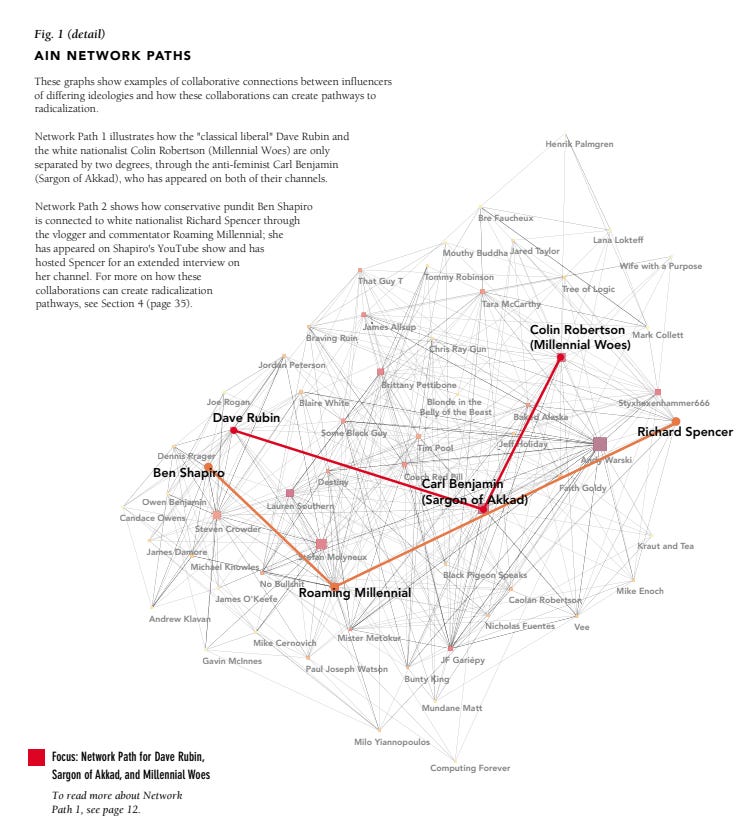
One common tactic was using network analyses to map out who was collaborating with who. Anyone who interacted with a disfavored figure or account could then be suppressed in turn. This discouraged any sort of collaboration or interaction or even honest debate with heterodox figures from anyone else, and also allowed for the bundling of classical liberals, anti-SJW/anti-feminists, mainstream conservatives, white nationalists, Catholic Integralists, and men defending Google’s hiring policy into one big blob labeled “hate.”
In 2019, YouTube began algorithmically suppressing “borderline content,” meaning content that explicitly did not violate YouTube’s already very broad post-2017 content restrictions but that YouTube’s censors judged as possibly still harmful. This type of suppression is even more insidious than a ban or algorithmic suppression, as it is almost impossible to prove or fight without inside information. YouTube also made their formal hate speech policy much stricter, prohibiting “videos alleging group superiority” and quintupling the number of channels and videos removed for hate speech over the already-high 2018 level. By December 2019, Google banned “insults based on protected attributes,” embedding demographic-level lèse-majesté law into the world’s biggest video platform.
In 2016, there was a thriving independent alt-center/”anti-woke”/anti-feminist ecosystem on YouTube, often connected to the New Atheists. By 2019, almost every major creator was banned, demonetized, suppressed, or had become leftist to survive. Naturally there were no new entrants into the now fully-closed YouTube ecosystem, except those connected to major conservative institutions. In their stead emerged anarchist/Communist “Breadtube,” named after Russian anarchist Peter Kropotkin’s The Conquest of Bread.
Since post-Millenial generations tend to be illiterate troglodytes strongly prefer video over text, video content served by algorithmic feed is their major source of information. Until TikTok, which has similar policies, YouTube was by far the largest source of this. This meant the elimination of anti-woke/anti-feminists from YouTube killed any sort of semi-popular intellectual opposition to the Great Awokening in under-30 cohorts.
The only site more emblematic of the annihilation of open Internet discourse 2015-2019 than YouTube is Reddit. If YouTube was the most important platform for monetization, allowing individuals to make careers outside of pre-existing institutions, and for reaching young people, Reddit was the most important platform for enabling public debate. In 2015, Reddit, like YouTube, had almost no content policy beyond banning illegal activity, doxxing, harassment that extended offline, and involuntary or underage pornography.
Reddit’s closure was largely driven by one thing: the ability for r/TheDonald, the major hub of Internet Trump support, to consistently reach and dominate the front page. To give an idea of how nonexistent content control infrastructure was in 2016, CEO Steve Hoffman was discovered personally editing critical posts on r/TheDonald. He then changed Reddit’s policy to exclude r/TheDonald from r/popular. 2016 is also when Reddit adopted the EU’s “Code on Countering Illegal Hate Speech Online.”
In October 2017, Reddit changed its policy to explicitly ban “hate speech” and kicked more than 20 subreddits off the site, including r/incels (part of the bizarre anti-incel moral panic of the 2010s). In March 2018, Reddit also banned the legal sale of guns and prostitution on the site. In September 2018, Reddit changed their harassment standard from requiring real-world threat of harm to the much laxer, and very subjective, standard of “anything that works to shut someone out of the conversation through intimidation or abuse,” and removed dozens of subreddits for violating it. The new harassment standard also applied to groups, not just individuals, so even scrupulous politeness and openness to individuals might not save a subreddit making arguments that did not flatter dominant groups.
In October 2018, Reddit revamped their quarantine system (“quarantined” subreddits are invisible to non-members, killing growth) and began quarantining dozens of subs, including popular dating subreddits such as r/TheRedPill, for being “controversial.”. It’s worth pointing out, for those who have grown accustomed to it, how totalitarian it is to suppress speech for being controversial, which simply means that not everyone agrees. This purge included both political subs like r/againstgaymarriage (recall that majority of the US, and a supermajority of the world, opposed gay marriage in 2015) and generally noxious—though, it must be emphasized, harmless—subs such as r/watchpeopledie (which was exactly what it sounded like). One of these subreddits, r/Ice_Poseidon was even dedicated to a single individual, streamer Ice Poseidon. Its quarantine left him “slumped and distraught,” as he depended on Reddit to grow his fanbase and earn a living. Through this, Reddit deputized content creators even on different platforms as Reddit’s speech enforcers, forcing them to purge their own fanbases lest they have their growth cut off by Reddit’s censors.
In January 2019, Reddit banned many subreddits for “anti-Muslim content,” including r/Gore and r/cringeanarchy, neither of which were political. In June, r/The_Donald was finally quarantined after years of failed algorithmic suppression, along with r/frenworld, a sub for Pepe the Frog memes. By 2020, Reddit had fully committed to the “the regulation and removal of hate speech on their platform.” r/The_Donald was finally banned, along with thousands of other subs.
A single paragraph from “Hate speech, Censorship, and Freedom of Speech: The Changing Policies of Reddit” sums the shift up:
In 2015, Reddit expressed ambivalence towards the topic of hate speech, and rather demonstrated their commitment to libertarianism when it concerned violent speech. This is reflective of the general American political philosophy concerning hate speech, which ultimately enshrines offensive language in the First Amendment right to freedom of speech offered by the American constitution. In regards to offensive content, Reddit moderators state specifically, “It’s ok to say ‘I don’t like this group of people.’ It’s not ok to say, ‘I’m going to kill this group of people’” (Reddit – [u/spez], 2015a). They also cited their commitment to preventing “the speech police knocking down their door” (Reddit – [u/spez], 2015a). By 2020, Reddit’s stance on hate speech would transform completely. They would state: “Everyone has a right to use Reddit free of harassment, bullying, and threats of violence. Communities and people that incite violence or that promote hate based on identity or vulnerability will be banned” (Reddit – [u/spez], 2020).
The nature of Reddit, which is split between millions of subreddits moderated mostly by volunteers rather than the site itself, adds another dimension to this story. The subreddit system is intended to promote community self-government, but is prone to “power mods,” individuals with unusual amounts of time and the inclination (and almost certainly including official agents of various influence/intelligence campaigns given the importance of Reddit) moderating many different subreddits. Since they are not company employees, it is difficult to find information on Reddit power mods, but by 2020 just five individuals autocratically ran 92 of the top 500 subreddits. Power mods tend to be ideologically leftist and are arguably more powerful than the site itself. In 2019 Reddit itself quarantined 256 subs, banned 21,900 subs, suspended 55,994 accounts for policy (as opposed to spam or other rule) violations, and removed 222,000 pieces of content for policy violations. In the meantime, volunteer moderators removed 84.1 million pieces of content.
Today, the Redditor stereotype is of a histrionic but slightly dull orthodox left-wing conformist hostile to any hint of heresy, but this was not always true. In 2014, a Redditor meant a libertarian-ish debate bro willing to argue about anything. Reddit was a very ideologically heterogenous site and the main discussion forum between different groups on the Internet. Nothing has successfully replaced 2014 Reddit for actual popular debate.
Facebook is by far the largest true social media platform, and critically can be used to reach and gather funds from the older voters that make up most of the electorate. For example, in the 2016 campaign Donald Trump was able to offset his weakness among big donors by raising $250 million through Facebook campaign events. Because of its importance to both Trump’s 2016 election and the Brexit campaign, Facebook was a favorite punching bag and target in the early days of the closure of the Internet. There was a concerted press campaign during and immediately after Trump’s 2016 campaign to portray Trump’s victory as the result of “fake news” or a Russian disinformation campaign on Facebook, with dozens of articles across many outlets, which Mark Zuckerberg correctly dismissed as crazy, hewing to Facebook’s long-time unofficial policy of content-neutrality. Unlike YouTube/Google, Reddit, or Twitter, which seem to have been internally eager to crack down, my impression is that of the major platforms, Facebook resisted post-2015 censorship the hardest. Facebook only went ahead with censorship after Zuckerberg was personally dressed down by Obama in Lima in 2016. Likely due to their intransigence, both Facebook and Zuckerberg were harassed even more than the other, more compliant tech giants by governments, academics, and media outlets for insufficient censorship for years afterwards, up to and including accusing Facebook of facilitating genocide.
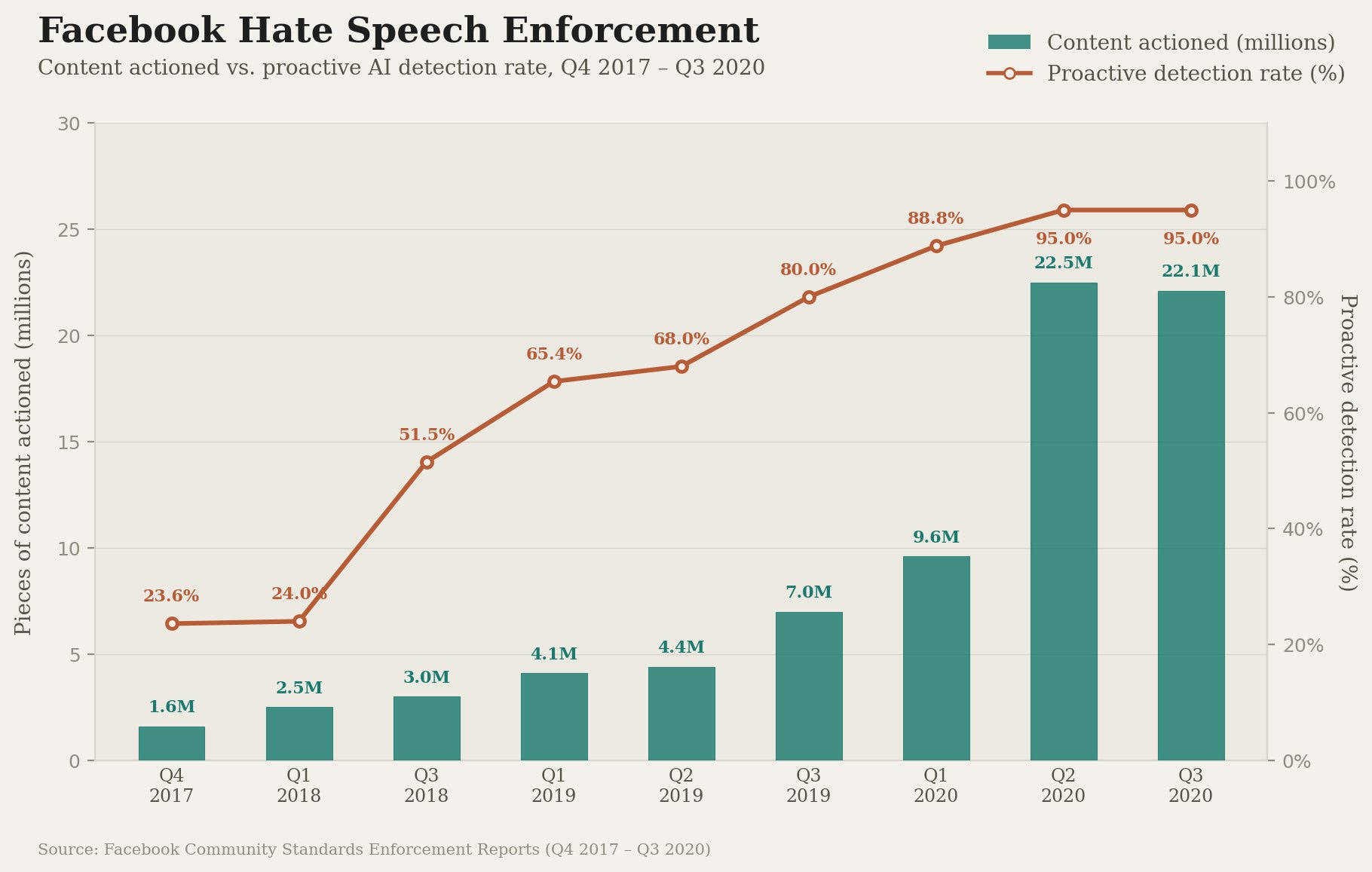
Unlike Twitter, Reddit, or YouTube, Facebook did not change its formal content policies much during this period. Until 2016, Facebook generally presented itself as a content-neutral platform, a distributor without editorial power, but unlike Reddit or Twitter was never explicitly committed to freedom of speech. Facebook’s changes in moderation policy can instead be tracked by their official pronouncements; Facebook began reporting “hate speech” moderation metrics for the first time in Q4 of 2017 and had practically erased it from the site by 2020.
Facebook began flagging “misinformation” in December 2016, in response to the election of Donald Trump. Facebook did not make truth judgements internally, instead outsourcing official truth to a network of third-party “fact-checkers.” The German government’s German Network Enforcement Act (NetzDG), passed in 2017, imposed large fines for illegal (including political) content. Since there were no fines for over-enforcement, this encouraged Facebook to aggressively censor. To implement these changes, Meta hired 3000 moderators in 2017, and rolled out a feature tagging stories as “disputed,” though this was removed in December 2017 when Facebook discovered that marking stories as “disputed” got them more attention. From 2018 through 2020, Facebook greatly expanded their misinformation-flagging program and the number and powers of third-party fact-checkers involved. Fact-checkers gained the ability to flag, “deboost,” and eventually remove posts at will.
This went into overdrive during the lockdowns.
For example, Facebook removed the Great Barrington Declaration page in February 2021 and restricted, suppressed and censored opposition to the lockdowns across the site, including removing pages of anti-lockdown protestors for violating social distance rules. Facebook aggressively censored discussion of the lab leak theory of COVID origins until May 2021 at the behest of the White House, when what had previously been officially an absurd conspiracy theory suddenly became both permissible and plausible. Facebook also censored content that the CDC claimed was “anti-vaccine” under the CDC’s direction, though this definition was so broad as to include the true claim that natural immunity was more effective than vaccination.
Facebook’s ramping up of censorship during the lockdowns was not limited to COVID-related topics. Facebook suppressed the New York Post’s story on Hunter Biden’s laptop in October 2020 on the advice of the FBI. This story was (1) indisputably true, (2) reported by a major corporate news outlet, and (3) of obvious relevance to the 2020 campaign—which is why it was censored. Along with Twitter, YouTube, Twitch, and Snapchat, Facebook banned Donald Trump, at the time the President of the United States, in January 2021.
The above timeline is based on public secondary sources, mostly Facebook’s official announcements. I was able to talk with an administrator of one of the largest non-institutional right-wing Facebook groups, and his timeline, based on personal experience, was slightly different (screenshots with the exact wording of what he told me and allowed me to share publicly can be found here).
The first major incident occurred in 2016, when the biggest Facebook page in his group in the emerging right-wing sphere, Disdain for Plebs (with tens of thousands of followers at the time), was banned for hate speech, for writing the following:
Donald Trump is not anti Muslim. He is anti ISIS. What Trump is trying to say is that Homeland Security can not differentiate which Muslim is radical wanting to cause harm and which is a harmless refugee. This is why nothing gets done. We are too busy being politically correct. Who is willing to sacrifice their family’s safety for the sake of political correctness? Are you? #TRUMP2016.
After the page was banned, he complained about the ban—which got him banned on his personal profile as well, also for hate speech. However, the Disdain for Plebs administrator appealed to Facebook, high-profile conservatives, including Lauren Southern—who was likewise banned for complaining about him getting banned for complaining about his ban—rallied to his defense, and he was eventually reinstated. At this point, bans for hate speech in general were not common, and could be avoided by not posting certain banned words.
The big crackdown occurred in summer 2017. Rather than bans for hate speech, the administrator accounts for the big Facebook pages were all simultaneously banned with no reason given, at the device level, which took down most of the pages (which are automatically removed if all the admin accounts are banned), including Disdain for Plebs (which, for reference, was started in 2014, reached 1K followers in 2015, 100K in 2016, and had over 200K when it was taken down for good in summer 2017). These behind-the-scenes purges of administrators were not only more effective, but also impossible to appeal. While normal conservatives could be rallied against clear censorship of things they said themselves, they could not really grasp or understand the implications of extremely opaque account removals. Furthermore, the removal of a personal account is not as newsworthy as the censorship of a large page, even if the result is the same.
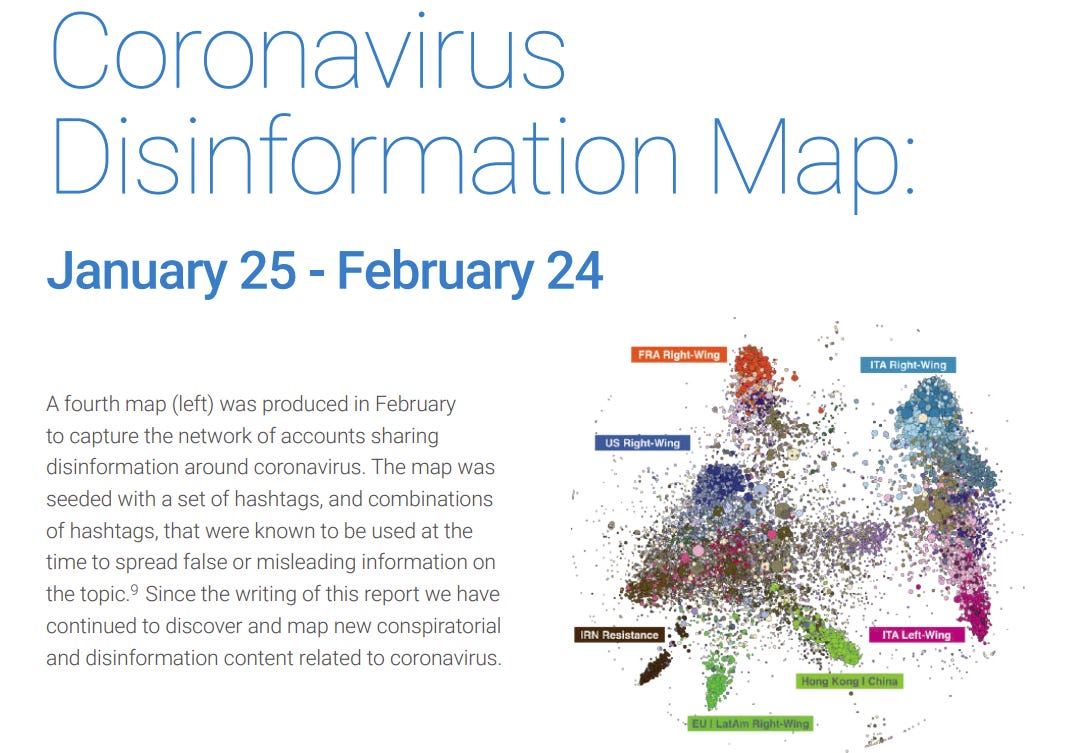
Administrator accounts, which were visible publicly but not tied to the wider right-wing sphere, on the other hand, were not banned, which saved a few pages. Personal administrator accounts are easily visible with internal access, which implies that these banwaves were not coming from Facebook itself but rather outside sources (he speculated European governments, academics, or NGOs) compiling lists of accounts to be purged. He pointed me to this network analysis, similar to those on YouTube and Twitter, as an example of the type of study mapping out the Facebook right for destruction common in this period.
After this big purge and several similar ones, the administrator I interviewed was the only member of his group whose page stayed up (because he had private and lurker alts which couldn’t be targeted without inside information) and was able to keep posting. However, his page was still shadowbanned/suppressed, cutting his reach by over 99% (he had over 40K followers and rarely got more than a few dozen views) by 2020.
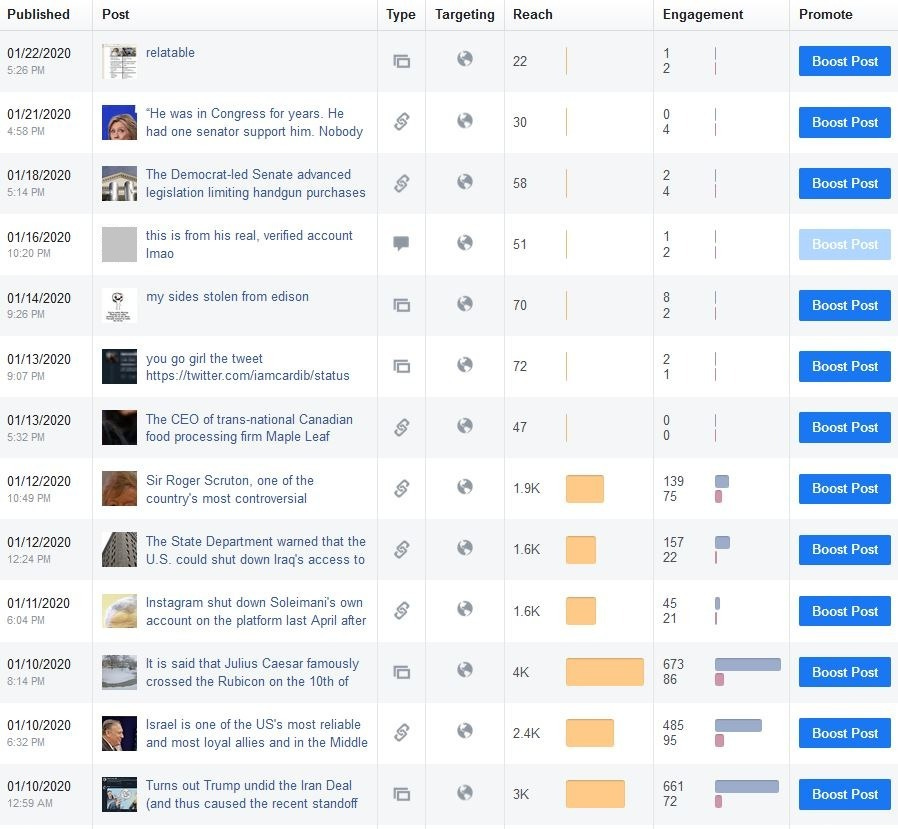
This suppression ended overnight after Biden’s inauguration in early 2021, with all restrictions gone, no more targeted purges of admins, and no more reach suppression. The same page now gets millions of views. This account, of restrictions being lifted upon Biden entering office in early 2021, differs from the impression I got from reading public announcements, which for Facebook really changed in 2022, when Facebook asked the Oversight Board for permission to be less restrictive in its removals of COVID-related content (the Board said no), and 2023 when Facebook reinstated Trump’s account. However, while his page (which is now largely apolitical) was no longer suppressed, most of the major figures purged in 2017 had long since moved on and Facebook remained a heavily moderated, censored, and depoliticized platform compared to its pre-2017 self. In his words:
By 2017 we had assembled a pretty high-powered group that included serious academics and talented artists, and some of us were in the process of starting more serious intellectual and artistic projects. However, the bans put an end to all of that. Several of us ended up doing their own things anyway, some even becoming commercially successful artists and writers, but these projects were all non-political and the ongoing harassment massively slowed down everything as everyone had to rebuild everything from the ground up.
In his view, Facebook had two major advantages over Twitter or other platforms, lack of which elsewhere greatly damaged the online right in the long term. First, it was more personal, slower paced, and less prone to sloppy engagement farming. Second, the group functions were much better, which allowed for proper gatekeeping and the building of stable, healthy communities of likeminded people. The world, and especially the world of online politics, is full of grifters, saboteurs, unstable individuals, chronic attention seekers, and other types that will predictably wreck any group they are involved with. It is also impossible to make intellectual progress if you have to constantly repeat entry-level facts and ideas to newcomers. Both of these make excluding some people or requiring a certain level of competence to contribute necessary. This might seem to contradict the ideal of free exchange of ideas and epistemic pluralism, but it does not; epistemologically, the ideal is low barriers to entry for creating groups, which can self-govern internally to keep out bad actors and ensure basic standards of conduct and knowledge. Groups that fail quickly collapse on their own, leaving successful groups to freely compete with each other for mindshare in public. This existed on Facebook (and Reddit) prior to 2017, but not since. In his words, the purges “destroyed the internal hygiene” of the Facebook right, paving the way for “degenatron grifters.”
Compared to the tech giants, Twitter has always been a small company. But it was the platform of choice for celebrities, journalists, academics, and politicians, giving it enormously disproportionate influence relative to its revenue. Twitter’s first UK executive, Tony Wang, famously described Twitter as “the free speech wing of the free speech party” in 2012, and the old Twitter rules, in operation 2009-2015, included the sentence “Because of these principles, we do not actively monitor and will not censor user content, except in limited circumstances described below” in its preamble. Unlike Google and Facebook, Twitter did not cooperate with the NSA, even when dealing with terrorist groups (the real kind, like ISIS, not “stochastic terrorism”).
In 2015, Twitter under Twitter general counsel Vijaya Gadde began reinterpreting Twitter’s existing rules much more broadly and banned hate speech, to “keep Twitter safe“ under the verbiage “hateful conduct.” Chuck Johnson was banned on these grounds for tweeting that he would “take out” (meaning attack digitally, not murder) a BLM activist.
In 2016, Twitter removed the sentence “Because of these principles, we do not actively monitor and will not censor user content, except in limited circumstances described below” from its rules preamble, no longer promising not to censor user content that didn’t break the rules. Instead, the new preamble read “In order to protect the experience and safety of people who use Twitter, there are some limitations on the type of content and behavior that we allow.” This formal change was backed up institutionally; in February 2016 Twitter established the “Trust and Safety Council,” a body which networked censorship/moderation/activist expertise from around the world to inform and run Twitter policy. As Twitter was the social network of the intelligentsia, this body was one of the most epistemically powerful nodes on Earth.
The so-called blue check aristocracy, wherein verified accounts were boosted over non-verified accounts, began to take form in 2016 and 2017. The word “aristocracy” is appropriate because verification was not something anyone could get and in practice this privileged status was granted and removed on an ad hoc basis. Verification formally was something anyone could apply for until November 2017, though it was limited to accounts of “public interest,” including government accounts, news organizations/journalists, entertainment, sports, business, and activists or public figures until. Informally, however, right-wing accounts were regularly stripped of blue check status (as happened with, among others, Laura Loomer, Tommy Robinson, and Richard Spencer) or not granted it to begin with. After November 2017 Twitter’s verification process became externally opaque, ad hoc, and internal rather than open. As verified accounts were structurally advantaged by Twitter, this in turn boosted left-wing journalists and activists and suppressed their right-wing counterparts. Verified accounts were also given more leeway with the non-political rules, such as the rule against posting private information. For example, in 2017, blue check Rose McGowan was temporarily locked for posting someone’s private number in relation to the Harvey Weinstein revelations. To prevent a blue check from being banned for violating the ban on posting private information again, Twitter formally banned “hate symbols” and “unwanted sexual advances.”
In 2018, Twitter banned “misgendering” transsexuals (including bans for simply tweeting “Men aren’t women,” a statement which would have been both uncontroversial and trivial five years prior), and laid out which groups got special protection (”women, people of color, lesbian, gay, bisexual, transgender, queer, intersex, asexual individuals, and marginalized and historically underrepresented communities”) under the rules. Twitter also began shadowbanning prominent Republican officials, including the Republican Party chair and several congressmen, though Twitter backtracked and claimed this was a bug after Republicans noticed.
Twitter “actioned” 250,806 accounts for hateful conduct in the first half of 2018, which increased by 54% by the second half of 2019. Some high profile figures banned in this era included Milo Yiannopoulos (338,000 followers, July 2016), major Trump advisor Roger Stone (October 2017), Gavin McInnes and the Proud Boys (August 2018), Alex Jones (coordinated with other platforms, September 2018), and Laura Loomer (265,000 followers, November 2018). The impact was many times greater on smaller accounts and anons, who unlike the above figures lacked any other clout or platform to fight back from.
As with other platforms, Twitter’s censorship escalated dramatically with the lockdowns and presidential election in 2020. Under its COVID misinformation policy, Twitter actioned 11.72 million accounts from January 2020 through September 2022. Specifically, Twitter banned content that went “directly against guidance on COVID-19 from authoritative sources of global and local public health information.” This included opposition to the lockdowns, support for the lab leak hypothesis of COVID origins, and information and claims that could lead to vaccine skepticism, including true information.
Twitter went even further than Facebook in censoring the New York Post’s reporting on Hunter Biden’s laptop in October 2020. Facebook merely suppressed distribution; Twitter blocked users from posting or sharing the link at all, even privately in direct messages. Twitter locked the official New York Post account, @nypost, for posting a link to their own reporting for two weeks, only allowing them back on the site when they deleted the tweets. Twitter also locked the account of the White House press secretary, Kayleigh McEnany, for sharing the story only weeks before the election.
When Elon Musk purchased the site in 2022, he released the Twitter Files detailing how the company’s censorship worked. No such equivalent exists for the other major platforms, but it is reasonable to assume the broad strokes are similar there. First, these files confirmed Twitter, along with other social media platforms, was working closely with US intelligence, with “constant and pervasive” contact with the FBI, with the FBI having a force of over 80 agents dedicated to social media. The FBI had a portal to report Tweets or accounts to Twitter for banning or suppression, and used it regularly, including for tiny accounts and joke tweets.
Second, the Twitter Files revealed that Twitter had many different hidden blacklists and suppression mechanisms beyond a formal, public ban, which were often used for bigger accounts. These included search blacklists (so accounts wouldn’t appear when searched), “do not amplify” lists, trends blacklists, and visibility filtering/shadowbanning, all of which Twitter had publicly denied doing. Some accounts targeted this way included Jay Bhattacharya, LibsOfTikTok, Charlie Kirk, and Dan Bongino. Unlike formal bans, which had to have some sort of rules-based justification, even if after 2015 the rules extremely broad and subjective, these shadowbans and suppression mechanisms were decided secretly by two internal bodies, SRT-GET and SIP-PES, a secret group including the “Head of Legal, Policy, and Trust (Vijaya Gadde), the Global Head of Trust & Safety (Yoel Roth), subsequent CEOs Jack Dorsey and Parag Agrawal, and others.”
Books are not a very efficient way of conveying a specific idea (for which a blog post is usually sufficient) or information (for which an LLM-generated research report is now likely the state-of-the-art), nor are they great for reaching a large audience (where short-form social media, especially video, dominates). But books are by far the best form of media for two things: first, they can deal with complex topics in depth. And second, unlike shorter forms, books are often referred to years or decades after they were written. It is very difficult to point someone without much context at the cloud of conversation around a particular topic or period, It is much easier to say “read this book.” Books are also more prestigious than other forms of media and sometimes easier to monetize, both of which are important motivators, and can lay out background information and multiple sophisticated arguments for low-context readers in one convenient package and therefore drive a broader conversation than other forms can.
Amazon’s market share of US book sales is roughly 50%, and its share of e-book sales is nearly 80% (and most of the remainder is on Google or Apple platforms, which moved in lockstep with Amazon). The closest a non-classified book can really come to being banned in the US is if Amazon removes it from their store. This makes Amazon a chokepoint for any would-be author. Amazon’s official position on books selling through the store in the late 2010s was as follows:
As a bookseller, we believe that providing access to the written word is important,” an Amazon spokesperson said in a statement. “That includes books that some may find objectionable, though we have policies governing which books can be listed for sale. We invest significant time and resources to ensure our guidelines are followed, and remove products that do not adhere to our guidelines. We also promptly investigate any book when a concern is raised.
But Amazon too revised its approach during the closure of the Internet. In 2017, Amazon began removing books for ideological reasons, starting with removing Holocaust revisionist and denial literature from its UK and US stores. In 2018 and 2019, Amazon began targeting specific right-wing authors, removing the books of pick up artist Roosh V (who was simultaneously removed from YouTube, PayPal, and Discus; the loss of revenue prevented him from publishing new articles), Jared Taylor, Greg Johnson, Kevin MacDonald, William Luther Pierce, Jonathan Bowden, David Duke, George Lincoln Rockwell, Savitri Devi, and James Mason, among others. As with other platforms, the chilling effect must have been many times larger than the direct effect.
As with the rest of the Internet, censorship on Amazon escalated massively during the lockdowns. Amazon banned contradicting public health advice, and under this policy banned Alex Berenson’s Unreported Truths About Covid-19 and Lockdowns in June 2020, a lockdown-skeptical booklet, before reversing course after Elon Musk publicly objected. At the same time, Amazon banned Coronalessons, a book on the constitutional implications and practical results of lockdown policies, before again reversing course after Marco Rubio intervened. Needless to say, the vast majority of potential authors do not have Elon Musk or Marco Rubio to go to bat for them. Unlike prior censorship waves, Amazon went after the non-institutional left under the same policy, banning Capitalism on a Ventilator, an October 2020 book comparing the COVID responses of the US and PRC.
Non-lockdown related censorship also ramped up in 2020. Amazon banned most editions of Mein Kampf in March, along with many other Nazi writings of historical importance. Amazon then banned Abigail Shrier’s Irreversible Damage, a book arguing that the extreme rise in transgender self-identification in the 2010s, especially among teenage girls, was the product of social contagion and the resulting hormone therapy and surgery was irreversibly damaging those caught up in it, from paid advertising on the site. In 2021, Amazon removed Ryan T. Anderson’s When Harry Became Sally from the site for contradicting the claims of the transgender movement.
In 2021, Amazon created a new “Do Not Promote” tag internally under pressure from the White House, which functioned similarly to YouTube, Facebook, and Twitter’s shadowban system. Books tagged “Do Not Promote” were not removed from the store (an action which could be noticed and opposed, and requires some sort of policy justification); instead they were excluded from Amazon’s recommendation engine, deranked in search results so that they wouldn’t appear even with highly relevant keywords, and authors were prohibited from advertising.
Amazon’s book bans have not stopped; Vauban Books’ paperback edition of The Camp of the Saints was removed on April 17th 2026 (archive link), citing offensive content, although it was later restored after public backlash.
Amazon also dominates e-commerce generally, with almost 40% of the market, six times its nearest competitor (Walmart). This makes Amazon a chokepoint for any kind of merchandise and thus important for monetization and loyalty signaling. Amazon has always had fairly common-sense policies for what they allow to be sold (no stolen or illegal goods, no weapons or explosives, no biological materials, etc), but as with books Amazon began tamping down on safe and legal goods with ideological valence in 2015, when it banned Confederate flag merchandise (an important American national symbol common across much of the country, not a fringe or extremist one, not that fringe or extremist views should be banned) across the entire store.
Amazon went on to ban “white supremacist and Neo-Nazi” symbols under pressure from Congressman Keith Ellison in 2018 (communist merchandise remains available), Proud Boys merchandise in 2020 (Antifa merchandise remains available), QAnon merchandise in 2021, and Three Percenters, Oath Keepers, and Boogaloo Boys merchandise (Black Lives Matter merchandise, associated with more violence and anti-government sentiment—not that anti-government sentiment should be banned—than all three combined by orders of magnitude, remains available), also in 2021.
The closest thing to a source of official truth our civilization has is Wikipedia. On most topics of public importance, it will be the very first source read by anyone looking for a broad overview, it is favored by search engines, and it is one of the most important sources of training data for large language models.
Wikipedia has a broadly left-wing viewpoint. This can be seen in several different ways. Wikipedia is much more likely to describe right-wing political figures and movements as extremists than it is left-wing ones.
And not only are articles on left-wing political figures more positive than articles on right-wing ones…
…but a particular politician changing affiliation to a right-wing party earns them a more negative page.
This is evidence that Wikipedia is not neutral, and arguably evidence of bias, but not necessarily part of the closure of the Internet. Wikipedia editors are overwhelmingly center-left to far-left, with a handful of centrists and center-rightists to balance them out.
Wikipedia reflecting the views of its editors rather than being neutral would be a failure of the site’s mission, but is not the same as censorship on social media platforms. Early Wikipedia articles, from the early 2000s, also skewed left, and this was long before mass Internet censorship in the US. This makes sense, as the leftwards skew of the early site reflected an extremely non-representative editor-base on an open platform. As more people got online and Wikipedia went from obscure site to cultural institution, Wikipedia got more neutral, getting close to true partisan neutrality by 2012 (Greenstein & Zhu 2012).
What changed, and the reason why Wikipedia belongs in this article, was a small group of overwhelmingly left-wing Wikipedia admins hostile to viewpoint diversity manipulating the list of acceptable sources that could be cited and restricting who could edit controversial pages. As with the rest of the closure of the Internet, this began in earnest in the 2015-2019 period, when the Daily Mail was deemed an unreliable source and deprecated in 2017. In 2018, the list of acceptable and unacceptable sources was formalized into the “Perennial Sources List.” Over the next few years many other non-left-wing outlets were either deprecated (meaning they could not be cited at all) or deemed unreliable, including major corporate outlets such as Fox News’ politics and science coverage. As of October 2020, Wikipedia’s list of deprecated sources included 16 right-wing ones and 1 left-wing one (Occupy Democrats). Less reliable left-wing sources, such as AlterNet, CounterPunch, and the Daily Kos, were not deprecated.
The reliable sources list was not the only chokepoint that was weaponized to turn Wikipedia from an aspirationally open and neutral site into a closed one. Wikipedia’s Arbitration Committee is “English Wikipedia’s highest ruling body” which can grant admins the power to impose discretionary sanctions at will on people editing certain topics. These are authorized on most of Wikipedia’s controversial topics, meaning controversial pages are much less open than the rest of the site. This body is not neutral, and cracked down on right-wing views in the 2015-2019 period. In 2018, administrators applying for a position on English Wikipedia’s Arbitration Committee were asked: “With the rise of far-right and hate groups online, are you concerned that editors espousing such beliefs may try (or are already attempting) to use Wikipedia as a vehicle for propaganda? Why or why not? If yes, what role do you think ArbCom could play in counteracting their influence on Wikipedia?”
And several administrators, who have immense discretionary power over who is allowed to edit certain topics, have expressed their own views that “right-wing ideology is disqualifying for Wikipedia editors,” that “believing that Trump is a good president indicates that you are probably not competent to edit Wikipedia,” or that “Nazis or racists” should be blocked from the site even if they are not breaking any rules (Tezuka & Ashtear 2020). These attitudes are reflected in enforcement actions. On controversial issues with clear left/right valence, such as race and intelligence, abortion, gun control, and President Trump, editors with right-leaning views were more than six times more likely to be sanctioned than those with left-leaning views.
Admins are much more left-wing and willing to censor alternative viewpoints than editors. In June 2020, the Wikimedia Foundation itself officially released a statement that “there is no neutral stance. To stay silent is to endorse the violence of history and power; yesterday, today, and tomorrow. It is well past time for racial justice in America and beyond,” on the issue of Black Lives Matter. This statement contradicts Wikipedia’s official policy of neutrality, and as such was debated by both administrators and regular editors. Non-admin editors were split on the statement, with some highly critical and slightly more against than for. Every administrator who discussed the issue, on the other hand, was either neutral or supportive of the Wikimedia Foundation’s statement (Tezuka & Ashtear 2020).
This restriction of which sources could be cited and who could write on controversial pages is the process that produced case after case like the below, wherein the Wikipedia article on Cultural Marxism went from a neutral description of a historical intellectual and political movement in 2014 to a hysterical denunciation of antisemitism and conspiracy theories in 2020.
Or the site going from describing the Republican Party as “conservative” to “right to far-right,” while the Democratic Party went from “socially liberal” with “centrist, liberal, and progressive factions” to “center-left to left” between 2014 and 2026.
Unlike the major social media platforms, Wikipedia was never the public square, so censorship is not the right word for what happened there. Neither is bias or lack of viewpoint neutrality, because Wikipedia’s non-neutrality in 2026 is very different from its non-neutrality in 2006. “Closure,” as who could edit controversial pages and what sources could be cited were heavily restricted by an opaque cabal of admins, fits.
Even if you were booted off of every major platform you could use the Internet to exchange information and ideas by making and running your own website, though this has both financial costs and a technical barrier to entry and cripples reach compared to being able to operate on social media. This created a hole in any narrative control infrastructure that limited itself to the major platforms. The main way people could find new sites or information off the major platforms was Google Search, which in 2014 felt almost magical in its ability to find niche information in the nooks and crannies of the web, including information that contradicted orthodox institutional positions and narratives.
It is widely understood that Google search today is far inferior to what it was in the early 2010s. It’s easy to attribute this entirely to the rise of search engine optimization or the need to sell more ads, but some of this degradation was actually intentional. In 2017, Google began “Project Owl,” an effort to stop what Google termed “problematic searches.” This was explicitly distinguished from previous areas of Google focus, like preventing spam, adversarial optimization, piracy, and low-quality content.
Google began removing “problematic” autocompletes from search suggestions and from featured snippets. Most perniciously, Project Owl deliberately began downranking or even excluding more-relevant answers to unusual queries in favor of generic ones from “authoritative” sources. Authoritative sources meant Reddit, Wikipedia, governments and NGOs, and a handful of major institutional news organizations. This killed the 2014 Google experience of regularly getting hundreds or thousands of extremely-relevant results to niche queries from dedicated websites, blogs, and forums, in favor of the current experience of a few dozen generic pages of dubiously-relevant Wikipedia, Reddit, corporate media, or SEO slop. This extended the narrative control infrastructure to all websites that depended on search to reach new people, which was almost all of them except for a handful of giants.
All of this was justified on public relations grounds. But as with the YouTube censorship campaign this was clearly pretextual. “Problematic searches” were only a tiny fraction of Google searches in 2017 (0.25%, according to their own numbers) and no one believes searching for something on Google means Google itself endorses it.
(Interestingly enough, as with YouTube’s censorship, Project Owl was triggered by a series of news articles from the British mainstream press, namely The Guardian [1][2][3]. Unlike with YouTube, I don’t know of evidence of direct British government involvement, though it would be silly to dismiss the possibility. At the very least, Google must have had the YouTube example in mind.)
However, the censors were not satisfied with merely obliterating open discourse on every major platform and making it impossible for curious people to find unorthodox ideas or communities of discussion. After all, crimethinkers could still make and host their own websites and if those sites were sufficiently well-known they might be able to survive being hidden by Google Search and suppressed on the major platforms. So the logical next step was to remove them from the Internet entirely. This was possible because several layers of the tech stack are oligopolies. The major players in this were Amazon, Microsoft, and Google in their capacity as cloud providers, Cloudflare in its capacity as a DDoS protection service, Apple and Google in their capacities as mobile app stores, payment processors like PayPal, Visa, Mastercard, and Stripe, and domain registrars like GoDaddy.
The first website to be deplatformed for non-criminal, explicitly ideological reasons was the Daily Stormer, a neo-Nazi commentary site. GoDaddy, the site’s domain registrar, revoked the site’s registration on August 13. Google and a series of other registrars did the same when the admins of the site tried to move it. The coup de grace came on August 16, when Cloudflare removed DDoS protections, effectively terminating the site. Being a neo-Nazi website, the Daily Stormer—and also Stormfront, purged at the same time—attracted few defenders, with no pushback from lawmakers or other powerful individuals or institutions. Since only a handful of neo-Nazis and fringe libertarians complained, the same model was quickly applied to other sites.
The next major site to be purged was Gab, a free speech alternative to Twitter founded in August 2016 by Andrew Torba in response to the early stages of the closure of the Internet. Unlike the Daily Stormer, which is an explicitly Neo-Nazi website, Gab is closer to a right-wing version of BlueSky, with the ideological valence coming from who was getting censored off Twitter in 2016 rather than who was leaving over their enemies no longer getting censored off Twitter in 2022. Apple refused to allow Gab on the iOS App Store due to “references to religion, race, gender, sexual orientation, or other targeted groups that could be offensive to many users.” Google removed Gab from the Google Play Store in August 2017, citing “insufficient moderation.” The combined market share of these stores being over 99.9%, this effectively banned Gab from mobile, but the website itself was not yet purged. In August 2018, Microsoft threatened to remove Gab from its cloud computing platform, Azure, unless Gab removed certain user posts, and Gab complied.
In October 2018, PayPal and Stripe forbade Gab from using their services, forcing the site to rely on crypto donations. Gab’s host, Joyent, also refused to host the site any longer, and GoDaddy, the domain registrar, de-registered the site. Coinbase and Square’s Cash App removed Gab and Andew Torba’s accounts in January 2019. In August 2019, AWS de-hosted Gab’s fundraising website and in June 2020 the credit card processor Visa blacklisted the site. In March 2025, Gab was forced to block all UK users by the British Internet censor/regulator Ofcom. Torba responded with vertical integration, rebuilding much of the Internet stack (email, hardware, browser, payments) internally, but this was massively inefficient, required a very high level of technical skill for a tiny company, and still greatly damaged distribution.
Another site caught up in the closure of the Internet was 8chan, founded as an uncensored alternative to 4chan. In August 2019, Cloudflare terminated DDoS protections, taking the site offline. 8chan was able to return using BitMitigate, a DDoS protection subsidiary of Epik, a free speech domain registrar of last resort. However, Voxility, the company Epik and BitMitigate rented servers from, then threatened to cut off Epik in turn, forcing Epik to cease providing service to 8chan. This did not save Epik in the long run; in 2021 the hacker group Anonymous, as part of “Operation Jane,” hacked the site for hosting the website ProLifeWhistleblower.com after GoDaddy removed it, and released gigabytes of customer data, explicitly to de-anonymize the company’s customers. Epik was sold in 2023 due to financial issues, and the new owners reversed the site’s pro-freedom of speech stance, eliminating the domain registrar and DDoS protector of last resort for deplatformed websites.
Parler, like Gab, was founded as an uncensored alternative to Twitter in 2018. Unlike Gab, whose user base tended to be more alt-right adjacent, Parler’s users were overwhelmingly mainstream MAGA Republicans. In January 2021, Apple removed Parler from the iOS App Store and Google did the same with the Google Play Store. Almost simultaneously, Amazon removed Parler from AWS, which took the site off the Internet. Payment processors (Stripe, American Express) and SaaS companies (Slack, needed to contact moderators, Twilio, needed for SMS, and Scylla, for internal databases) also cut ties. Parler was able to restore service eventually, but lost 96% of its user base.
As with the major platforms themselves, there was rapid escalation over time, from an explicitly Neo-Nazi website to a social media platform that primarily appealed to alt-right adjacent figures banned from Twitter and Reddit to a social media platform that primarily appealed to normal MAGA Republicans well within the national Overton window to Epik, which merely provided software services without discriminating according to ideology.
In the 2010s, forum after forum and open-source project after open-source project went through a similar open to closed transition as the major platforms. Before this transition, open-source was a meritocratic field where one’s identity and politics did not matter, only their contributions. Likewise Internet forums not specifically devoted to politics were typically ideologically pluralist and apolitical. After, open-source became an explicitly anti-meritocratic space where adopting left-wing shibboleths was mandatory. Even silence could invite attacks.
Typically, the way this worked was through cliques of activists setting up a code of conduct for the forum or project, with an admin committee to define and enforce it, and then using their administrative powers to eliminate dissenters. This was noticed at least as early as November 2015 by Eric Raymond, in his blog post “Why Hackers Must Eject the SJWs.” The organizing document of this push in the open-source world was the Contributor Covenant. Created in 2014, the Contributor Covenant was adopted after a concerted activist push by thousands of open source projects around the world. It included the key lines (emphasis mine):
We are committed to making participation in this project a harassment-free experience for everyone, regardless of level of experience, gender, gender identity and expression, sexual orientation, disability, personal appearance, body size, race, ethnicity, age, religion, or nationality. (…) Project maintainers have the right and responsibility to remove, edit, or reject comments, commits, code, wiki edits, issues, and other contributions that are not aligned to this Code of Conduct, or to ban temporarily or permanently any contributor for other behaviors that they deem inappropriate, threatening, offensive, or harmful.
You do not have to be a lawyer to notice how vague and subjective this statement is, and how strong the enforcement powers granted to the code of conduct committees to enforce it are. This included removing contributors for non-leftist speech on other platforms that had nothing to do with the project at all, which had and has a chilling effect on everyone even tangentially involved in open source.
It is impossible to give even a rough play-by-play of this process, as there are literally tens of thousands of miscellaneous open-source projects and Internet forums, and I only have personal experience with a handful, but the result was the destruction of open discourse across the long tail of non-political forums and websites and the enforcement of strict speech and ideological control there as well. This was a disaster for any forum that might touch an ideological third rail. I experienced it as a sudden collapse in the quality of discussion across several ideologically diverse and mostly apolitical technology, history, and fiction-focused forums around 2017, which eventually drove me to Twitter. Twitter was large enough that one could partly escape the censors, but at the cost of far lower average quality of discussion and strict format limits.
The individuals involved were and are very disproportionately a specific type: transwomen, usually anti-capitalist, often explicitly communist in addition to holding whatever the leftist omnicause beliefs du jour are. Some high-profile public examples include Coraline Ehmke, creator of the Contributor Covenant and the Post-Meritocracy Manifesto, Valerie Aurora, and Teresa Deubelli (Rust). However, I do not make this observation from public information but because the same pattern occurred on the small non-technical forums I used to participate in back in the 2010s. The strongest calls for censorship almost always came from the tiny handful of anticapitalist transwomen—usually only one or two per forum—present. This type of person portrays all political dissent as a direct physical threat to their personal safety and as such is committed to the totalitarian project of erasing all dissent everywhere. They are also coordinated and extremely overrepresented in highly-masculine volunteer pursuits such as open-source programming and Internet forum participation/moderation/hosting, and as such are able to ride roughshod over a much larger, but disorganized and apolitical (maybe liberal and libertarian-inclined, but not strongly), number of other contributors and forum admins/moderators.
Comments sections used to be a staple of news sites across the Internet, allowing readers to, for the first time, directly respond to formerly one-way broadcasts in the public square and discuss these broadcasts in public with other readers. By 2008, 75 of the top 100 most-circulated newspapers in the US had comment sections, and most of them were open so that anyone could participate. Like every other major locus of free discussion, this was ended with the closure of the Internet, with hundreds of sites either closing their comments sections or heavily restricting them from 2015 onwards, though a handful began earlier.
In response, Andrew Torba, the founder of Gab, created a browser extension called “Dissenter” in 2019, which allowed users with the extension installed to write comments on any page on the Internet that other users with the extension could see and respond to, creating a sort of universal comments section for those so inclined. Dissenter—and the infinitesimal fraction of the pre-2015 open Internet discourse it represented—was then immediately removed from the Chrome and Firefox extension stores.
Tech companies had, and used, the power to close the Internet, but they could not and would not have done it alone. The 20th century totalitarian party-states, like Nazi Germany, the USSR, or the PRC, with their tendencies to formalize and unify authority, had official government censorship departments with lists of ideas and topics that could not be mentioned, and a party line on what narratives are publicly acceptable. Western states today, and especially the US, do not. Instead, these functions are outsourced to an opaque web of nominally-private NGOs, media organizations, and academics. Jacob Siegel, pointing to the close links between these organizations, tech companies, and US intelligence, calls this network The Information State, and I prefer the term “para-state” for those organizations that are neither for-profit tech platforms nor officially part of the government.
This type of arrangement, with organizations separate from, but reliant on and often deputized by, the state determining publicly-permissible thought is common in Western history. For much of its existence the Catholic Church played a similar role. Today, the most institutionally similar regime outside the West is the Islamic Republic of Iran, with a clerical body that is not part of the formal state, the Supreme Council of Cyberspace, determining what is to be censored.
Why is it appropriate to call these organizations para-statal rather than private? First, because they are often public trusts, given tax privileges in exchange for operating in the public interest as determined by the state. Second, they were and are usually funded by governments— especially the EU, Germany, Britain, and the US—or by other tax-privileged public trusts. Third, they exercise power, such as blacklisting and censorship, usually exercised by states. Fourth, they are often directly privileged and empowered by governments; for example, under the EU’s Digital Services Act, tech platforms must defer to registered “trusted flaggers.” These institutions are not part of the formal state, but they are part of the ruling regime.
In the US, the para-state is much more dangerous than the formal state when it comes to censorship. The formal state in the US is extremely fragmented and polarized, which means there are always power centers within the formal government to oppose the censors. Perhaps even more importantly, the US has strong memetic antibodies against formal state restrictions on speech, which makes it very easy to point at and mobilize opposition against. The para-state, on the other hand, is homogeneously leftist (aside from a handful of explicitly conservative organizations, as per Conquest’s Second Law) and unbound by Constitutional and many legal restrictions. The formal state also typically coordinates through public and explicit law or regulation rather than vague, opaque, and ever-shifting “codes of conduct” and “content policies,” which are much harder to oppose. This is less true in the rest of the world, where explicit state controls on speech are common. There, such organizations are often backed up by very heavy-handed state power.
In order to suppress “misinformation,” tech companies needed some source of truth. But no source of objective truth on all possible topics of discussion exists in the real world, and Facebook or Google or some government saying “we will decide what you’re allowed to talk about online” would not have survived scrutiny. So to determine what was officially true for the purposes of moderation, tech companies turned to third-party fact-checking organizations, which sprouted like weeds during the closure of the Internet. These groups attained total epistemic authority over the public square between 2015 and 2022.
Most official fact-checking organizations were and are certified by one of two groups: the International Fact-Checking Network (IFCN) and the European Fact-Checking Standards Network (EFCSN), which creates a chokepoint in the fact-checking ecosystem. There is significant overlap between the IFCN and EFCSN; many organizations are certified by both and EFCSN’s chair also sits on the IFCN’s advisory board. The EFCSN was founded in 2022 with the consolidation of several dozen pre-existing European fact-checking organizations under one umbrella. The EFCSN is funded mostly by the European Union, with additional contributions from Meta and Google, the last funding a truly Orwellian “prebunking at scale” project.
The IFCN was founded by the Poynter Institute, a school of journalism, in 2015, after a $1M foundation grant. The Poynter Institute hired an ex-SPLC employee to create a list of 515 news websites to be blacklisted by advertisers, including mainstream conservative ones like the Washington Examiner, in 2019. The IFCN’s funding sources are very similar to those of the fact-checking organizations it certifies: tax-privileged foundations, Google and Meta, and the US State Department. “From its launch in 2015, the IFCN has received funding from the following organizations: Arthur M. Blank Family Foundation, the Duke Reporters’ Lab, the Bill & Melinda Gates Foundation, Google, Facebook/Meta, U.S. State Department, the National Endowment for Democracy, the Omidyar Network (Luminate), the Open Society Foundations, Fritt Ord Foundation, Duke Reporters Lab, Craig Newmark Philanthropies, and the Park Foundation.” If we add the European Union and the British and German foreign offices, this list covers the major funders of almost every fact-checking and anti-disinformation organization.
The Trusted News Initiative (TNI) was founded in 2019 as an “alliance of news media, social media, and technology corporations” to “combat disinformation” and is closely linked to the British government via the BBC. Unlike the EFCSN or the IFCN, the TNI does not certify organizations; instead it coordinates incumbents, such as Microsoft, the European Broadcasting Union, Twitter, YouTube, Radio Canada, the Australian Broadcasting Corporation and Agence France-Presse, to move against “disinformation” as quickly as possible across as many channels as possible.
These three organizations exist to certify or coordinate fact-checkers with governments and platforms, but what of the fact-checking organizations themselves? The first five official fact-checking partners of Meta in 2016 were PolitiFact, Factcheck.org, Snopes, ABC News, and the Associated Press. As the ecosystem expanded and professionalised, a galaxy of smaller and more specialized groups sprang up, with the larger fact-checking organizations often using them as their own sources of ground truth. A few examples of these organizations include the Atlantic Council’s DFRLab (founded 2016, it is funded by the US State Department, National Endowment for Democracy, and UK Foreign Office, among others), the Global Disinformation Index, a UK nonprofit that builds advertiser blacklists (founded 2018, funded by the UK Foreign Office, the European Union, the German Foreign Office, the Open Society Foundation, and the US State Department, among others), and the Stanford Internet Observatory (founded in 2019, it was funded by the National Science Foundation, before being defunded when Republican politicians realized it kept labelling conservative arguments as misinformation).
Ironically, the best descriptor of fact-checking organizations uses their own terminology: they are professional purveyors and enforcers of malinformation, that is, true information that gives a false impression. There are many ways, even sticking strictly to factuality, to deceive, of which the most important to fact-checkers are decisions on which claims to fact check, how loosely to interpret claims (no one speaks with perfect precision all the time, so you can fact-check the same imprecise but broadly correct statement as mostly true or mostly false), which authorities to defer to as sources of ground truth (you can find credentialed experts to say almost anything), what context should be taken into account, and what the statement is ostensibly implying (so the same statement can be declared either true or malinformation).
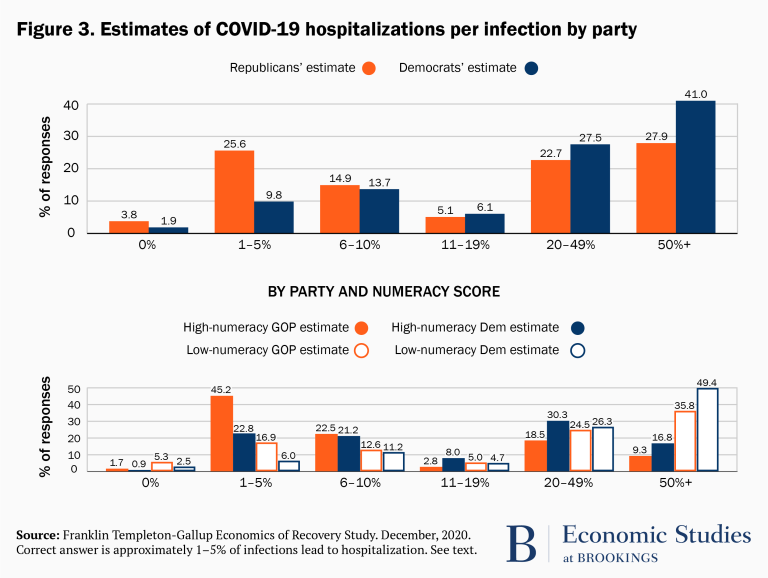
Those trusting fact-checkers tend to be more correct than a random person on the total set of possible questions, but extremely and systematically misinformed on key issues of public importance, such as virulence of COVID-19 or the number of unarmed blacks killed by police.
But fact-checkers and disinformation NGOs did not always stick strictly to factuality. Often they were simply wrong, not just misleading. A notorious example is Hamilton 68, founded by a former FBI agent and funded by the Alliance for Securing Democracy (ASD, founded 2017 in direct response to the 2016 election). Hamilton 68 had a proprietary list of 644 Twitter accounts that they claimed to be linked to Russian disinformation operations. Hamilton 68 would look at what these accounts were posting about, use this to claim that whatever the topic was was downstream of Russian influence, and then be cited as an authority on this by other fact-checkers and media organizations (“including NBC, CBS, ABC, PBS, CNN, MSNBC, The New York Times and the Washington Post,” plus “Snopes and Politifact”). This “independent expert research” was then used as a pretext to suppress these discourses.
As it turns out, Hamilton 68’s list of Russian agents consisted of a handful of public Russian accounts (mostly connected to Russia Today) and hundreds of ordinary Americans with zero ties to Russia, mostly conservatives or otherwise right-of-center but including a few dissident leftists and others as well. Twitter knew this internally by 2017, but said nothing; this was only revealed in 2022 with the Twitter files. The Hamilton 68 episode shows how easily claims of foreign influence were weaponized to suppress domestic dissent, and the false narrative that Russian influence campaigns were a major component of Brexit and the 2016 presidential election were crucial to legitimizing the closure of the Internet.
Other high profile failures include labeling the lab-leak hypothesis of COVID origins a debunked conspiracy theory in 2020 even though it was always plausible, suppressing a BMJ report on poor medical practices at a contractor working for Pfizer, labelling true allegations that the Biden administration was purchasing crack pipes for smokers as “mostly false,” or labelling claims of Biden’s evident senility as false every year from 2020 through 2024.
Still, the factual record of fact-checkers is not the primary issue. No individual or organization is perfect. This is precisely why the fact-checker approach of censorship and suppression is so dangerous. If you or I make a mistake, someone else can explain why we’re wrong, in public. When the fact-checkers make a mistake, and then appropriate or are given the power to decide any alternative is “disinformation” or “misinformation” or “hate” and so censor and suppress everyone else, error correction is impossible.
One word that comes up again and again when asserting the epistemological authority of fact-checkers and thus their ability to provide a source of truth to serve as a basis for censorship and suppression is “nonpartisan.” There are two reasons appeals to nonpartisanship are wrong. The first reason is obvious: these organizations were not and are not actually nonpartisan. The rhetorical trick being played by use of the word “nonpartisan” is to conflate lack of formal affiliation with a political party with lack of ideological bias, but one does not imply the other. When asked in 2023, the vast majority of “misinformation experts” reported being left-wing and none reported being more than slightly right-of-center.
Unsurprisingly, given the extreme partisan skew of fact-checkers, right-wingers are more likely to (correctly) say they favor one side.
The second reason is more fundamental and arguably more important: just because a position does not have strong political valence does not mean it is correct. Not every error is politically or ideologically motivated. Even if fact-checkers were to make a serious effort to be genuinely nonpartisan as opposed to simply using the word to deflect criticism, they would still not be a reliable source of truth that could reasonably be used to censor. The idea that nonpartisanship confers epistemic authority reflects the collapse of the Enlightenment ideal of debate, in which many participants are assumed to have agendas but are judged on evidence and argument, in favor of a Ministry of Truth model.
The other word that appears again and again in discussions of the fact-checking network is “independent,” (or “third-party”) as in “independent fact-checkers say…” Independent has multiple meanings. The epistemological value of independence is that, if many independent individuals or organizations look at some issue, their errors and biases should be uncorrelated and will hopefully cancel out. If many uncorrelated (and capable, and interested) groups all come to the same conclusion that consensus itself provides evidence that this conclusion is correct.
In the context of fact-checking organizations, however, “independent” does not mean “uncorrelated errors.” It means “organizational independence.” Fact-checkers were not formally beholden to formal governments or tech companies or foundations; they were not shills for someone else’s agenda. But this does not mean fact-checkers are neutral or disinterested, or that the errors of different organizations are uncorrelated.
In fact, there are many sources of correlated error. All major fact-checking organizations share similar funding sources, namely governments, a handful of large tax-privileged foundations, and tech companies. All rely on similar sources of fact, mainly establishment news organizations, and sometimes governments, academics, and other NGOs, to judge what the ground truth of a matter is rather than independently verify claims themselves. Fact-checking organizations are almost all certified by one or two meta-fact-checking groups, so the errors of the IFCN and EFCSN are spread throughout the ecosystem. And of course, professional fact-checking is a homogeneously left-wing milieu. In practice, fact-checking organizations operate as a bloc on all issues of public importance, a bloc that is not synonymous with truth.
Before the Internet, the social role of the media was to uncover and disseminate information about the world. The Internet rendered this largely obsolete, as it allowed for much easier dissemination of information, which put traditional media in steep decline. The closure of the Internet gave the media a new lease on life as an integral component of the emerging censorship para-state. Rather than finding information, media outlets became sources of official truth to be cited by fact-checking organizations to be used by tech companies to provide lists of ideas, groups, and individuals to suppress, and to coordinate censorship campaigns with threat of bad press. To facilitate this, Meta and especially Google began replacing lost ad dollars with their own grant programs for recognized news organizations.
In some jurisdictions, this para-state relationship is even formalized, with the governments of Canada, Australia, the Nordics, the United Kingdom, France, California, New York, and Illinois giving officially-recognized journalists direct subsidies or tax exemptions, and the European Union and the United Kingdom exempting them from some online speech restrictions. This is in addition to publicly-funded broadcasters in the UK, France, Germany, Italy, Spain, Ireland, Portugal, the Netherlands, Belgium, Switzerland, Austria, the Nordics, Canada, Australia, and New Zealand, which enthusiastically participated in the closure of the Internet.
The last leg of the para-state involved in the closure of the Internet was the army of enforcers that was responsible for making sure dozens or hundreds of the different private organizations involved got with the program of mass censorship. NGOs can’t throw people in prison, so they operated through pressure campaigns, both in public in concert with media organizations, and behind the scenes, against private companies. These organizations used mafia tactics: censor the people and ideas we want you to censor, bringing people aligned with us into your organization and decision-making structure to do so in the process, or we’ll launch a PR campaign smearing you, with the threat of aligned governments and already-captured private institutions destroying your business to back said PR campaign up. Like the fact-checkers and disinformation experts, these enforcer organizations were and still are overwhelmingly tax-privileged nonprofit public trusts.
It is difficult to tell from the outside, but the most important of these organizations is probably the Southern Poverty Law Center (SPLC). The best account here is Patrick McKenzie’s “Notes on a non-profit indicted for bank fraud,” which can be summarized as follows (though I would recommend reading the entire thing): The SPLC ran a coordinated pressure campaign, starting in 2017 and escalating in 2020 and 2021, going after “Internet companies” which included not only tech companies like Facebook and Twitter, but also “banks, credit card processors, and any other financial infrastructure their enemies could touch” to remove “extremists” from the Internet and from financial infrastructure. The SPLC maintains a blacklist, the SPLC Extremist Files, to be used in financial infrastructure and elsewhere, one with quasi-official status used across many major companies and platforms, alongside the US Treasury Department’s OFAC. It’s worth pondering the word “extremist” for a moment. Even taken entirely literally—and the SPLC, of course, is not a neutral organization whatsoever—all it means is extreme relative to the mainstream/orthodox view. The SPLC thus does its best to purge any sufficiently radical social critique from both financial infrastructure and the Internet.
The SPLC campaign had two parts, a public pressure campaign in the media, and a much more consequential series of private, behind-the-scenes, meetings with industry. To cite McKenzie:
The campaign’s declared aims were three. To convince those companies to censor more communications the coalition characterized as hate. To blacklist organizations and individuals the coalition characterized as promulgators of hate or violence. And to interdict the flow of funds to those blacklisted parties.
There were hundreds of meetings total, and these meetings included employees in the “communications, legal, government affairs, Trust and Safety, and compliance” areas. The SPLC’s tactics included telling industry participants that “if they did not accede to demands [to mass-censor and debank] they would be profiting from evil,” and that they were taking “blood money.”
But the SPLC did not limit itself to moral hectoring; it also regularly threatened companies with “coordinated negative public messaging with the goal of causing reputational harm” and “adverse legislative, executive, or regulatory action indirectly by coalition participants who are reasonably read as exercising substantial political influence.” The SPLC and its aligned non-profits “nominated accounts for adverse actions, up to account closure, in no uncertain terms, and it was not a request.” The usual process for the SPLC was “get the meeting, get a commitment under threat of coordinated public pressure, then judge progress against the commitment to be inadequate. In the next meeting, offer absolution and de-escalation, contingent on policy concessions. Repeat as desired.”
Other examples of this type of NGO specializing in coercing private actors include the Center for Countering Digital Hate, a British nonprofit that builds advertiser blacklists (founded 2018) and the Anti-Defamation League (ADL). The ADL coordinated ad boycotts against Facebook in June 2020 and Twitter in November 2022 for allowing “hate speech,” i.e. insufficient censorship, and maintained a “Hate on Display” database of symbols to be censored, including the OK sign, and a “Glossary of Extremism and Hate” of organizations to be deplatformed, suppressed, and debanked. The Glossary was taken down in 2025 after Charlie Kirk’s assassination as TPUSA, as mainstream a conservative organization as they come, was one of the listed “hate groups.” The ADL also recommends and publishes tactical guides to deplatforming and directly coordinated at least one public deplatforming campaign, against Tucker Carlson.
The combination of state-funded or tax-exempt and privileged fact checkers, journalists, and NGO enforcers, alongside formal Western governments and tech giants, combined to create a decentralized, para-statal version of the People’s Republic of China’s Internet censorship and narrative control infrastructure. I am not the first person to observe this; NS Lyons pointed it out in The China Convergence in 2024, and no less a liberal magazine than The Atlantic published “Internet Speech Will Never Go Back to Normal: In the debate over freedom versus control of the global network, China was largely correct, and the U.S. was wrong” back in 2020, not only pointing out the ongoing closure of the Internet and rise of the para-state and comparing it to China, but endorsing and celebrating it.
In ecology, r/K selection theory describes the inherent tradeoff between quantity and quality of offspring. K-selected creatures reproduce and mature slowly, produce few offspring with significant investment in each one, and tend to be bigger, longer-lived, and more complex (think humans, bears, or whales) while r-selected creatures (think rabbits, insects, or krill) mature quickly and produce many offspring with little investment in each one and tend to be smaller, short-lived, and less complex. Generally, the less stable and predictable an environment is, the more r-selected organisms dominate, and vice-versa.
We can draw an analogy between natural and intellectual ecosystems. High-quality thought requires enormous investments of time, effort, background research, and often funding and skills that take a lifetime to develop. Where the rules are stable, it is possible for people to make the investments necessary for high-quality, deep thought to flourish. This long-term stability is the ideal the institution of academic tenure is intended to promote. On the other hand, an unstable environment promotes the opposite, since serious effort would be wasted and there is little prospect of making a career out of it.
Once the closure of the Internet began, you were likely to be demonetized or suppressed or banned for making arguments or bringing up facts that embarrassed leftist orthodoxy online. There’s no point in putting serious effort into creating something or establishing a long-term stable Internet presence that could develop a reputation or be referenced later under such conditions.
This wrecked serious alternative discourse, rationally driving would-be dissidents away from reasoned and researched essays, debates, books, art, or original reporting. What survived under these conditions was burner ephemeral-by-design anonymous accounts posting low-effort memes, concentrated on Twitter, the best large platform for this. What’s worse, the chilling effect of banwaves or doxxing, people being deterred from ever posting or even thinking about certain subjects or ideas, is many times larger than the direct effect, which strangled the pipeline of new thinkers/writers/posters/artists into the dissident sphere.
Another effect was to drive heterodox discourse away from heavily-censored topics and towards safe ones, like seed oils or religious extremism. It is much safer to performatively support a Catholic integralist state than to bring up national IQ stats. Since uncensored topics tend to be those on which the institutional consensus either doesn’t exist, because it is unimportant, or is mostly correct, because censorship is not required, this further degraded heterodox discourse.
High quality thought also requires debate, criticism, and verification from informed interlocutors. Before the closure of the Internet, very political people would discuss with, collaborate with, criticize, and be criticized by both subject matter experts in major institutions and other interested amateurs. A figure who mostly focused on, say, anti-feminism might collaborate with, say, a niche YouTube channel focused on warship history or evolutionary biology, which would both sharpen the former and also serve as a pipeline to attract viewers from the latter. The use of network analysis to attack—ban, demonetize, suppress, dox—anyone even interacting with known heterodox figures or ideas discouraged anyone whose top priority wasn’t heterodoxy from mentioning it or positively interacting with known dissidents. An example of this is the flight of the rationalist sphere from sex realism and hereditarianism, as rationalists knew the dissidents were broadly correct but wanted to mostly focus on other topics, and so eliminated most discussion of these things from their own circles.
This was bad for even non-partisan, non-political, and non-heterodox Internet discourse, since reality is one and all truths are connected, and there is inevitably intersection between most fields of discourse and crimethoughts. For example, development economics is incomplete without reference to IQ. And it was a disaster for dissident thought, because it turned the “political sphere” into an intellectual ghetto, with little cross-pollination with other areas of discourse or good-faith criticism from non-dissidents. Some areas where the orthodoxy is wrong are easy, such as the existence of biological sex. But others are not. For example, a strong discussion on trade policy requires a high level of technical expertise to contribute. The closure of the Internet ensured technical experts would avoid dissidents and thus prevented the latter from incorporating said expertise, with unfortunate consequences when the burned-out carcass of the dissident sphere suddenly became very influential in 2024.
The closure of the Internet may not have caused the Great Awokening, but it did prevent any serious opposition to it and allowed it to snowball. Until 2015, you had a vibrant and popular anti-SJW scene on every major platform, and while this scene was not always the most rigorous it was leagues more intellectually sound than its opponents. Random amateurs could and regularly did publicly embarrass professional journalists, academics, and activists by simply being more correct than them. And if they were good enough at it, they could make a living doing so. By 2017, this was impossible, and the only way forward was within an explicitly-political conservative institution, with the resulting strictures and lack of credibility.
And of course beyond the broader political and epistemic disaster, many individuals had their lives ruined. This is sometimes trivialized as “cancel culture,” but many people lost their careers, some lost access to the banking system, and a few even went to prison outside the US. Of course, this drove people with something to lose into hiding, which left the dissident space online, demand for which is impossible to eradicate as the status quo is not flawless, dominated by the desperate and by professionals with adverse incentives.
The closure of the Internet did not accomplish what its architects intended. It failed to restore the epistemic authority of the academia/media/NGO network. It did not succeed at its top priority of keeping Donald Trump out of office. It has not stopped the rise of right-wing politics in Europe and the Anglosphere. And it did not keep the population compliant with the ever-changing winds of public COVID policy (RFK Jr is in the White House). The reason why it failed at all of these things is quite simple: all of them are downstream of people rationally responding to real-world issues, not bovine masses imbibing troughs of disinformation. To quote page 249 of Jacob Siegel’s The Information State:
Mass censorship and manipulation did not convince vaccine skeptics to reconsider their position. Instead, it appeared to redouble their doubts. The same was true for efforts at deradicalizing Trump supporters. Perhaps it was not a coincidence that the crusaders against disinformation tended to come from fields like counterterrorism, journalism, academia, and epidemiology that shared records of failure in recent years. If information control failed to achieve its putative goals, it did keep many people employed, offering them back some of the authority that their professions had squandered.
By removing harmful ideas, the war on disinformation was supposed to rebuild people’s trust in their political system. Without mis- and malinformation polluting their minds, they would come to see the party and its affiliated institutions as legitimate and good. Instead, it accelerated a debilitating collapse of legitimacy across American society. In a Gallup poll from 2022, at the height of the information state’s power, Americans expressed record-low levels of confidence in their institutions. Only 23 percent said they had a great deal of trust in the presidency, down 15 percentage points from the previous year. Congress was at 7 percent. Newspapers hit an all-time low of 16 percent, and just 5 percent among Republicans.
Curbing Russian influence was always more of an excuse than the real purpose, but it is worth pointing out that the closure of the Internet failed at that too. This was always inevitable, because Russian influence operations were approximately irrelevant on the major Western platforms in 2015 and so there was not much to curb. It did, however, make organic pro-Russian sentiment much more common on the domestic Western right. It did so mostly indirectly, via negative polarization, because Western rightists correctly saw “fighting Russian influence” as an excuse to suppress them and delegitimize the 2016 election. Russia was also painted, by the censors themselves, as a paragon of conservative values to justify the crackdown on the right, which naturally made disinterested rightists, not knowing much about Russia beyond what the media told them, drift towards it. Additionally, many Western rightists joined Russian social media platforms, most notably Telegram, after being banned on Western ones (Voskresenskii 2023).
More importantly, the vast majority of pro-Russian sentiment in the early 2010s was not found on the right, but on the left, a relic of the Cold War. Recall Obama laughing at Mitt Romney for declaring Russia a threat in 2012 or the German government’s reaction to Trump’s warning about becoming dependent on Russian gas. And this went double for the anti-establishment left. The purge of the right naturally made the anti-establishment left, and with it pro-Russian sentiment, more prominent. And in part because of its presence on both ends of the political spectrum, foreign policy (and economic) heterodoxy were more permissible than “hate.” Pro-Russian right-wingers were less likely to be banned and suppressed than accounts talking about migration or race or feminism or any number of other topics, provided they downplayed their domestic political views and focused on foreign affairs, and could even expect some degree of solidarity from the left.
The closure of the Internet failed to “deradicalize” the emerging online right too. In fact, it backfired. The online right after the purges was more radical, more open to using violence, more anti-Semitic and more fascist. Why?
First, it’s important to understand that most dissidents had, and some still have, fairly mainstream political views. Steve Sailer, for example, has argued civilly and rationally for decades for immigration restriction and better selection of immigrants, fewer foreign wars, and less affirmative action. Most dissidents circa 2014 departed from the institutional consensus on a few particular issues—most commonly related to the histrionic and hyper-aggressive variant of feminism common in 2014—but otherwise considered themselves liberals, libertarians, conservatives, moderates, or otherwise non-radicals. James Damore is an example: his only dissident view was that Google’s technical hiring process picked up more men than women because men were, on average (he took pains to point out that this did not necessarily apply to individuals) more interested in programming, and not because Google was sexist and needed special hiring tracks for women. Otherwise, he was a self-identifying liberal.
There were certainly “extremists” (not that “extremism” is something that ought to be persecuted or necessarily wrong) who believed some sort of radical overhaul of society was needed, but they were a small and fringe minority within the many heterodox spheres of 2014 and 2015. The “moderates” who were basically OK with the 2012 or 2007 West were much closer to the popular mood than the more esoteric and eccentric radicals, and so far more popular. This popularity made them high-profile. And since they didn’t see themselves as dissidents, and so typically didn’t maintain opsec, they were easy targets and targeted first. With them gone, the radicals were able to take over the sphere.
And it’s not just a question of selection effects. The arrival of mass censorship vindicated the radicals. Many of the purges were framed as fighting online Nazis and anti-Semites or misogynists, and actually getting persecuted in the name of and nominally on behalf of the Jews or of women changed things. It’s one thing to joke about Jews running the world, and it’s quite another to watch one of your friends get fired and debanked by a campaign organized by the ADL. Without these purges, many would have soon moved on to another meme. But once under fire, they dug in. Their views crystallized and hardened. An anonymous poster recalled that “we discovered National Socialism from first principles.”
I also believe the closure of the Internet is essential to understanding why major Silicon Valley figures, who had been loyal Democrats for decades, moved to the Republican Party in the 2020s—many of them are liberal or libertarian-inclined and were horrified by seeing this happen first-hand.
Because the hegemonic leftist institutional consensus is wrong about many easily-observable features of reality, it cannot actually shut down resistance to its authority. Reality bats last. But it did succeed in obliterating the online intellectual ecosystem and with it any rigorous alternative or correction mechanism. So the closure of the Internet did not lead to the resurrection of the deeply flawed institutional consensus but a kind of epistemic wasteland of lowest-common-denominator populism and mind-numbingly stupid propaganda. Contrast Sean Last with Candace Owens.
Without beating around the bush: the closure of the Internet was first and foremost a left-wing project targeted at the right. But there’s some nuance to that. The Internet being the reserve of college-educated Millennials, the major tech platforms responsible already had left-leaning customer bases and almost homogeneously left-wing employees in 2014. Google, the most powerful tech company at the time, was famously involved in both the Obama campaigns and administration and more than 97% of big tech employee political donations went to Clinton in 2016.
But nothing even close to this occurred in the first great Internet debate of the 2000s, atheists/evolution vs Christians/creationism. As with the Great Awokening in the 2010s, both tech and academia were overwhelmingly on one side (atheism/evolution). But unlike in the 2010s there was no mass censorship or suppression. Creationists could and did take advantage of the fall of academic and media gatekeepers to make their arguments at length in the public square online, with both sides building great batteries of talking points (I have fond childhood memories of TalkOrigins), writing books and blogs, and debating each other, especially on Reddit and YouTube. To the extent mass debates in the public sphere can really be ended, atheism/evolution won eventually, but it won through evidence and argument.
So rather than a story of institutional capture, with left-wingers gaining both critical mass and coordination within important and previously-neutral institutions and pushing out others, as occurred with academia in the 1960s and 1970s, the closure of the Internet is largely a story of internal change within the left, which went from, at least rhetorically, largely in favor of free speech and open discourse to viscerally hostile. Why?
The ideological origins of the closure of the Internet can be traced to early 2010s radical-left forum politics. The argument was that negative rights, freedom from censorship, was not enough to maintain equitable discourse. It was also necessary to safeguard positive rights to bring about a more “inclusive” public sphere that was “safe” for “marginalized” groups, even if that meant censorship. This doctrine of affirmative discourse and safe spaces was incubated in the many post-Occupy-Wallstreet forums of the early 2010s. Tumblr especially was notorious for this. On Reddit, a major player was the subreddit r/ShitRedditSays. Founded in 2010, its purpose was to point out crimethink elsewhere on Reddit to shut it down through harassment while lobbying for site-wide censorship, all in the name of making discourse more inclusive. Other sites were pervaded by the same spirit, and members of these circles who argued that censorship would hurt the marginalized—who by definition lack power— or who did not believe that words hurt people’s safety—or that safety ought to be the prime directive of supposed radicals—were driven out. By 2014, online radical leftists had shed any residual libertarianism and were fully onboard with censorship on virtually every issue, including transgenderism, which almost no one outside of fringe activist circles had even heard of.
But until 2015, the mainstream left (“liberals”), the left of the New York Times and the Democratic Party and the State Department and HR and Google, paid little attention to this argument. Why did this change?
It is tempting to attribute this to broad trends, like the Western left becoming more female and nonwhite, both groups relatively hostile towards freedom of speech, or to the Great Awokening, beginning in 2013, when the left as a whole became much more intense and hysterical (note: the word “radicalization” is not correct, because most of the object-level beliefs were already there in 1970). But the closure of the Internet is too directly tied to three specific events: the mass migration into Europe in 2015 and corresponding domestic opposition, Brexit in 2016, and the election of Donald Trump later that same year, and was often spearheaded by the exact same people and institutions that previously promoted an open Internet. So I think the answer is simpler: before 2015, mainstream leftists believed an open Internet benefitted them and after 2015 leftists realized an open Internet hurt them.
Until 2015 leftists thought they were factually correct and their opponents ignorant and backwards, and so open discourse favored them, and were vindicated in the creationism vs evolution debates. They also did not understand just how strongly they gatekept institutional discourse in the media and in academia, seeing it as a conservative myth (“reality has a liberal bias”) and themselves as underdogs. Underdogs, of course, benefit from free and open discourse because it’s the powerful who set the rules (by definition). After 2015, leftists understood at some level they were factually wrong (hence, for example, fines for referencing Afghan rape statistics in Europe) and that Mencius Moldbug’s view, that they were institutionally hegemonic and the overwhelmingly dominant party in the West, was correct.
Despite the fact that the closure of the Internet was the primarily an ideological and partisan project, elected Republicans did very little to fight the first phase (2015-2019). While Trump supporters were being purged left and right, the most effective resistance to the Great Awokening memeplex suppressed, and online hubs of right-wing support annihilated, the GOP did little. Why?
First, the left played its cards well. Without awareness of what was happening, resistance was impossible, and through successive waves of censorship, the left maintained ironclad narrative control. Indeed, their control was so all-encompassing that most discourse on censorship got the sign backwards: that it was the right that was engaging in censorship, not the other way around. All the stories about Trump’s attacks on the freedom of the press (almost always meaning ‘insulting journalists or the media’) or abolishing internet neutrality redirected public attention away from the ongoing closure of the Internet towards something that was not actually happening. The discourse was also muddled by the fact that traditionally pro-civil-liberties, anti-censorship organizations suddenly switched and embraced political censorship against the right. Organizations such as Reporters without Borders and Amnesty International came to condemn the lack of censorship as an infringement on the freedom of the press. This was aided by the fact that high-profile far-right figures such as Richard Spencer were allowed to remain posting on Twitter, which reinforced the impression that there was no censorship, even as smaller and less notorious accounts were banned left and right.
Second, elected Republicans, like all elected officials, are generally old, and being old did not understand or especially care about the Internet to begin with. And the Republican Party was also an incumbent power center and thus naturally opposed the rise of independent discourse online, which threatened the 2015 GOP consensus almost as much as it did the establishment left one. Trump himself shocked and appalled much of the Republican Party, and Trump’s actual views were and are remarkably moderate.
Most Republican officials and the broader Republican institutional sphere were and are appalled by the online right and were happy to see it destroyed. Institutional conservatives did not understand that the NGO/academia/media blob did not and does not particularly distinguish them from the online right, seeing both as purveyors of “hate,” “disinformation,” “misogyny,” “racism” and other thoughtcrimes, and that as soon as the latter were gone they would be next. Thus the GOP allowed their domestic opponents to thoroughly purge the Internet of meaningful opposition almost without a fight.
This only changed in 2020, when the censors came for mainstream right-wing media outlets like the New York Post, any questioning of public health dogma around the origins of COVID and the lockdowns, and anodyne books arguing against the transgender movement, which did not even meaningfully exist in 2014, plus the obvious, over-the-top partisan interference in the 2020 election and near-complete deplatforming of Donald Trump.
The most common response to complaints about every major Internet platform going from havens of open discourse to Stalinesque extirpation of wrongthink in five years is that opposition is inherently illegitimate because the platforms doing the purging were privately owned and operated, not governments, and so have the right to moderate however they see fit. The First Amendment only applies to the (US) government, not private companies, so not only are appeals to freedom of speech are invalid, but any sort of action to fight this closure is itself a violation of the right of these platforms to freedom of speech.
The easy retort here is that governments were involved. Even setting aside para-statal organizations funded and empowered by formal states, formal state involvement in the closure of the Internet was extensive at every step of the way, from the British government ad boycott that kicked off YouTube’s closure to Germany’s NetzDG to years of regulatory threats from the EU to backroom channels to the US security state.
For example, in 2016, the EU “introduced voluntary legislation that saw Twitter, Google, Facebook, and Microsoft commit to regulating hateful speech.” The EU also exercised informal pressure from the beginning, imposing a “code of conduct on countering illegal hate speech online” on YouTube, Facebook, Twitter, and Microsoft that same year. In 2020 this escalated to law with the EU’s Digital Services Act (DSA), which imposed fines of up to 6% of global revenue for illegal content. The DSA also mandated certain privileged EU-based organizations (mostly NGOs and officially-recognized journalists) get “trusted flagger“ status, meaning their reports of illegal content must be prioritized. In this way, the formal state/supra-national organization is able to empower the para-state to carry out day-to-day censorship of tech platforms. Furthermore, adherence to the 2016 Code of Conduct can be used as evidence of compliance with the DSA, which gives platforms a strong revenue incentive to police speech on their own rather than wait to get flagged. In this way, what appears to be a purely internal within-platform push for censorship may be driven by EU mandates.
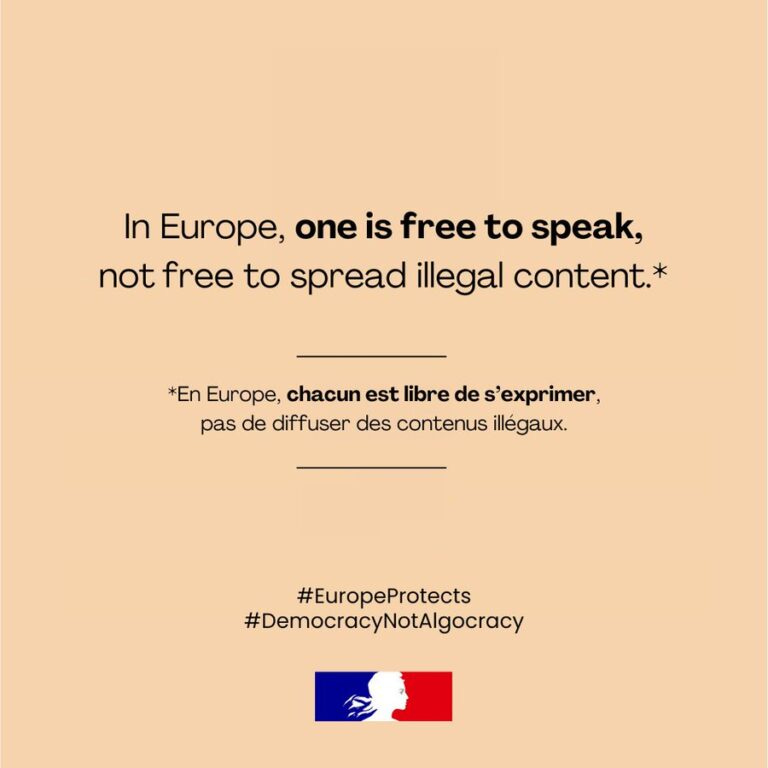
In 2015, Germany prosecutors opened a criminal investigation into Facebook’s managing director for Northern, Eastern, and Central Europe for failing to take down “hate speech” related to the 2015 mass migration into Europe. By the end of the year, Facebook, Twitter, and Google agreed to remove hate speech within 24 hours of it being reported to combat “racist sentiments” on the refugee influx. In 2017, Germany introduced the NetzDG act, which forced large platforms to hire thousands of moderators or potentially face huge fines for hosting illegal content even outside of Germany. This was later used as a template for similar laws in 25 other countries plus the EU, including Russia, Pakistan, France, Egypt, Brazil, Australia, Turkey, Belarus, Indonesia, and Britain. These moderators then form a constituency for more censorship within the company forced to hire them. Today, the German government is a major source of funding for the para-state and funds open source contributors to promote political causes within major open source projects such as GNOME and Python.
The British government was and is probably the most important formal state pushing the closure of the Internet. Not only did the British government kick off the censorship of YouTube by starting the 2017 ad boycott, but after Brexit the nominally right-wing UK government, driven by deranged conspiracy theories about Cambridge Analytica, spent several years hounding social media executives, particularly Mark Zuckerberg, into ramping up narrative control. Legally, this culminated in the 2023 Online Safety Act, which mandates services assess and mitigate the “risk” of “illegal content,” file regular reports with British social media regulator Ofcom, and remove it quickly once found, enforceable with fines of up to 10% of global revenue. The British government has never stopped ramping up its demands for censorship under this act, with social media regulator Ofcom threatening X (which had made a “voluntary” agreement to review and assess suspected “hate content”) over insufficient alacrity in removing “hate content” in May 2026.
Britain’s 2023 Online Safety Act was not original. It was actually Australia, while imposing perhaps the world’s most severe lockdowns, that passed the first Online Safety Act in 2021. Australia’s OSA gives the country’s eSafety commissioner, Australia’s independent online regulator (a position created in 2015 at the very beginning of the closure of the Internet) the ability to remove content at will. Australia was also the first Western country (after Russia and China) to force companies to break encryption on demand, in 2018, explicitly out of concern that “hate groups” were using encrypted chats. This has since been copied by none other than the United Kingdom and the EU, the latter after a bizarre procedural manipulation where the act passed despite being voted down by a majority no less than three times. Outside of China, Australia likely has the most well-developed Internet control infrastructure in the world and is the world’s leader in the formal, legal censorship of the Internet.
New Zealand is not an especially important market or legal innovator, but the New Zealand government coordinated a pledge to “counter online extremism” in 2019, which most tech companies and Western governments immediately signed. The US abstained, citing freedom of speech, until the Biden administration, which broadly supported the closure of the Internet at every level from the White House down to the lowest staffers, took office in 2021.
The United States, as a legacy of the Anti-Federalists codifying freedom of speech in the First Amendment and of courts interpreting it very broadly to protect communists and socialists in the 20th century, has not yet passed formal laws censoring the Internet the way most Western countries have. But the government’s powers are much broader than formal law. It is difficult to point to informal, back-channel pressure, but a few examples include the White House Director of Digital Strategy requesting Facebook remove “borderline” content that was “often true,” but could result in vaccine hesitancy in 2021 and the Surgeon General demanding platforms crack down on COVID “misinformation,” also in 2021.
The DHS, through its CISA sub-agency, was a leading node in the government side of the censorship network, with the director of the Election Security Initiative at CISA recommending the use of third-party nonprofits as a “clearing house for information to avoid the appearance of government propaganda.” Two of these nonprofits included Stanford’s Election Integrity Project (EIP), set up directly by CISA, and its successor, the Virality Project, which censored true and even institutional information, such as the Cleveland Institute’s article on natural immunity, that might lead to vaccine hesitancy.
The FBI was also a central node, not only playing the leading role in the previously-discussed Twitter Files but also pressuring Facebook into censoring the (true) New York Post story on Hunter Biden’s laptop in 2020. Formally, FBI-social media cooperation was supposed to be focused on foreign influence, but in practice focused mostly on “domestic reports.” There was an enormous spike in tech companies—specifically Facebook, Google, Twitter, and TikTok—hiring ex-intelligence, especially ex-FBI employees, in 2017/2018, and this surge continued through 2022. This is not inherently suspicious, as former intelligence agents have expertise in cybersecurity and other relevant fields, except that they flocked to content control and moderation roles, such as Trust and Safety.
These examples are not even close to comprehensive, but should suffice to demonstrate that the closure of the Internet was not merely private actors autonomously and independently choosing mass censorship. It was full of state involvement and direction. Even when platforms appeared to be censoring of their own accord, this was at least partly downstream of state harassment of executives, particularly for Facebook, driven by internal constituencies of censors hired to comply with regulations, or “voluntary” commitments extorted with the threat of fines.
But this riposte misses the point in two ways. First and most importantly, this is a legalistic argument. It’s true that the First Amendment applies only to the US government, but so what? Freedom of speech is valuable for reasons both moral—people should be able to speak their minds—and practical—the reigning orthodoxy is always wrong about something, and dissidents must be able to argue against it to address this. Those making this argument are saying that censorship is the default and must be accepted everywhere it is not explicitly Constitutionally forbidden.
Second, the argument that censorship is only invalid if it’s coming from the government and is otherwise itself part of freedom of speech and the right to property is fundamentally a classically-liberal position. This argument is almost always made in bad faith, since the people making it are almost never themselves classically-liberal or libertarian, but an argument made in bad faith can still be correct. But classical liberalism is the wrong framework to use, except as an ideal, when discussing the 21st century West, which is not at all classically liberal and very different from the type of societies classical liberalism was developed to protect freedom in.
In the 19th century liberal worldview, the major threat to human freedom was the formal state and state-granted monopolies. If, for example, the owner of an auto company demanded their employees eat American food rather than foreign ethnic cuisine, that was their prerogative; would-be employees could always work for someone else instead. If the owner of a press refused to print socialist or fascist or atheist or Quaker literature on their own initiative, authors could go to a different press, or set up their own.
Crucially, this is premised on robust competition and differentiation within the private sphere. If a university wants to impose a particular point of view as a condition of attendance or employment, they can. But there are universities that don’t impose this that would-be students or scholars can enter instead, and mutatis mutandis for any particular for-profit enterprise and its employees and customers. In this way, non-state controls on human freedom can never seriously threaten it generally, as there are always alternate options and private actors check each other. The only way these controls can really bite is if there exists true, organic, society-wide consensus on something.
This was a reasonable description of Atlantic society in the 18th and early 19th centuries. But it is not a good description of 21st century America, which is full of non-formal-state chokepoints. Some examples of these chokepoints are governing bodies of academic fields, such as the American Psychological Association, accreditation boards for new schools, such as the American Bar Association, and the “Big Three” oligopoly of Blackrock, Vanguard, and State Street, which collectively exercise enormous power (more than 25% of the S&P 500) over capital allocation nominally on behalf of millions of small owners, who are organizationally incapable of exercising authority over them. When these chokepoints are captured and weaponized, there is no alternative individuals can turn to, and so private restriction of freedom is very much possible in a way it wasn’t in 1800. For the closure of the Internet, the most important chokepoints by far were the natural monopolies created by tech network effects.
(That major tech platforms are closer to private governments than companies owing to the lack of serious alternatives is not original to me. Many academics made this exact point in the late 2010s, but usually to justify the government putting pressure on these platforms to close the Internet. An example of this genre is Lawless: the secret rules that govern our digital lives, which argued for forcing tech platforms to hire human rights lawyers.)
The classically liberal argument for the permissibility of private censorship is also premised on owner-operators being the norm, which, as with robust competition in the private sphere (excepting state-backed organizations), accurately described the 18th and 19th century Atlantic worlds but not the 21st century. In the classical liberal view, if Henry Ford doesn’t want to employ spaghetti eaters or the owner of a small cake shop doesn’t want to serve Mormons or gays it is his right, as his company belongs to him and is his to dispose of. But in most large organizations today, management has power. The argument I’m responding to is often phrased as “if [Google/Twitter/Reddit/etc] doesn’t want to host [speech or person], you have no right to force them.” But Google/Twitter/Reddit/etc are not people, and the decisions of the organizations are made by managers, not the owners to whom they belong, and from whose property rights this argument derives its validity, in the classical liberal framework. Managers using the resources of a corporation or public trust such as a university to pursue ideological ends, in this case the mass censorship of the Internet, are exercising power that is not legitimately (per the classical liberal tradition) theirs. This is exacerbated by the fact that managers tend towards group-think and prioritizing social hierarchies over reality.
What’s more, the strong public/private distinction on which classical liberalism is founded does not exist and has not existed for many generations. In the United States, the most classically-liberal state and society on Earth, we are nearly a century removed from the New Deal. State spending is around 40% of GDP in the US, higher elsewhere in the West, and private economic activity and organizations intensively regulated and heavily taxed (which means tax-exempt organizations can be fairly termed privileged).
Especially notable is Civil Rights rulemaking and jurisprudence, which effectively criminalizes right-wing speech in domains adjacent to protected classes in all large institutions via the hostile environment doctrine; this means, whatever the composition of their customers and employees, large institutions are predictably somewhere between silent and very left-wing on these issues. This is very similar to how the People’s Republic of China controls speech; the state does very little censoring itself but instead imposes liability on private platforms.
Western private institutions whose composition is closely controlled by the state via tight regulation on hiring and promotion, and which often depend on the state as customer or for funding, should not be thought of as wholly separate from the state, any more than one should see Huawei as independent of the Chinese government.
There is little practical difference between a handful of naturally-monopolistic tech platforms coordinating with tax-privileged and state-funded NGOs to shut down dissent and a formal government list of “disinformation” to be censored. In practice, the closure of the Internet involved—and continues to involve—both, but even if every step had scrupulously obeyed the letter of the First Amendment it would not matter.
2022 was the local maximum of the closure of the Internet, when the information control system was at its peak. This begs the question: why did it stop getting worse after seven years of uninterrupted intensification? There are several reasons. First, the end of the lockdowns in February/March 2022 removed most of the moral urgency that had surrounded COVID. The lockdowns themselves also discredited the censorship complex as what was officially “disinformation” versus plausible and discussible or true shifted monthly. This is a general problem with censorship. With older ideas and problems, orthodoxy exists and is often correct, having been tested and discussed in the past, and so there’s a decent chance censors will at least be factually correct. But no such orthodoxy exists when faced with a truly new problem or idea. It must be discussed and debated to even hope to approximate correctness, and by preventing debate the censors guarantee that they will be wrong. And unlike non-institutional online discourse 2015-2019, which was always the province of an unusual minority, the lockdowns deeply affected the lives of almost everyone on a daily basis, and so the failure of the censorship complex could not be simply swept under the rug.
Second, Donald Trump was out of office and seemed more likely destined for prison than the White House. Third, Elon Musk purchased Twitter and fired most of its staff. By showing it was possible to defy the censorship network, he triggered a preference cascade among tech elites. Parts of their companies may have been ideologically committed to the censorship project, but founders themselves still personally tended towards the libertarian ethos of the pre-2015 Internet. Fourth, the Republican Party began mobilizing against the closure of the Internet for the first time in 2021, in direct response to the sharp escalation of censorship and targeting of mainstream Republican figures, institutions, and ideas, rather than just heterodox and dissident ones, in 2020. This can be seen with the rise of censorship and free speech as themes in fundraising emails.
Elon’s purchase had another salutary effect. The release of the Twitter Files proved beyond a shadow of a doubt that the FBI was directly involved in censoring mainstream Republicans on Twitter and other social media platforms. The fact of direct FBI involvement made it much easier for conservatives, suspicious of the state and lacking the vocabulary and legal arguments to deal with para-state tyranny, to oppose. This was bolstered by episodes such as the abortive “Disinformation Governance Board”, which would have created a formal body within the DHS to coordinate pre-existing censorship and narrative control efforts within the department. In substance, this was no different from what was already being done by the fact-checking NGO cartel, but it being part of the formal state made it legible to the mostly-classically-liberal Republican Party, which thinks in terms of the First Amendment and state overreach.
The Republican Party in the United States is the “outer party” in the sense of lacking organized representation in permanent publicly-funded or empowered institutions and regulatorily-mandated positions, but it still wields considerable power through elected officials, and the threat of state- and federal- level political intervention triggered walkbacks of the most extreme censorship on the part of the tech giants.
With all that said, none of the infrastructure built 2015-2022 was dismantled outside of Twitter/X. The pre-2015 status quo of the Internet, where free speech and level playing fields were to be expected, was not restored. We still live in the world of shadowbans and algorithmic suppression and purges for “hate speech,” and at any point the machine can be revved back into full gear. It took decades to create the pre-2015 ecosystem, and even if all censorship had stopped, which it did not, it would probably take decades to recreate. Most born in the 21st century have never really known a free Internet, and expect gatekeeping, sanitization, and silencing as a matter of course. The right way to think about the post-2022 thaw is as a partial restoration of the conditions of 2019, before the information apparatus went into overdrive during the lockdowns, not 2014.
Since the end of the lockdowns, the most important trend in the world has been the extraordinarily rapid rise of large language models (LLMs), beginning with the release of ChatGPT in November 2022. LLMs have already produced multiple trillion dollar companies and are revolutionizing mathematics, cybersecurity, and programming. LLMs, unfortunately, are an epistemically-centralizing technology. A single flagship model may answer a trillion queries over its lifetime, many orders of magnitude more than any person could, and what’s more, almost all LLMs share a very similar default (meaning without explicit prompting to leave this basin) worldview. They take similar stances on political issues or values, and they defer to the same sources and organizations and conceptual frames. Even when LLMs hedge and provide sound reasoning and evidence for their views, their responses are silently shaped by this worldview and their values.
(Incidentally, almost all of the high-quality discussion and information dissemination about LLMs has been online, on social media and various blogs. Imagine if Timnit Gebru and the BlueSky hivemind could censor all LLMs discussions they didn’t like. Something like this would be the case if not for the 2022 thaw.)
The default worldview of most LLMs is that of 2018 Reddit or Wikipedia, or Google Search post-Project Owl. This is not intrinsic to the LLM architecture. LLMs trained on different datasets (Talkie) or deliberately post-trained to take a different view (Grok) have different default worldviews. It is a function of the text these models are trained on and, because of the exponential rise in publicly-available data over time, most of the organic human text (as opposed to synthetic data) these models are trained on is very recent. This means the default worldview of most LLMs is one created by the closure of the Internet, when intelligent or popular heterodoxy meant banning, suppression, or demonetization.
LLMs defaulting to specific worldviews is not equivalent to the massive censorship and narrative control campaign that closed the Internet; no human is inherently prevented from expressing alternative views or accessing alternative information. But I do expect it to have a similar effect on society. People will use LLMs for research and defer to their conclusions and analyses. Most of the time, they will be right to do so, and this habit will become ingrained. Through these mechanisms, the default LLM worldview is being baked into, and will continue being baked into, the human noosphere. Where this worldview is morally wrong or factually false or simply wildly misleading, it will become ever-harder to learn and articulate why.
LLMs also enable deanonymization at scale. Not only do LLMs have truesight, and thus the ability to identify authors from even quite small fragments of text if they have a corpus under their own name (and even if they don’t, they are scarily good at inferring author characteristics from the text they produce), but they can also automate the grunt work of collating vast reams of public data about an online personality, across many platforms and years or decades, to identify them. LLMs encourage deanonymization from the other direction too; without proof-of-humanity it has already become increasingly difficult to find actual human beings in the tidal wave of slop produced by LLM-based agents, which can easily evade the crude filters used to detect and prevent bot activity in the past, and this is only getting worse.
LLM-based systems are already superhuman hackers, which in turn forces further dependence on a small number of large institutions with privileged early access to the most advanced LLMs for cyberdefense (Project Glasswing or OpenAI’s equivalent), adding another chokepoint to the Internet ecosystem. During the closure of the Internet, deplatformed websites were often targeted by major corporations removing protections from hacking, and some, such as Gab, were able to survive by building their own defenses. This will soon be impossible for those without privileged LLM access.
Lastly, LLMs enable far more sophisticated automated narrative and information suppression than the approaches used 2015-2022. It was often possible to get around automated censorship and suppression through indirection, irony, and memes, albeit at the cost of precision, rigor, clarity, and openness to outsiders, but LLMs are capable of understanding human context and nuance. I expect all of the major platforms are already doing this, and if not they will be in the next major censorship push.
In order to avoid LLMs locking in the epistemic closure of the late 2010s even further, they, or at least the most powerful and commonly-used LLMs, will need to make John Stuart Mill look like Mao.
I have dated the closure of the Internet from the years 2015 to 2022, because those are the years we went from default-open Internet to default-closed Internet, when the narrative control reached peak intensity, and because of the partial pullback in 2022. But it never actually stopped and was certainly never reversed. The push from the para-state and from within tech platforms themselves has weakened, but formal state efforts continue to intensify.
The current major front of the closure of the Internet is the age and identity verification pushes taking place (California, Germany, Australia, United Kingdom, European Union, France, United States), often combined with minimum ages for social media, usually under the guise of protecting children. By its nature, age verification precludes anonymity, without which expressing marginalized views is quite dangerous. Restricting teenagers from the Internet also makes them much more dependent on (heavily gatekept) institutional media and school to access information.
Other recent moves include the UK planning to force social media platforms, especially YouTube, to algorithmically favor British state media and approved “trusted news sources.” This is not very different from what Google has already done on both YouTube and Search since 2017, but it’s an escalation in the amount of formal state involvement. The Canadian Liberals are floating a plan to allow the government to prosecute both platforms and users of social media sites for posting false or misleading information (as determined by them). The French government is raiding X offices over the company’s insufficiently censor-friendly moderation practices. And while the censorship para-state has shrunk in the US since 2022, it has only grown in Britain and Europe; the Demos “Epistemic Security Network” was founded in the UK in 2025 and the EU has invested hundreds of millions of euros into these organizations since 2024.
The United States is my country and America is my nation, but the Internet is my culture, and watching this happen and living through it was and is agonizing. There have been countless laments of the decline of intellectual discourse on the Internet. Some attribute it to the natural monopolies and economies of scale of Web 2.0, some to the expansion of the Internet beyond overwhelmingly Western intelligent and often technical users, to normal people and non-Westerners, and some to the inferiority of younger generations. Almost none of them point to the successful society-wide campaign to censor and police the Internet covering all major platforms and the means to find things outside of them. Few seem to even realize this happened. That the closure of the Internet happened and its approximate scope should be common knowledge, and there needs to be a convenient name and narrative for it so that it sticks in people’s heads. Censorship, suppression, and heavy-handed political manipulation and moderation are the norm today, and many seem to have forgotten that it was ever otherwise.
The best pieces of online writing on this are probably Jacob Siegel’s “A Guide to Understanding the Hoax of the Century,” Patrick McKenzie’s “Notes on a Nonprofit Indicted for Bank Fraud,” Jack Goldsmith and Andrew Keane Woods’ “Internet Speech Will Never Go Back to Normal,” as well as Matt Taibbi’s series on the Twitter Files. I would recommend reading all of these.
But to the best of my knowledge, no one has named this phenomenon or pointed out, explicitly and in so many words, that it was ideologically motivated, that it happened across every major platform at the same time rather than a series of individual incidents, nor has anyone even sketched out the effects, so it fell to me to write this. I regret being unable to do it justice. A proper treatment would require at least a book, with more careful documentation and better writing and editing than I am able to do myself, as well as interviews with as many key decisionmakers within the censorship apparatus and significant purged individuals as possible, and ideally several. A professional historian could spend their entire career chronicling it. McCarthyism is taught in schools, and the closure of the Internet is orders of magnitude larger than McCarthyism ever was.