President Trump on Thursday claimed that the war with Iran is “over,” after announcing he had canceled further U.S. military strikes on the Islamic Republic.
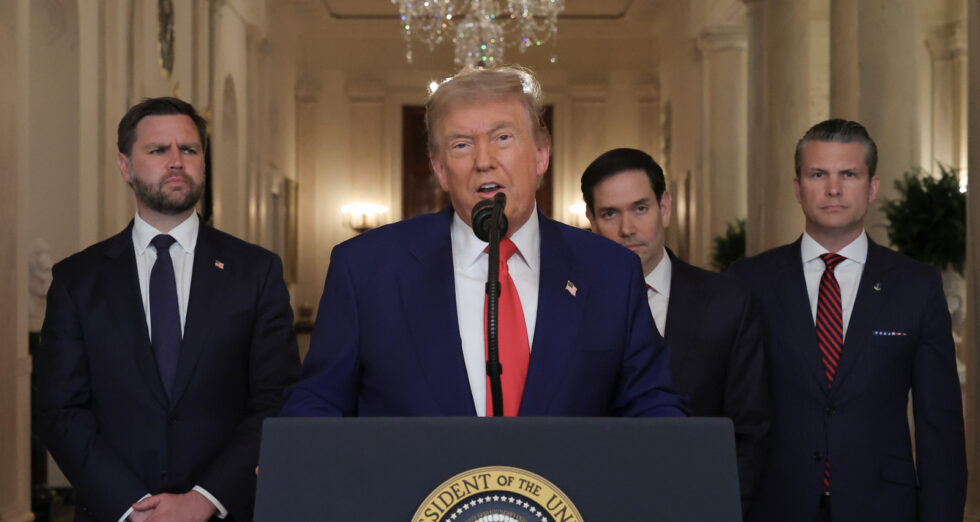
“I don’t know if you heard, but we ended the war with Iran today,” Trump said during a tele-rally in support of GOP Georgia Lt. Governor Burt Jones, who is running for governor.
Advertisement
“They have agreed never to have a nuclear weapon, something that we insisted on; that was the whole purpose. That was 95 percent of it,” he added.
Trump also said that the U.S. Navy blockade of the Strait of Hormuz would continue until a formal agreement was signed. He indicated interested parties would meet in Switzerland to finalize the deal.
Reports said the agreement could be signed as soon as Sunday, ahead of the G7 summit that will be held in the European country.
Israel had not publicly commented as of Friday on the latest draft memorandum of understanding that was reported by Iranian state media.
Advertisement
Trump said Thursday that he had discussed the potential agreement with Israeli Prime Minister Benjamin Netanyahu as well as other leaders in the region.
According to Trump, the conversations focused on the developing negotiations and the framework of a possible understanding with Iran.
Trump’s full statement on Truth Social said:
Based on the fact that discussions with the Islamic Republic of Iran have been brought to the highest level of Iranian leadership and approved, I have, as President of the United States of America, cancelled the scheduled strikes and bombings against Iran this evening.
Discussions and final points have been, in both concept and great detail, approved by all parties involved, including the United States, Israel, Saudi Arabia, UAE, Qatar, Turkey, Pakistan, Bahrain, Kuwait, Jordan, Egypt, and others. The Naval Blockade will remain in full force and effect until this Transaction is finalized — Time and place of the signing to be announced shortly.
Netanyahu’s office later confirmed the call, saying in a statement that while Israel is not a direct participant in the negotiations, the prime minister welcomed Trump’s commitment to ensuring that any final agreement would include significant restrictions on Iran’s nuclear program and address other destabilizing activities by the regime.
Roughly 25% of the world’s seaborne oil shipments and about 20% of global liquefied natural gas exports move through the Strait, making the narrow waterway one of the most strategically important energy chokepoints on the planet and a focal point throughout the conflict.
Financial markets responded positively Friday amid growing optimism that a diplomatic breakthrough could be within reach.
European stocks rallied sharply, with the pan-European Stoxx 600 climbing 1.8% and most major indexes posting gains of around 2% in morning trading.
Energy markets also reacted to the prospect of easing tensions. U.S. crude oil futures for July delivery fell 1.61%, while August Brent crude futures, the international benchmark, dropped 1.75% as traders priced in a reduced risk of supply disruptions, CNBC reported.
Trump personally warned Fox News correspondent Trey Yingst about impending U.S. military action against Iran just hours before American forces launched a new round of strikes targeting the country’s military infrastructure earlier in the week.
According to Yingst, Trump spoke with him by telephone from the Situation Room shortly before the attacks and described the operation that was about to unfold.
The president later confirmed through social media posts that he believed Iran would face severe consequences after negotiations failed to produce an agreement.
“Iran’s Military is a complete and total mess,” Trump wrote on Truth Social.
He added that much of the country’s naval and air capabilities “doesn’t even exist anymore” and warned that Iranian leaders would “pay the price” after taking too long to negotiate.
U.S. Central Command announced that additional self-defense strikes began at 5:15 p.m. Eastern Time Thursday against multiple targets in Iran at the direction of the commander-in-chief.
This article may contain commentary which reflects the author’s opinion.