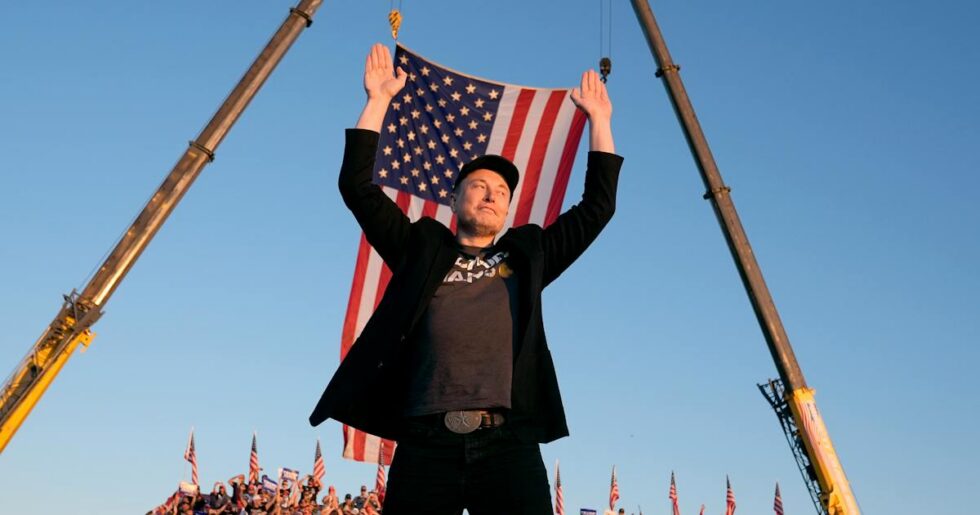
Liberal policy initiatives also deserve a share of the blame. As the first half of Musk reminds us, Musk built his empire largely during Barack Obama’s presidency, taking advantage of federal incentives to replicate NASA functions for private profit. Garver, the Obama appointee at NASA who worked closely with SpaceX, still seems to admire Musk’s work in that era even as she’s aware of his subsequent depravities, and as we see in news footage from the time, Obama himself was similarly impressed. So were California’s governors Arnold Schwarzenegger and later Gavin Newsom, who allowed Tesla to game the state’s climate incentives for additional free money. As Gibney shows, Tesla gained tens of millions of dollars’ worth of zero-emission vehicle credits by claiming to operate facilities in California that could swap out an electric vehicle’s battery in under three minutes; only one such station was ever opened, in a remote part of the state, and the general public was never granted access to see how this alleged battery swap miracle worked.
The friendliness of officials toward Musk is juxtaposed with an epic trail of destruction. Gibney talks to a lawyer in Florida who has taken Tesla to court over its misleadingly marketed self-driving cars, which have been involved in at least 60 deaths of both drivers and innocent pedestrians. He later shows Musk gutting the federal bureaucracy through his Department of Government Efficiency, or DOGE, starting in early 2025—dramatized in part by an original first-person shooter scenario in which our point of view is a DOGE agent rampaging through a government office. And he reminds us of the millions of people in the global south who have been cut off from life-saving assistance since DOGE dismantled the United States Agency for International Development. Samantha Power, the last head of USAID, chokes up on camera as she contemplates the gratuitous suffering Musk has inflicted on the world’s poorest people.
Sam Harris, the celebrity neuroscientist and New Atheist, suggests in an interview with Gibney that the pandemic and social media are responsible for his former friend Musk’s descent into egomania and his embrace of the far right. Early in 2020, Musk tweeted that Covid-19 was producing an irrational panic, and when Harris objected, Musk bet Harris $1 million against a bottle of tequila that fewer than 35,000 Americans would die. After that grim benchmark was swiftly cleared, Musk abruptly ended his friendship with Harris, and his behavior has only gotten more erratic and his politics more reactionary from there. Anyone who was on Twitter back then could see its algorithms and an echo chamber of millions of fans warping Musk’s brain in real time, and when he purchased the platform two years later, he recalibrated it, immersing those who still use it (including Gibney, and me) in racist memes, conspiracy theories, and worse. We’ve all seen social media and pandemic isolation distort once-rational minds, but Musk’s issues go back much further; though the film doesn’t cover his childhood in South Africa until after its intermission, it’s clear that his father Errol, whom Musk has called “a terrible human being,” left deep marks. At one point in the documentary, Errol describes in gruesome detail how he once apparently shot and killed three intruders in the Musk family home, covering it in blood.