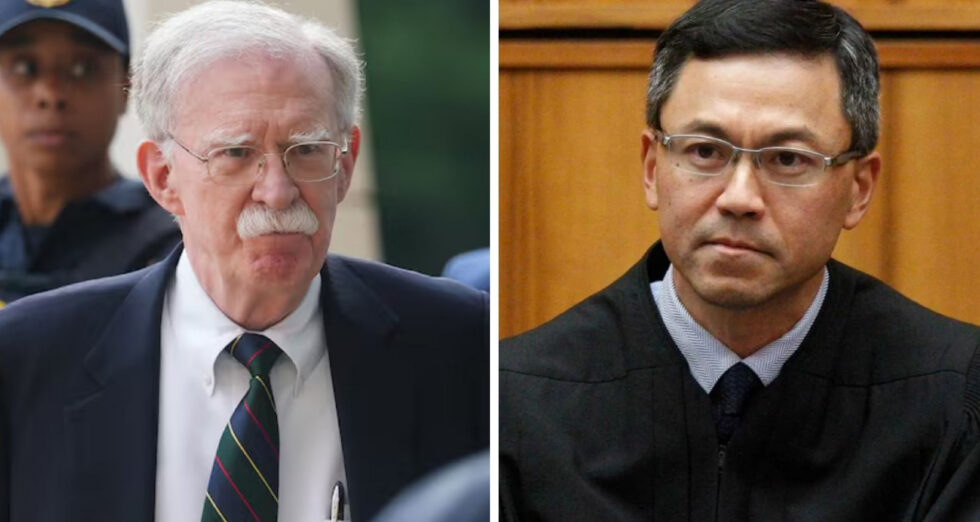
Former National Security Adviser John had a courtroom showdown on Friday after he was indicted for retaining classified information.
In a dramatic courtroom development, Bolton pleaded guilty to one felony count of unlawfully retaining national defense information.
Advertisement
The veteran foreign policy hawk, who served in President Donald Trump’s first term before becoming one of his sharpest critics, entered the plea in federal court in Greenbelt, Maryland.
This came after a months-long case that began with an FBI raid and an 18-count indictment.
The saga traces back to Bolton’s tenure as national security adviser from April 2018 to September 2019.
Prosecutors alleged he kept sensitive “diary-like” notes containing highly classified information — some marked Top Secret — at his Bethesda, Maryland home and transmitted them improperly, including to family members via personal email and messaging apps.
FBI agents executed search warrants on Bolton’s Maryland residence and Washington, D.C. office in August 2025, recovering classified documents related to intelligence sources, methods, foreign adversaries’ plans, and U.S. covert actions.
Advertisement
On October 16, 2025, a federal grand jury in Maryland indicted Bolton on 18 counts: eight for transmission of national defense information and 10 for unlawful retention.
Each carried a potential 10-year prison term. Bolton surrendered the next day and pleaded not guilty.
The case involved prepublication review disputes tied to Bolton’s 2020 memoir “The Room Where It Happened,” which was harshly critical of Trump.
Prosecutors focused on notes Bolton retained for personal use rather than solely on the book’s published content.
Bolton initially pushed back, with a statement after indictment describing the charges as part of an “intensive effort” by Trump to intimidate opponents.
Bolton agreed to plead guilty to a single count of retention, pay a $2.25 million fine, and face a sentencing range of zero to five years in prison.
The deal recommends no prison time in some accounts, but the judge holds final authority.
On Friday, June 26, Bolton formally entered a guilty plea before U.S. District Judge Theodore D. Chuang.
Sentencing is expected within 90 days.
Bolton now faces up to five years behind bars, three years of supervised release, a multimillion-dollar fine, and forfeiture of his federal pension.
Advertisement
NEW: Former Trump national security adviser John Bolton pleaded guilty Friday in federal court to one count of retaining national security information related to his time in the White House.
As part of the plea agreement, Bolton faces up to five years in prison, agreed to pay… pic.twitter.com/QQofcNXUEH
— Clash Report (@clashreport) June 26, 2026
Some see the hefty financial penalty as recouping potential book-related gains from material derived from classified notes.
U.S. Attorney Kelly O. Hayes announced the resolution, stating, “John Robert Bolton II plead guilty in federal court to the unlawful retention of national defense information… Mr. Bolton faces a maximum sentence of up to five years in prison followed by a term of up to three years of supervised release. He will also pay a fine of $2.25 million and will forfeit his pension.”
“Keeping Americans safe always has been, and always will be, the top priority for the U.S. Attorney’s Office for the District of Maryland. If anyone endangers our national security, we’re committed to holding them accountable,” Hayes said.
Acting Deputy Assistant Attorney General Hayden O’Byrne added, “If you leak America’s secrets or if you mishandle them, the United States Department of Justice National Security Division and our U.S. Attorney partners will be there to prosecute you.”
Critics of Bolton have long accused him of hypocrisy, given his vocal criticism of others’ handling of secrets while allegedly compromising them himself.
As sentencing approaches, Bolton’s legal team is expected to argue for probation, citing his age, service record, and the single-count resolution.
Prosecutors will likely highlight the seriousness of retaining sensitive defense information.
This article may contain commentary which reflects the author’s opinion.