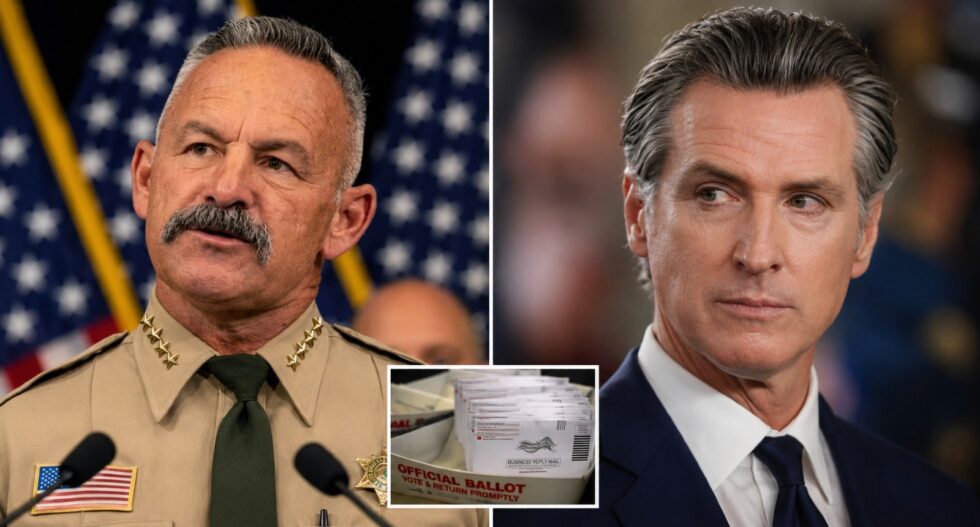
A high-stakes election integrity fight in California has reached the state’s highest court, with Riverside County Sheriff Chad Bianco refusing to surrender roughly 650,000 ballots seized during an investigation into the 2025 special election — despite Democratic Attorney General Rob Bonta demanding their return.
The California Supreme Court heard arguments Monday over whether Bianco acted within his legal authority when his department took possession of ballots cast in Riverside County during the November 2025 election involving Proposition 50, the state’s controversial congressional redistricting measure.
Bianco has remained unapologetic, insisting his department received a complaint that required investigation and that the seizure was lawful.
Advertisement
“I did this, and this was legal,” Bianco told reporters.
“I went a different route. They are legal. Both routes are legal. It’s just their side doesn’t like the route I chose,” Bianco added.
The sheriff’s legal team told reporters Monday that the ballots remain securely in Bianco’s custody while the legal dispute plays out.
Advertisement
“The sheriff is holding that evidence, safeguarding it as a custodian for the court,” attorney Bradley Hertz said.
At the center of the dispute is Proposition 50, which California voters approved during the November 2025 special election.
Advertisement
The measure involved congressional redistricting and officially passed statewide by more than 3.4 million votes, according to California election results.
Bianco, however, has publicly raised questions about whether ballot records examined by investigators matched the results produced by voting machines.
“How strange, that now we have evidence that the machines counted something different than the ballots that we have, and an Attorney General runs in to stop that investigation so that we’ll never know,” Bianco said outside the courthouse.
The sheriff’s statement represents his allegation about the evidence and does not, by itself, establish that the certified statewide election result was incorrect.
The California Supreme Court dispute currently centers on Bianco’s authority to seize and retain the ballots.
Bonta launched his legal challenge against Bianco in March, demanding that the sheriff return the election materials.
The UCLA Voting Rights Project separately challenged Bianco’s actions.
The Democratic attorney general maintains that California law gives his office supervisory authority over local sheriffs and argues that Bianco ignored that authority by refusing to comply with the demand.
“This is a sheriff that – despite the clear language in the California constitution, and in California government code, providing me direct supervision, authority over him – failed to comply with it,” Bonta told reporters Monday.
“He can read, he knows what it says, it makes his violations even more egregious,” Bonta added.
Advertisement
Bianco strongly disputes Bonta’s interpretation of the law, arguing that the attorney general’s supervisory authority does not give him the power to shut down a legitimate investigation.
“If you take it word for word, in that context, it means that he has direct authority that if I’m not doing my job he can order me to do it and if I don’t do it he can do it for me. But he cannot stop an investigation,” Bianco charged.
That disagreement has now placed two powerful California law enforcement officials on opposite sides of a consequential legal battle: Bonta says Bianco exceeded his authority, while the sheriff argues he would be abandoning his law enforcement responsibilities if he surrendered potential evidence before his investigation was complete.
The fight is unfolding amid a much broader national debate over election administration and ballot security ahead of the 2026 midterms.
Just Monday, the U.S. Supreme Court handed the Trump administration a significant victory by allowing revised restrictions involving mail-in voting to take effect while litigation continues.
Advertisement
The administration has argued that stronger safeguards are necessary to reduce vulnerabilities in mail voting, while Democratic-led states challenging the measures contend they improperly interfere with state election administration.
The Justice Department has also intensified scrutiny of election records elsewhere.
Earlier this year, federal officials demanded approximately 865,000 ballots and related records from Michigan’s Wayne County, which includes Detroit, as part of an investigation into compliance with federal election law.
Democratic officials there pushed back against the request.
Advertisement
California is now facing its own showdown over who ultimately controls election materials once law enforcement claims those records have become evidence.
For Bianco, the issue is straightforward: His department received a complaint, opened an investigation and obtained evidence that he says must remain protected while investigators determine what happened.
For Bonta, the controversy raises a different question — whether an elected county sheriff can independently seize and retain hundreds of thousands of ballots despite objections from state authorities responsible for overseeing California elections.
The California Supreme Court did not immediately rule following Monday’s arguments, leaving the roughly 650,000 ballots in Bianco’s possession while the justices deliberate.
This article may contain commentary which reflects the author’s opinion.