President Donald Trump scored a significant Supreme Court victory Monday as states across the country prepare for the November midterm elections.
The decision removes a major legal obstacle that had prevented the administration from moving forward with portions of Trump’s election-related executive order in nearly half the country.
Advertisement
The Supreme Court paused a federal judge’s injunction blocking the Trump administration from implementing provisions of Trump’s March executive order affecting mail-in voting in 23 states and the District of Columbia.
The 10-page unsigned opinion allows the administration to begin moving forward while litigation over the legality of Trump’s directives continues.
The dispute involves three provisions designed to strengthen citizenship verification and procedures surrounding mail-in ballots.
Advertisement
The first directs the Department of Homeland Security to create lists of adult U.S. citizens in each state and provide them to states at least 60 days before a federal election.
Another directs the attorney general to prioritize investigations and potential prosecutions of state and local officials who issue federal ballots to individuals ineligible to vote.
Advertisement
The third directs the U.S. Postal Service to develop rules involving lists of voters receiving mail ballots and restrictions on mailing ballots to individuals not included on enrolled-voter lists.
California and 22 other states, along with the District of Columbia, challenged the executive order, arguing that Trump was interfering with authority the Constitution gives states over elections.
U.S. District Judge Indira Talwani previously prohibited the federal government from implementing the challenged restrictions in those states before the November elections.
The U.S. Court of Appeals for the 1st Circuit declined to pause Talwani’s ruling, prompting the Trump administration to seek emergency intervention from the Supreme Court.
Solicitor General D. John Sauer argued that the states had sued prematurely because federal agencies had not yet determined exactly how Trump’s directives would be implemented.
The Supreme Court’s majority agreed.
Regarding the citizenship lists, the majority characterized Trump’s order as an internal directive from the president to an executive branch official that does not itself require states to do anything.
The justices reached a similar conclusion regarding Trump’s directive to the attorney general, saying prioritizing investigations and prosecutions involving existing federal election laws falls within presidential authority.
The majority also concluded that the states’ challenge to the Postal Service provision came too early because no final rule existed when they filed their lawsuit.
Advertisement
“If the Postal Service’s final rule harms the States,” the majority wrote, “they may challenge that rule.”
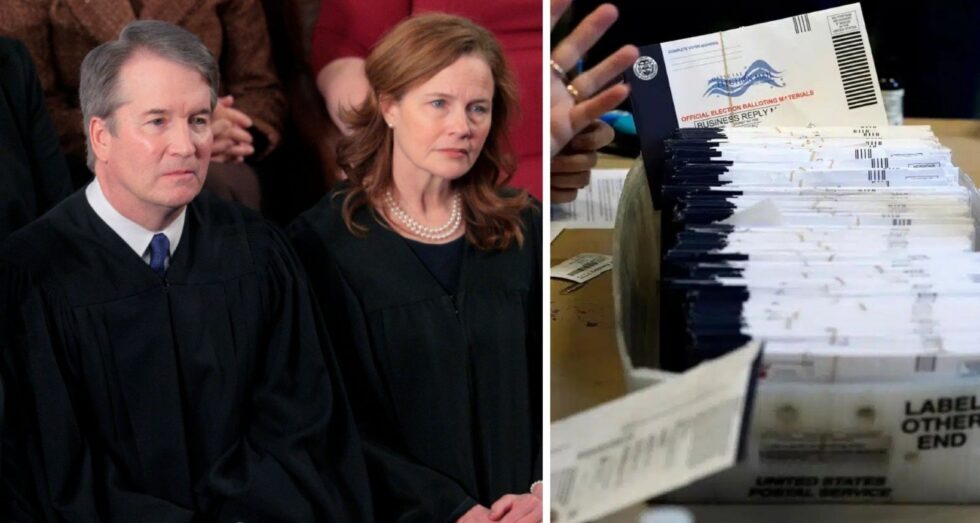
The administration recently told the Supreme Court that the Postal Service is preparing requirements for federal ballot mail, including the official Election Mail logo, automation-compatible envelopes and unique barcodes.
The majority also determined that keeping Talwani’s injunction in place could irreparably harm the government because even an eventual court victory might arrive too late for the 2026 midterms.
The court’s three Democratic-appointed justices dissented.
Justice Sonia Sotomayor, joined by Justice Elena Kagan, emphasized that Monday’s decision does not determine whether Trump’s executive order is ultimately legal.
Advertisement
“Today’s decision merely postpones adjudication of those challenges,” Sotomayor wrote.
Justice Ketanji Brown Jackson issued a separate dissent accusing the majority of “[t]aking its eye off the ball” and arguing that states now face an extraordinary dilemma over when they can challenge election rules.
Monday’s ruling does not resolve every legal battle surrounding Trump’s order.
A separate ruling in another case still temporarily prevents the Postal Service from implementing one provision nationwide, meaning another significant legal obstacle remains.
Advertisement
But the Supreme Court’s intervention nevertheless represents an important victory for Trump by removing the injunction covering 23 states and Washington, D.C., while allowing his administration to move forward with other portions of the order, SCOTUS Blog reported.
BREAKING: The Supreme Court has cleared the way for President Trump’s executive order restricting mail-in voting ahead of midterms. https://t.co/FDJnPdmoBw
— The Associated Press (@AP) August 24, 2026
With mail-in and absentee voting approaching in several states, additional court battles over Trump’s election directives could come quickly.
This article may contain commentary which reflects the author’s opinion.