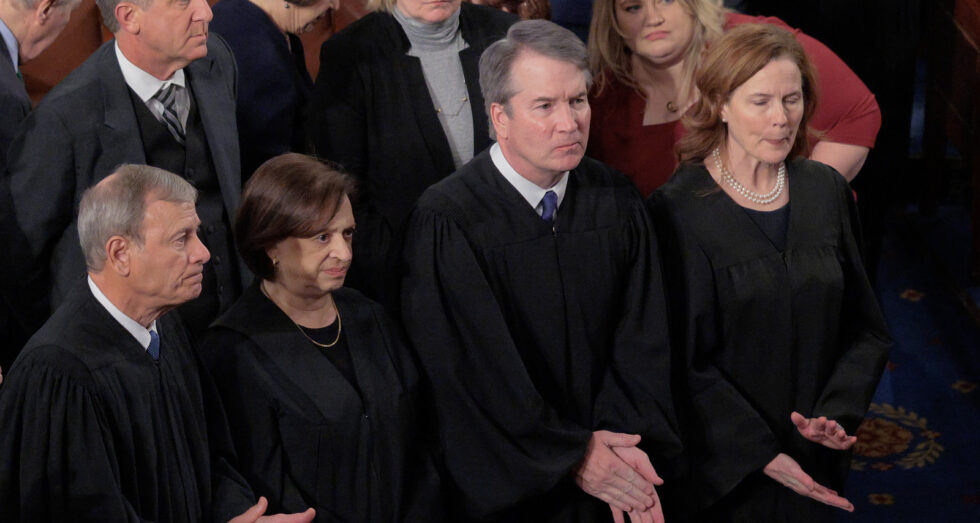
U.S. Supreme Court Chief Justice John Roberts is facing a new impeachment resolution introduced by Rep. Steve Cohen, a Democrat from Tennessee.
Cohen unveiled the long-shot effort on Thursday after previously announcing he would not seek reelection, amid a rapidly shifting political landscape following a major Supreme Court of the United States ruling in late April that significantly narrowed the scope of Section 2 of the Voting Rights Act of 1965.
Advertisement
As of now, the impeachment resolution has attracted no co-sponsors.
With Republicans narrowly controlling the House, the measure is not expected to move forward, though it reflects growing frustration among many Democrats with the court’s 6-3 conservative majority.
Cohen said in a statement announcing the resolution that Roberts has led the court to be “understood as biased: with decisions designed to benefit Republicans at the expense of representative government, seemingly contradictory and unexplained orders, and a pattern of ethical breaches that raises questions about the role of the wealthy.”
Advertisement
“I have come to the unfortunate conclusion that while John Roberts remains Chief Justice, correcting this misconduct and ensuring the Justices and the Court itself comply with their legal obligations will be impossible,” Cohen, whose seat is going to be redrawn out of existence by the Tennessee Legislature, said.
In recent years, the Supreme Court has pivoted significantly to constitutional originalism following the appointments of three justices during President Donald Trump’s first term.
The court’s constitutionalist majority has since overturned or narrowed major precedents involving abortion rights, affirmative action, voting laws, and federal regulatory authority.
The rulings applauded by many Republicans as righting decades of wrongs.
However, they have been sharply criticized by Democrats, who argue the court has become increasingly ideological and partisan, which is false.
Roberts addressed those criticisms directly during remarks at a gathering of lawyers and judges in Pennsylvania earlier this month.
He defended the high court and the judiciary and pushed back against claims that the Supreme Court operates as a political institution.
“I think at a very basic level, people think we’re making policy decisions, [that] we’re saying we think this is what things should be as opposed to this is what the law provides,” Roberts said.
“I think they view us as truly political actors, which I don’t think is an accurate understanding of what we do. I would say that’s the main difficulty,” he said, via Newsweek.
Cohen’s resolution includes six articles of impeachment against Roberts, primarily focused on accusations that the Supreme Court, under his leadership, has acted in a partisan and inconsistent manner, per Newsweek:
- Article I: “Failure of Stewardship: Politization of the Court” — accuses Roberts of allowing the court to become “a political instrument” through its handling of election and redistricting cases.
- Article II: “Violation of Oaths: Entrenchment of Minority Rule” — argues Roberts enabled partisan gerrymandering and weakened voting rights protections through decisions including Rucho v. Common Cause and Louisiana v. Callais.
- Article III: “Violation of Oath: Empowering the Rich Over the Poor” — criticizes Roberts’ role in campaign finance rulings, including Citizens United v. FEC and McCutcheon v. FEC, alleging the decisions favored wealthy interests.
- Article IV: “Violation of Oath: Unaccountable Executive Branch” — focuses on Roberts’ opinion in Trump v. United States, arguing the ruling on presidential immunity undermined constitutional checks and balances.
- Article V: “Violation of Oath: Arbitrary Decisions” — accuses the court of increasingly relying on unexplained emergency docket rulings that the resolution says lack “meaningful analysis.”
- Article VI: “Violation of Oath and Laws of the United States: Failure To Recuse” — alleges Roberts failed to recuse himself from cases involving law firms connected to his wife, Jane Sullivan Roberts, who worked as a legal recruiter.
The resolution concludes that Roberts “has acted in a manner contrary to his trust as the Chief Justice of the Supreme Court of the United States” and therefore “warrants impeachment and trial and removal from office.”
This article may contain commentary which reflects the author’s opinion.