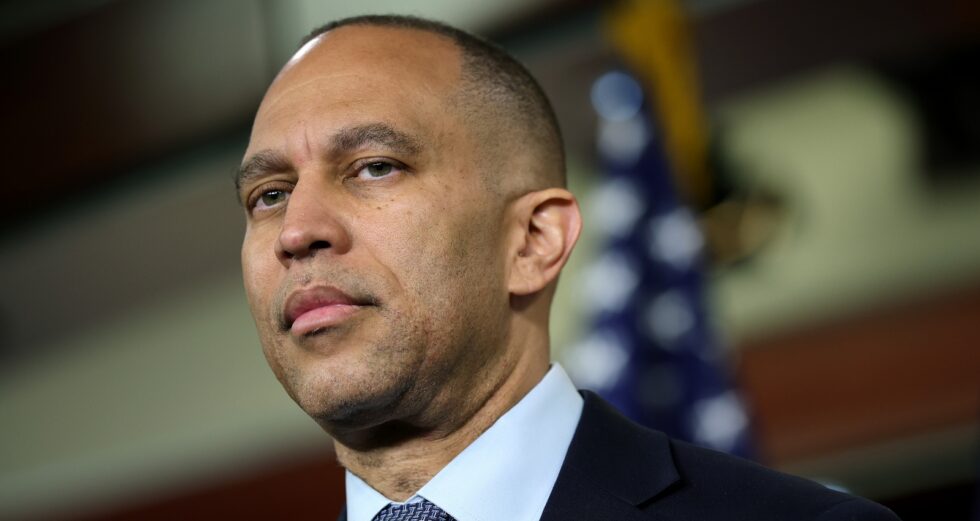
House Democrats are reportedly confronting an unusual concern ahead of the midterm elections: winning control of the chamber may not be enough to prevent serious problems inside their own party.
According to New York Times national correspondent Jeremy Peters, some Democratic lawmakers fear that a narrow House majority could hand a small group of Democratic Socialists enormous leverage over the party’s agenda.
Advertisement
Peters discussed those concerns Friday during an appearance on HBO’s Real Time, where he was joined by CNN host and chief political correspondent Dana Bash.
“The Democrats have a real enthusiasm problem, right?” Peters said.
He argued that some voters are looking at both President Donald Trump’s Republican Party and the Democrats without feeling particularly enthusiastic about either choice.
Advertisement
Peters said that uncertainty makes it difficult to determine exactly how well Democrats will perform even if the political environment ultimately delivers them control of the House.
But the size of a potential Democratic majority could prove nearly as important as whether the party wins one at all.
Advertisement
“The Democrats in the House that I talk to are really worried that, if they don’t pick up a dozen seats, they’re going to be beholden to the new Squad and this handful of Democratic Socialists who will, essentially, have veto power over the entire Democratic establishment agenda,” Peters said.
“That’s a big concern.”
Bash immediately agreed before explaining how a narrow majority can empower relatively small factions inside a political party.
She compared the potential Democratic predicament to the influence conservative Tea Party lawmakers previously exercised within the Republican Party.
“If it’s a slim majority, minority rules, within the party,” Bash said.
The basic mathematics of the House help explain the concern.
When a party controls the chamber by only a handful of seats, a similarly small group of lawmakers willing to withhold their votes can potentially prevent leadership from passing legislation without making concessions.
That could present a significant challenge for House Minority Leader Hakeem Jeffries if Democrats capture the majority but fail to build a substantial cushion.
Bash offered a hypothetical scenario in which approximately ten members aligned with the Squad refused to support legislation unless Democratic leaders embraced one of their major priorities.
Advertisement
She used Medicare for All as an example.
“If you have, let’s say, you had four members of the Squad and then it was growing, let’s say you have ten people who are absolutely I’m not going to do anything unless you pass Medicare for All, just for example, Rep. Hakeem Jeffries, if he doesn’t have a majority of more than ten people, he’s screwed,” Bash said.
The comments highlight an increasingly important dynamic surrounding the battle for control of Congress.
Democrats are not simply attempting to capture enough Republican-held districts to reclaim the House.
Party leaders could also need enough victories to prevent any single ideological faction from effectively becoming indispensable to passing legislation.
Advertisement
The Squad has represented the progressive wing of the House Democratic caucus for years, frequently pushing leadership toward policies including Medicare for All and other progressive priorities.
A new group of Democratic Socialist candidates could potentially expand that faction following November’s elections.
The precise influence those lawmakers would possess would ultimately depend on the final composition of the House and whether they vote together as a bloc.
Republicans have experienced similar difficulties while operating with narrow House majorities, where relatively small groups of members have occasionally been able to derail legislation or force leadership into difficult negotiations.
Advertisement
Bash’s comparison suggested Democrats could find themselves dealing with their own version of that problem.
The stakes would become particularly significant if Jeffries becomes speaker with only a narrow margin separating Democrats and Republicans, Breitbart News reported.
Leadership would then need to keep moderates representing competitive districts together with progressive lawmakers representing heavily Democratic constituencies, despite potentially substantial disagreements over policy.
This article may contain commentary which reflects the author’s opinion.