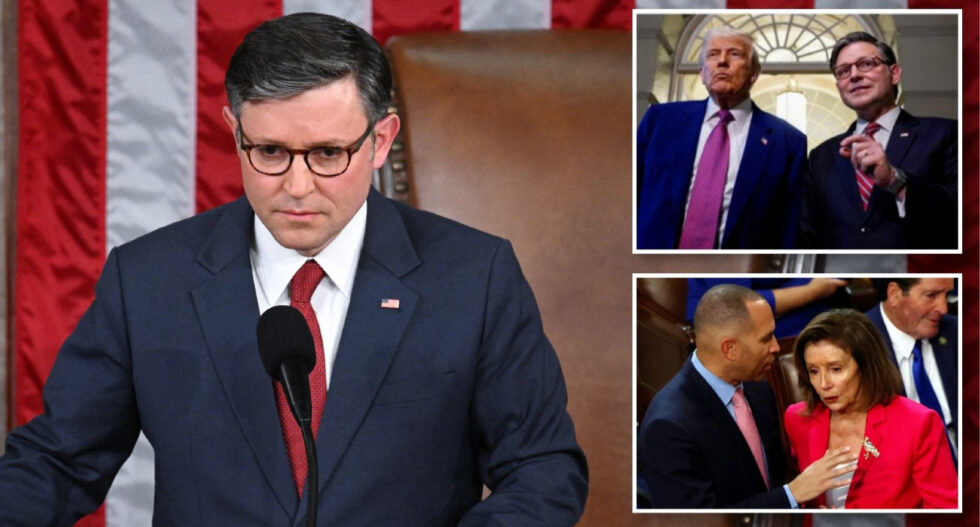
House Republicans continue to deliver for President Donald Trump despite having a razor-thin majority, while the GOP-controlled Senate, with a larger majority, has been disappointing.
On Thursday, the House again proved it could overcome Democratic obstacles to move the president’s agenda forward.
Advertisement
The House narrowly passed the most expensive defense authorization bill in U.S. history on Wednesday, approving the measure by a four-vote margin.
The following day, however, the Senate declined to advance its own version after lawmakers in both chambers split over whether the military campaign against Iran should have congressional authorization.
The impasse represents more than a procedural dispute. For the first time in 66 consecutive years, it poses a serious threat to passage of the National Defense Authorization Act (NDAA).
Advertisement
If Congress fails to reach an agreement before Oct. 1, the stalemate could delay or disrupt major Pentagon priorities, including $17.5 billion for the Golden Dome missile defense initiative, $54.6 billion for drone autonomy programs, and pay raises for more than 1.3 million active-duty service members, according to the Congressional Research Service’s defense authorization primer.
The House approved the NDAA by a 216–212 vote, marking one of the narrowest margins in recent history for legislation traditionally considered must-pass.
Advertisement
Seven Republicans opposed the bill, while six Democrats voted in favor.
On the same day, the House also passed a separate $95 billion reconciliation package by an even narrower 216–214 vote.
According to Air & Space Forces Magazine, approximately $60 billion of that package is designated for the Pentagon to replenish munitions stockpiles and cover operational costs related to the conflict with Iran.
On Thursday, the two chambers diverged over the broader debate surrounding the Iran conflict.
The House passed a nonbinding concurrent resolution urging President Donald Trump to end the military campaign against Iran by a 214–208 vote, according to Stars and Stripes.
That same morning, the Senate narrowly failed to discharge Sen. Chris Van Hollen’s (D-Md.) war powers resolution—a binding measure that would have required U.S. forces to withdraw within 60 days—by a 47–49 vote, according to the official Senate record.
Sen. John Fetterman (D-Pa.) voted against the resolution, while Sen. Susan Collins (R-Maine) voted in favor.
The Senate then adjourned until July 27 without scheduling a vote on its version of the National Defense Authorization Act.
Advertisement
The House version of the NDAA authorizes approximately $1.1 trillion for the Department of Defense, roughly $40 billion for the Department of Energy’s nuclear weapons programs, and more than $10 billion for other national security-related activities, bringing the total authorization to approximately $1.15 trillion.
According to H.R. 8800, that leaves an estimated $350 billion gap from President Trump’s original $1.5 trillion request, with the remaining funding expected to be addressed through separate reconciliation legislation that has yet to be finalized.
The Senate failed to advance its own version of the NDAA on July 14 when a cloture vote fell short, 50–46, of the 60 votes required under Senate Rule XXII, according to Breaking Defense.
Senate Majority Leader John Thune (R-S.D.) changed his vote from “yes” to “no” after it became clear the motion would fail, a procedural step that preserved his ability to bring the measure back for another vote.
Advertisement
He has not announced when he intends to do so.
The central dispute has remained unchanged since July 14.
Senate Democrats argue that the legislation would effectively authorize continued funding for a military conflict that, in their view, has proceeded without explicit congressional approval.
According to testimony from Defense Secretary Pete Hegseth before a Senate committee on July 21, the conflict with Iran has resulted in the deaths of 18 U.S. service members and cost approximately $37.5 billion.
Advertisement
Time magazine reported on July 22 that an additional 482 U.S. troops have been wounded.
Senate Minority Leader Chuck Schumer (N.Y.) clearly stated the Democratic position before the July 14 vote, as PBS NewsHour reported.
“The NDAA cannot become a permission slip for that recklessness that we see occurring in Iran. Donald Trump does not get to drag the American people deeper into a war he cannot explain and does not know how to end — and then demand that Congress look the other way,” he said.
This article may contain commentary which reflects the author’s opinion.