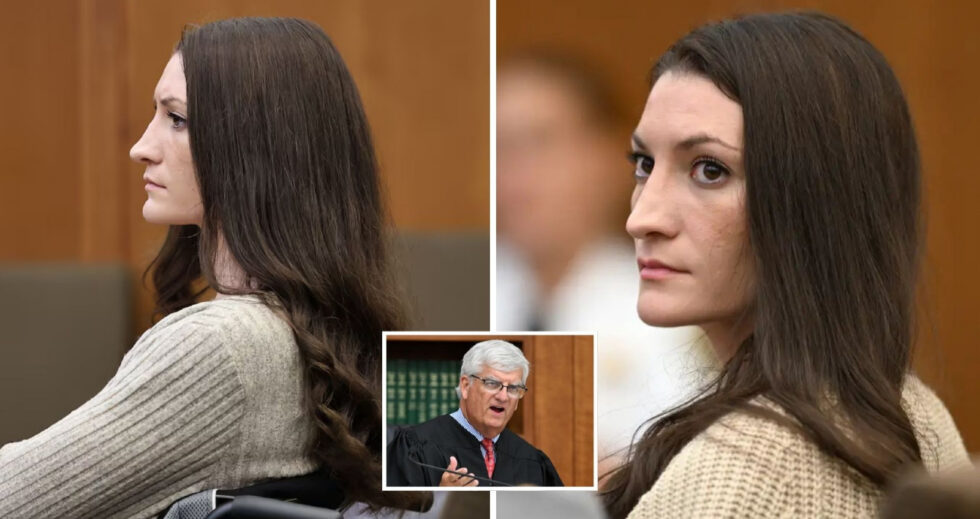
Another shoe has dropped in the case of Lindsay Clancy.
The prosecutor who helped put one of America’s most notorious mothers behind bars believes an unexpected dynamic could emerge when jurors decide Lindsay Clancy’s fate.
Advertisement
Rather than being more receptive to her postpartum psychosis defense, some of the women on the jury could prove to be among the least sympathetic.
Rep. Tommy Pope, who prosecuted Susan Smith for murdering her two young sons in 1994, drew the comparison as Clancy’s closely watched Massachusetts murder trial approached its conclusion.
His assessment centers on the personal experiences female jurors may bring into deliberations.
Advertisement
Pope told Fox News Digital that women who personally endured postpartum depression or other severe difficulties after childbirth may hold Clancy to a higher standard because they experienced those struggles without harming their children.
“For the most part, the women were the ones that said, you know, when I had my kids, I went through hell, or I went through depression, or I battled this, or I was overwhelmed,” Pope said of his experience with the Smith case, adding that those mothers nevertheless viewed their children as the most important people in their lives.
Advertisement
That experience could create what Pope called a “strange twist” for Clancy’s defense.
“While a woman may have even faced postpartum depression, she may have overcome it and then be less sympathetic to Clancy,” Pope said.
Clancy, 36, is charged with three counts of first-degree murder in the January 2023 strangulation deaths of her children, 5-year-old Cora, 3-year-old Dawson and 8-month-old Callan at the family’s Duxbury, Massachusetts, home.
Her attorneys do not dispute that Clancy killed the children but contend that postpartum psychosis left her not criminally responsible for the killings.
Pope successfully prosecuted Smith after she strapped 3-year-old Michael and 14-month-old Alexander into her vehicle and rolled it into a South Carolina lake, eventually receiving a life sentence after initially falsely claiming a black man had carjacked her and abducted the boys.
The prosecutor who secured a conviction for Susan Smith, who drowned her two sons, says Lindsay Clancy’s defense never proved a “break from reality” — the key threshold for a psychosis defense — as jurors prepare to deliberate her fate.
Rep. Tommy Pope, who helped put Smith away… pic.twitter.com/j0LlWLutM8
— Fox News US (@FoxUSNews) August 27, 2026
Pope also suggested Clancy’s current physical condition could affect jurors differently, as she is paralyzed and has appeared throughout the trial in a wheelchair.
He speculated that some male jurors could view Clancy as having already endured substantial punishment because of her injuries, potentially creating the opposite dynamic from what might ordinarily be expected.
Advertisement
Meanwhile, prosecutors used their final expert testimony to challenge a central component of Clancy’s insanity defense.
Forensic psychiatrist Gregory Saathoff testified that he found it significant that Clancy had not previously reported hearing voices to the numerous mental health professionals who treated her before the killings.
Saathoff also questioned Clancy’s account that a commanding voice telling her to kill her children stopped after she strangled Callan.
“Committing the act is not curative of the voice. I’ve not ever seen that,” Saathoff testified, according to The Associated Press.
Advertisement
Prosecutors have additionally focused on what they describe as the calculated nature and timing of the killings, which occurred during a relatively narrow period after Clancy’s husband left the home.
Defense expert Dr. Phillip Resnick offered jurors a dramatically different interpretation, testifying that Clancy believed an outside force had taken control of her body.
Resnick said Clancy described feeling like a “puppet” whose actions were being controlled by someone else.
Her defense has argued that postpartum psychosis, along with her psychiatric treatment and medications, left Clancy incapable of being held criminally responsible.
Advertisement
The prosecution has attempted to demonstrate that mental illness alone does not necessarily mean someone is legally incapable of controlling their conduct.
With testimony concluding and closing arguments beginning, the focus now turns to the 18 people seated for the trial, consisting of 12 women and six men, from whom 12 deliberating jurors will ultimately be selected, Fox News reported.
Those jurors will be tasked with weighing competing expert testimony, Clancy’s mental state and the circumstances surrounding the deaths of Cora, Dawson and Callan before determining whether prosecutors have proven her criminal responsibility beyond a reasonable doubt.
This article may contain commentary which reflects the author’s opinion.