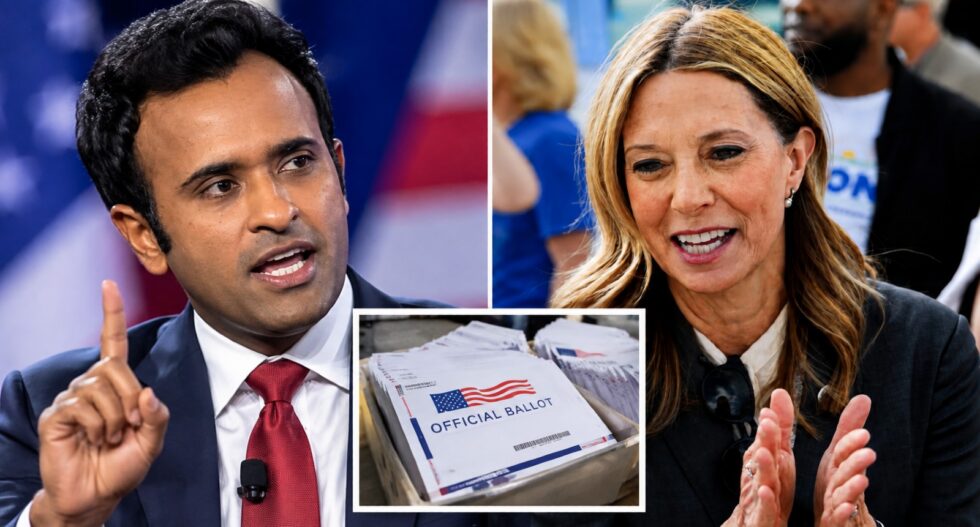
Republicans have received good news in Ohio after an early-voting projection suggested an advantage before November’s midterms.
Advertisement
An Election Data Guy graphic dated October 26 estimates Republicans hold a 128,129-vote advantage among early and mail voters.
The model assigns Republicans 561,061 votes, Democrats 432,932, and another 4,905 outside those two estimated partisan categories.
Its headline total stands at 1,003,361 early and mail votes, with projected statewide turnout reaching 55%.
Republican support is modeled between 52% and 58%, compared with a Democratic range of 41% to 47%.
Advertisement
Those numbers provide Republicans a favorable scenario, although modeled affiliations are not verified votes for either Senate candidate.
Republican Senator Jon Husted faces former Democratic Senator Sherrod Brown in a contest attracting attention and significant campaign spending.
Brown’s previous statewide experience makes him formidable, while Husted benefits from Republican strength in recent Ohio elections.
Early voting patterns may reveal enthusiasm, but Election Day participation and late mail returns could reshape the eventual outcome.
A modeled firewall describes an estimated partisan advantage already accumulated, rather than a protective margin that cannot disappear.
The 55% turnout figure likewise remains a forecast, not a measurement of ballots ultimately cast statewide this November.
OHIO – 10.26.26
🗳️ 1,003,361 votes in
🔴 Firewall of 128,129
🥇Race is leaning Republican https://t.co/SdURtaUg4H
— E_DataGuy (@E_DataGuy) October 26, 2026
Ohio’s Senate battle also unfolds amid an extraordinary financial contest, with Republicans commanding national resources.
President Donald Trump’s political operation remains central to that financial strength, particularly through the MAGA Inc. super PAC.
Federal Election Commission records show MAGA Inc. collected $449.4 million between January 2025 and October 14, 2026.
The committee reported roughly $164.3 million remaining in cash on October 14, after extensive spending during the cycle.
That current balance matters more than earlier headlines describing nearly $300 million available at the beginning of 2026.
However, super PAC resources cannot simply be transferred into candidate accounts, and spending remains subject to applicable rules.
Advertisement
Another Republican powerhouse, Senate Leadership Fund, has raised $545.6 million during the current two year election cycle.
Its reported cash balance stood near $88.4 million through October 14, following substantial expenditures on competitive Senate contests.
That fundraising scale illustrates how Republican allies can sustain expensive television campaigns and other voter outreach efforts.
Advertisement
The National Republican Senatorial Committee separately reported about $237.8 million in receipts through October 14, according to federal filings.
Its cash balance reached approximately $25.2 million, although filings also listed $20 million in outstanding committee debt.
The Republican National Committee ended September holding $97 million, versus $19 million at the Democratic National Committee.
That fivefold cash advantage gives Republicans flexibility for organizing, advertising, legal support, and voter turnout operations.
September reporting also showed the Democratic National Committee carrying roughly $15 million in debt, complicating its financial picture.
Republican Senate fundraising surged during the third quarter, with the NRSC bringing in $73 million overall.
The Democratic Senatorial Campaign Committee collected approximately $48 million during that period, according to published disclosure analysis.
On the House side, Republicans also maintained substantial resources, although their national campaign committee’s advantage was narrower.
Advertisement
The National Republican Congressional Committee held roughly $61 million entering October, compared with $56 million for Democrats.
Democratic candidates have outraised Republican opponents in several prominent Senate contests, including Ohio, complicating the broader fundraising picture.
Brown’s fundraising strength underscores why Husted and Republican allies cannot rely exclusively on favorable national financial totals.
Outside groups can nevertheless supplement candidates with independent advertising, helping offset disadvantages in individual campaign accounts.
A Supreme Court decision earlier this year also expanded permissible coordinated party spending, potentially increasing advertising efficiency.
Money cannot guarantee electoral success, but sustained funding can support voter contact through the final days before November 3.
For Ohio Republicans, the combination of optimistic modeling and substantial national resources offers a plausible path to victory.
The decisive test arrives when actual ballots are counted, replacing projections and fundraising headlines with verified election results.
This article may contain commentary which reflects the author’s opinion.