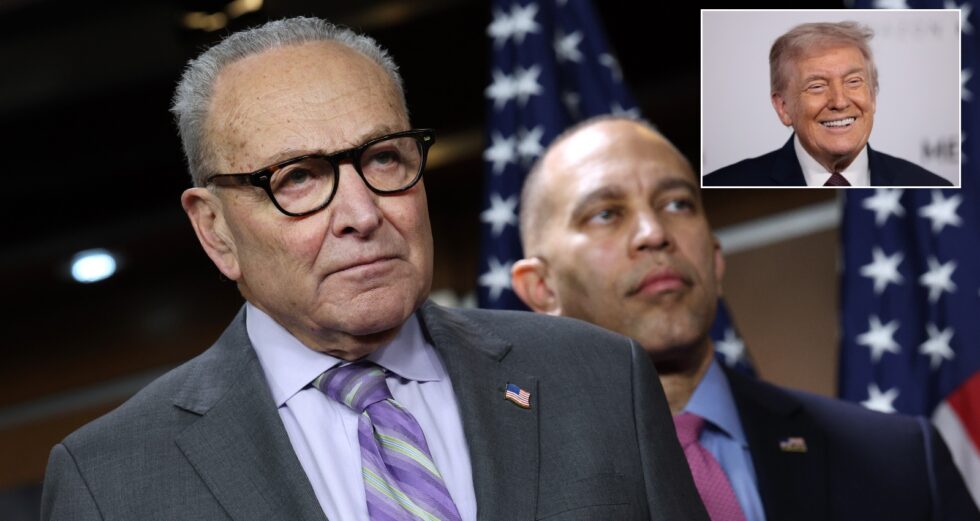
President Trump didn’t launch his political career to upset Democrats and RINOs, but much of what he’s done through one-and-a-half terms has angered many on the left and the moderate right.
And he’s angering them again, with a big change he’s making to a law long-used by the hard left and soft right to burden all Americans.
Advertisement
Trump has announced another major policy shift that is drawing criticism from Democrats and some moderate Republicans, this time involving the Endangered Species Act.
The Trump administration said Friday it is changing how the federal government interprets the term “harm” under the Act, arguing the revision restores the law’s original meaning.
Advertisement
The Departments of Commerce and the Interior said they are rescinding what they described as an outdated regulatory definition of the term. Under the revised interpretation, “harm” will no longer include habitat modifications that could negatively affect the survival of protected plant or animal species, according to Just the News.
Administration officials said previous interpretations expanded the law beyond congressional intent and were used to block energy development, logging, infrastructure projects and certain uses of private property.
Advertisement
“For years, federal agencies abused the ESA to obstruct lawful land use and burden American families and businesses,” Interior Secretary Doug Burgum said in a news release.
“This action restores common sense, respects private property, provides much-needed certainty for landowners and follows the statute Congress actually passed,” Burgum added.
In a joint statement, the departments said the Endangered Species Act’s core protections remain in place, including the prohibition on actions that directly injure or kill endangered species.
Officials also said the regulatory change is consistent with the Supreme Court’s 2024 decision in *Loper Bright v. Raimondo*, which held that courts must independently interpret federal statutes rather than defer to agencies’ interpretations of ambiguous laws.
The announcement comes shortly after another major Supreme Court decision expanding presidential authority over the executive branch. In a 6-3 ruling, the Court held that presidents may remove officials from independent federal agencies without the employment protections that had existed for decades.
The decision gave Trump the authority to remove Federal Trade Commissioner Rebecca Slaughter, a Democratic appointee whose case became a key test of the administration’s effort to broaden presidential removal powers.
In reaching its decision, the Court overruled its 1935 precedent in *Humphrey’s Executor v. United States*, ending a longstanding doctrine that allowed Congress to provide certain executive branch officials with protection from at-will removal.
According to The Hill, the ruling is expected to have significant implications for independent agencies overseeing labor relations, federal employment, workplace discrimination, consumer protection, aviation safety and financial regulation.
Commentator Ben Dyke described the ruling as a “bombshell,” calling it “historic.” He argued that the majority correctly restored constitutional authority to the president as head of the Executive Branch.
“If anything more is left of Humphrey’s, we overrule it,” Chief Justice John Roberts wrote for the majority.
Beyond the Federal Trade Commission, the decision is expected to affect roughly two dozen multimember independent agencies by giving future presidents broader authority to replace commissioners and board members with appointees who share their policy priorities.
The Court’s dissent argued that the ruling grants presidents authority that “neither the People, nor Congress, nor the Constitution bestowed upon him.”
Dyke disagreed with that conclusion, pointing to Article II of the Constitution, which states, “The executive Power shall be vested in a President of the United States of America.”
He argued that this language makes clear the Framers intended the president to exercise authority over the Executive Branch, rather than allowing officials heading congressionally created agencies to resist or delay presidential directives.
This article may contain commentary which reflects the author’s opinion.