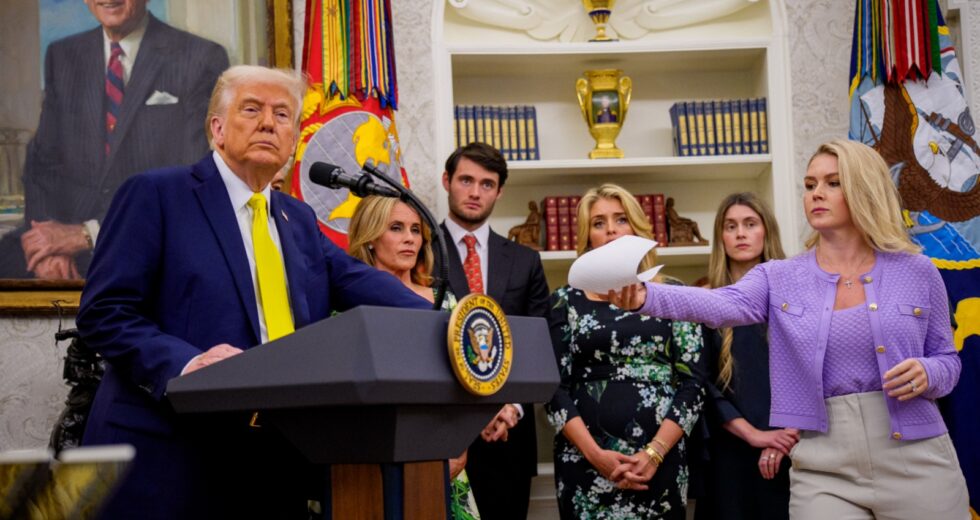
President Trump is continuing to follow a “stick and carrot” approach to foreign policy as he tries to reposition the United States as the preeminent economic power in the world.
That includes widespread use of tariffs imposed on countries who don’t reflect U.S. values or goals.
Advertisement
To that latter point, the president is increasing tariffs on imports from 60 countries that have not enacted bans on goods produced with forced labor, as the current 10% global tariff rate is scheduled to expire Friday.
Senior administration officials said Thursday that countries that have implemented or begun enforcing laws prohibiting imports made with forced labor will continue to face a 10% tariff.
Advertisement
Countries that have not adopted such measures will instead be subject to a 12.5% import duty, with the new rates taking effect at 12:01 a.m. on July 24, the New York Post reported.
“The United States has had a forced labor import ban for nearly a century, and rigorously enforces it; it’s well past time for our trading partners to do the same,” said US Trade Representative Jamieson Greer.
Advertisement
“Today’s action will begin to correct what is both a human rights abuse and distortive trade practice to improve the welfare of workers everywhere,” he noted further.
According to the Office of the U.S. Trade Representative, the 10% tariff rate will apply to imports from Argentina, Bangladesh, Cambodia, Canada, Ecuador, El Salvador, Guatemala, Honduras, India, Indonesia, Jordan, Malaysia, Mexico, Pakistan, Sri Lanka, Trinidad and Tobago, and the United Kingdom.
For certain products, imports from European Union member states, Taiwan, Japan, South Korea, and Switzerland will face either 10% or 12.5% tariffs, while imports from all remaining countries will be subject to the 12.5% rate.
One administration official noted that India qualified for the lower 10% tariff after enacting legislation aimed at preventing the import of goods produced with forced labor.
The expanded tariff policy signals that the Trump administration is continuing to advance its trade agenda while pursuing new legal mechanisms for imposing import duties after the Supreme Court struck down last year’s “Liberation Day” tariffs, The Post noted further.
“It encourages stronger labor rights enforcement abroad,” one official told The Post of the so-called Section 301 approach.
“It will restore fairness in the global market for American workers. And it incentivizes our trading partners to join the United States in eliminating forced labor from global supply chains,” the official said.
Advertisement
“For nearly a century, the United States has prohibited imports made in whole or in part with forced labor,” the official noted further.
Oil and gas imports will be exempt from the new tariffs, which are being implemented following a Section 301 investigation involving at least 60 countries.
The duties are being imposed under Section 301 of the Trade Act of 1974 as President Trump’s across-the-board 10% tariffs under Section 122 are scheduled to expire just after midnight Thursday.
Advertisement
The new import taxes will apply to approximately 99% of U.S. imports, although administration officials said the economic impact is expected to be limited because the rates are largely consistent with the previous tariff structure.
An administration official also said the Section 301 tariffs will not be “stacked” on top of existing Section 232 tariffs, which were imposed on national security grounds and apply to products such as steel, aluminum, and other goods.
Trump announced the Section 122 tariffs after the Supreme Court struck down his baseline 10% tariff imposed under the International Emergency Economic Powers Act (IEEPA) on Feb. 20.
The latest trade action follows the president’s decision earlier this week to impose a 50% tariff on certain imports from Canada, The Post noted.
Advertisement
In June, the U.S. Supreme Court declined to take up a challenge to tariffs imposed on Chinese imports during President Trump’s first term, leaving the trade measures in place.
The decision came after HMTX Industries and several other businesses appealed a lower court ruling that upheld the tariffs.
This article may contain commentary which reflects the author’s opinion.