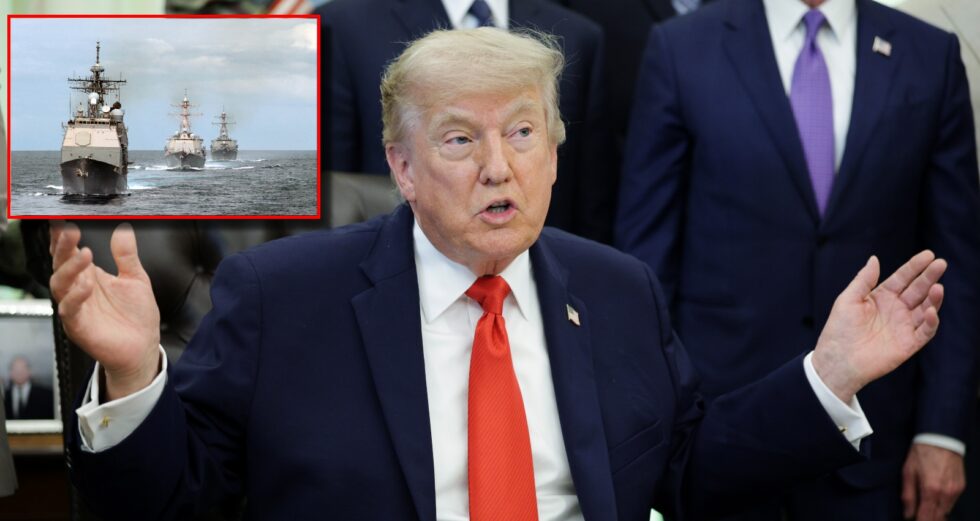
President Donald Trump revealed Wednesday that a military operation he authorized last month has safely escorted more than 100 million barrels of oil and over 200 commercial vessels through the Strait of Hormuz, the critical Persian Gulf shipping lane that has faced repeated threats amid tensions with Iran.
In a post on Truth Social, Trump described the effort as a previously undisclosed “secret mission” aimed at protecting one of the world’s most important energy corridors.
Advertisement
He also delivered a blunt message regarding control of the strategic waterway, declaring that the United States—not the Iranian regime—ultimately controls access through the Strait.
“Last month, I directed our Great U.S. Military to execute a secret mission to support Oil Tankers and other Commercial Ships through the Strait of Hormuz,” Trump wrote on Wednesday.
“Today, I am pleased to announce that this effort has resulted in more than 100 MILLION Barrels of Oil making its way through the Strait, and into the Open Market,” he added.
“More than 200 Commercial Ships have safely traveled through the Strait,” Trump’s post continued.
Advertisement
“This wildly successful effort is because the UNITED STATES of AMERICA CONTROLS the Strait of Hormuz — NOT Iran. Their military is defeated, and their economy is lost. It’s over for Iran!” he concluded.
The disclosure comes as the United States continues enforcing a security presence in and around the Strait of Hormuz while negotiations between Washington and Tehran remain unresolved, despite Trump’s repeated assertions that an agreement is within reach.
Although the conflict has technically remained under a ceasefire, Iranian forces have continued to harass and interfere with commercial vessels operating in the Persian Gulf, raising concerns about freedom of navigation and regional stability.
Against that backdrop, Trump’s announcement serves as a clear reminder of American naval power and its role in safeguarding one of the world’s most important shipping lanes.
By highlighting the successful movement of more than 200 commercial vessels and over 100 million barrels of oil through the Strait, the administration is underscoring its commitment to keeping global commerce flowing despite ongoing threats from the Iranian regime, analysts note.
In his Truth Social post, Trump did not specify which military units or assets were involved in the escort operation, nor did he name the shipping companies or tankers that participated.
He also did not clarify the legal basis for the U.S. blockade of the waterway or to describe the specific Iranian provocations that triggered the mission.
The Strait of Hormuz remains one of the world’s most critical maritime chokepoints, serving as the gateway for roughly 20% of global oil shipments.
The narrow passage between Iran and the Arabian Peninsula is vital to international energy markets, and even minor disruptions can send shockwaves through oil prices, fuel costs, and economies around the globe.
For decades, Iran has sought to use its strategic position along the Strait as a geopolitical pressure point, repeatedly threatening to close the waterway or targeting commercial shipping during periods of heightened tensions with the United States and its allies.
Iranian-backed attacks, vessel seizures, naval harassment, and other provocations have made the region a persistent flashpoint.
Those concerns have not disappeared during the current conflict.
Despite a ceasefire that has largely paused open hostilities, Iranian forces have continued actions that threaten commercial navigation and regional stability.
As a result, ensuring freedom of passage through the Strait has remained a top priority for the United States and its partners, who view uninterrupted shipping as essential to both global commerce and energy security, notes the Conservative Institute.
Analysts noted that the figure Trump mentioned – 100 million barrels of oil – is not insignificant. They say it represents average global oil consumption per month.
Also, “the scope and rules of engagement for the military escort mission remain unclear,” the outlet reported.
Oil prices have fallen this week after reaching more than $100 a barrel during the height of the conflict.
This article may contain commentary which reflects the author’s opinion.