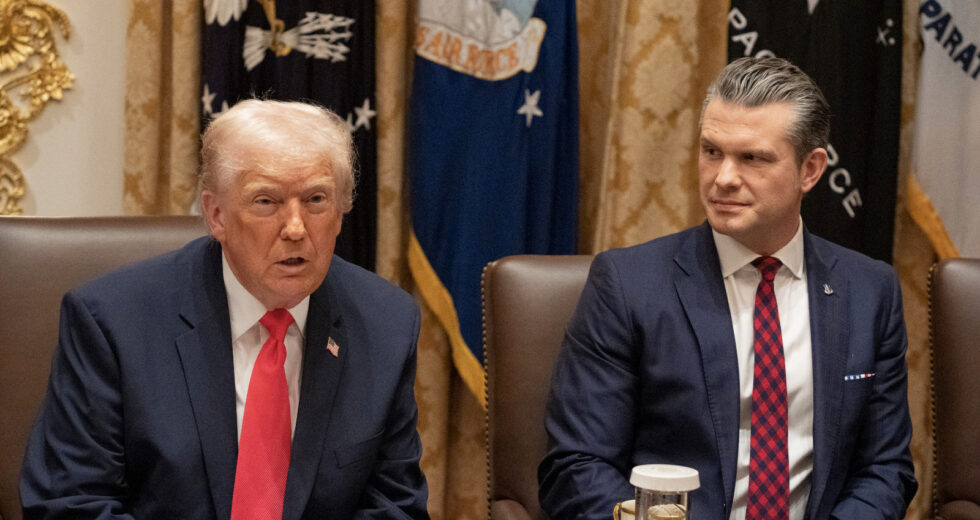
The White House has denied “reports” that President Donald Trump was considering a major cabinet shake-up.
Reports have surfaced claiming that Trump is considering firing War Secretary Pete Hegseth and CIA Director John Ratcliffe over their alleged objections to the peace agreement with Iran.
Advertisement
This was first reported by Israel Hayom, who cited anonymous sources familiar with the administration.
It implied that internal debates over the Iran deal were finished and that officials who had voiced reservations could face issues.
Hegseth and Ratcliffe were among those who could be impacted, with an alleged source quoted as saying, “The debate has been settled. Anyone who stood against it could pay a personal price.”
The story, later reported by the Daily Express, was linked to broader discussions within the administration about the terms of the deal, including fears Iran was not living up to its nuclear-related commitments.
Those accounts said Hegseth, Ratcliffe, and others, including, in some accounts, Secretary of State Marco Rubio, had raised questions in internal deliberations about the viability of Iran’s concessions.
Advertisement
This was a stark contrast to the support of figures like Vice President JD Vance and envoys involved in the negotiations.
The reporting said the differences were potential reasons for personnel changes as talks continue following weeks of tensions between the U.S. and Iran.
In response, White House spokesperson Anna Kelly issued a clear denial.
“I have never heard of this ‘reporter,’” Kelly posted on X while tagging Israel Hayom reporter Danny Zaken. “Until he started consistently pushing fake news without reaching out to the White House for comment. To be clear, this clown has no idea what he is talking about and his ‘sources’ are probably the voices in his head.”
High-level peace talks between the United States and Iran have concluded, mediators said Monday, with the “immediate” launch of a new round of lower-level technical discussions this week in Switzerland.
The two sides agreed on a road map aimed at reaching a final agreement within 60 days, according to a joint statement from the mediators, Pakistan, and Qatar.
A communication channel was also established to prevent “incidents and misunderstandings” and to ensure the safe passage of commercial vessels through the Strait of Hormuz, the mediators said, calling the progress “encouraging.”
Vance had begun the talks on Sunday, expressing hope that the two sides could make progress.
At the same time, back in Washington, President Trump issued a firm warning of fresh attacks on Tehran if it blocked the reopening of the strait—showing the kind of strong leadership that has forced Iran back to the table.
Despite the typical Iranian bellicosity, negotiators from the two countries — along with mediators from Pakistan and Qatar — held about 18 hours of intensive talks and consultations at the Swiss resort of Bürgenstock.
The Bürgenstock gathering, dubbed the Lake Lucerne Summit, is part of a 60-day effort to build on the recently announced U.S.-Iran ceasefire and establish a broader deal to end the war and address concerns about Iran’s nuclear program.
Tensions flared over the weekend after Iran, in typical fashion, said it was closing the Strait of Hormuz in response to Israeli actions against Hezbollah in Lebanon.
U.S. Central Command said Saturday that commercial vessels were still passing through the waterway, underscoring that Tehran’s threats often amount to bluster when confronted with American resolve.
The safe passage of commercial vessels through the Strait of Hormuz is critical to bringing down global oil prices.
In a phone interview on Sunday with Fox News’s Trey Yingst, Trump threatened to attack Iran and take over the Strait of Hormuz if Tehran interfered with passage through the waterway.
“You close [the Strait of Hormuz] and you won’t have a country,” Trump said he told Iranian officials, Yingst posted on X “You won’t even make it back to your fu*king country.”
Trump also underscored the threat in a Truth Social post in which he urged Iran to stop Hezbollah militants in Lebanon from “causing trouble.”
“If they don’t, we’ll hit Iran very hard again, just like we did last week, only harder,” he said.
This article may contain commentary which reflects the author’s opinion.