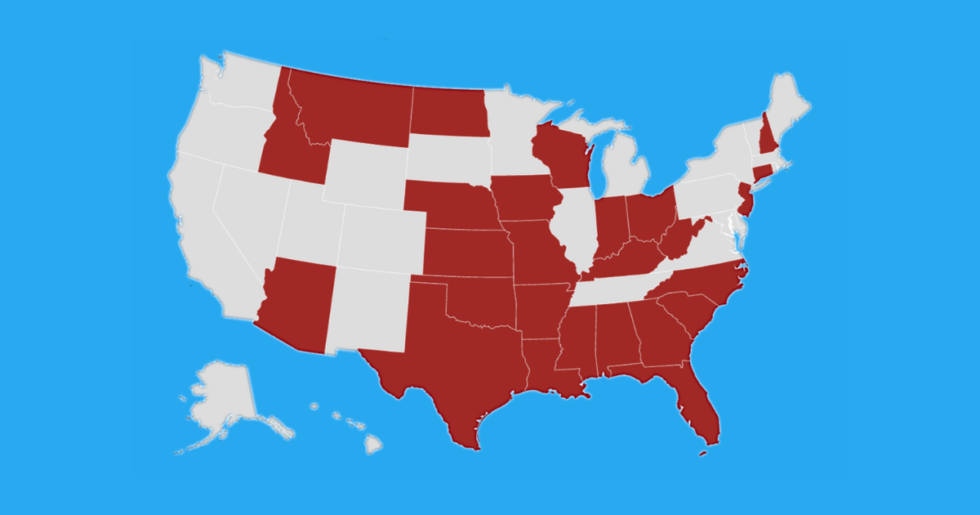
In the year and a half since President Trump appointed billionaire Elon Musk to lead the federal government’s new Department of Government Efficiency (DOGE), at least 26 states have launched their own versions of the highly controversial agency — creating offices, task forces, laws, and committees supposedly designed to cut government waste.
Stateline points out how quickly red states jumped on the DOGE bandwagon, with new “efficiency” task forces set up by GOP governors or legislative bodies in Kansas, Missouri, New Hampshire, North Carolina, Oklahoma, Texas, and Wisconsin within weeks of Trump signing his executive order to launch DOGE.
Efforts to cut red tape and streamline bureaucracies at the state level are not new. Still, GOP governors are now following Trump’s lead by using “efficiency” as a euphemism for shrinking the role of government and eliminating social support programs rather than cutting waste or improving processes.
“One person’s concept of waste is another person’s vital service,” William Glasgall, public finance adviser at the nonprofit Volcker Alliance, told Stateline.
The nonpartisan Economic Policy Institute puts it more bluntly:
While these initiatives vary, they all use disingenuous calls to “root out inefficiency” and “cut wasteful spending” as a smokescreen for the same right-wing agenda many conservative state lawmakers and their allies have pursued for decades: consolidating power in the hands of a minimally accountable executive, attacking public-sector workers, and cutting public services to finance tax cuts for the wealthy.
This formula has become especially clear in the hands of Trump loyalist Russell Vought, director of the Office of Management and Budget and the founder of Heritage Action, who spelled out a detailed roadmap for consolidating executive power in Project 2025. Once Musk left DOGE after stirring things up for five months, Vought “took up the mantle of decimating federal capacity on behalf of billionaire interests,” according to the Revolving Door Project’s report on DOGE’s first year.
ALEC Pushes State DOGE Efforts
Many state governments have turned to model legislation from the American Legislative Exchange Council (ALEC), the right-wing, corporate-backed bill mill, for examples of model bills that, together with Trump’s DOGE, provide a roadmap for slashing social programs under the guise of efficiency and regulatory reform.
At its annual meeting last summer, ALEC drew a standing-room-only crowd of legislators to a plenary session on how to make the “DOGE idea happen at the state level,” according to ALEC President and Chief Economist Jonathan Williams.
ALEC runs a Government Efficiency Coalition that takes credit for providing “proven solutions” at the federal level and similar state DOGE efforts.
ALEC’s Essential Policy Solutions playbook, which the Center for Media and Democracy (CMD) has described as a state-level Project 2025, provides a legislative blueprint for dismantling regulations, bolstering the fossil fuel industry, gutting funding for public education, curtailing voting rights, and much more.
ALEC’s centerpiece bill supporting the “DOGE idea” is its 2024 Regulatory Management Act, which calls for establishing an office “under the direction and control of the governor” to catalog state regulations, run them through a cost-benefit analysis, determine if they are responsive to systemic problems, and request that agencies reevaluate regulations it deems unnecessary. In so doing, the office is explicitly directed to reject statutory authorization as sufficient justification for regulatory action.
ALEC’s Spending Evaluation Act requires that every new program, agency, or mandate that calls for the expenditure of public funds sunset five years after authorization unless it has been evaluated and made public.
Its Efficiency in Government Act calls for the privatization of government spending on goods and services and for comparing the costs of governmental versus private delivery of programs. It directs agencies to “consider alternative methods for performing in-house activities with effectiveness and cost-efficiency as primary concerns.” In addition, the bill stipulates that “every law, rule, or policy must detail both [the] short-term and long-term economic effects of the regulation,” and that legislators need to “review the alternatives, including the effect of doing nothing.”
ALEC’s Economic Impact Statement Act requires that states analyze both the short- and long-term economic effects of any proposed new environmental regulation before it’s adopted. The statement must provide a “conclusion” about the expected economic impact of the regulation, “including an analysis containing a description as to which persons will bear the costs of the action and which persons will benefit directly and indirectly from the action.”
Cicero Pushes Its Own State DOGE Blueprint
The Texas-based Cicero Institute also provides a roadmap for states wanting to establish government efficiency operations. Cicero reported $13.3 million in revenue in 2024, much of it from its founder and Board Chairman Joe Lonsdale, a billionaire venture capitalist and cofounder (with Peter Thiel, among others) of the controversial software giant Palantir Technologies.
Cicero develops legislation on education, homelessness, healthcare, and government spending. Its model bill, titled A Blueprint for a State Department of Government Efficiency, aims to reduce regulations, audit every governmental program, and conduct cost-benefit analyses.
Cicero supports giving governors authority for program review, writing, “A state DOGE centralizes regulatory review and oversight, giving governors the authority, resources, and data they need to make government more efficient.”
Cicero is a partner of the State Policy Network (SPN) of right-wing think tanks in all 50 states and Washington, DC. SPN groups serve as a policy, communications, and litigation arm of ALEC, lending its cookie-cutter agenda a sheen of academic legitimacy and state-level support.
Gutting Social Programs Under the Guise of Efficiency
In most cases, state performance on efficiency programs in the past year mirrors the failed attempts by Trump’s DOGE to save significant amounts of money. The digital “wall of receipts” it proudly published was riddled with errors — including claims of eliminating an $8-billion contract that was, in fact, an $8-million one; canceling deals that were double-counted; and reporting total savings that independent reviews concluded were only a fraction of the claimed amount.
In short, a year after its launch, the federal effort failed to cut overall spending even as Trump and Musk managed to shed government workers faster than any administration since World War II — often using unconstitutional methods that are still being challenged in court, with more than 130 lawsuits filed (including many related to the Privacy Act).
DOGE efforts in various states have been no more successful at eliminating “waste” and reducing government spending, but as the following examples indicate, some are in fact achieving the underlying goal of gutting social support programs.
Florida
The Department of Government Efficiency task force set up by Republican Governor Ron DeSantis claims to have identified more than $1.86 billion in “wasteful” local spending, but found no fraud or criminal wrongdoing in its statewide probe of “waste, fraud and abuse.”
DeSantis delivered a keynote address at ALEC’s 2023 annual meeting, and has delivered on many of the pay-to-play group’s anti-labor and education policies.
The items DeSantis’ DOGE has flagged as examples of “excessive local government spending” align with the Trump administration’s “anti-woke” crusade, including $1.9 million in grants Jacksonville has awarded to “DEI-focused arts programs;” an expenditure of “$150,000 over three years to help illegals evade deportation” in Orlando; St. Petersburg’s $307,000 investment in “a climate action plan to promote Green New Deal initiatives;” and the $75,000 a year Pinellas County spends on its annual Pride festival, among many other local programmatic expenditures. Most municipal and county governments have defended these expenses, and so far DeSantis has not released any figures on savings from eliminating such “wasteful” local spending of taxpayer dollars, but has pushed to get an amendment to cut state property taxes on the ballot this fall.
Louisiana
In January, Republican Governor Jeff Landry issued a Louisiana DOGE report claiming to have identified the potential for almost $1 billion in annual savings across 17 departments “without any reduction in services.”
But just over $603 million of the savings identified comes from federal sources, with half of that stemming from removing “ineligible” residents from Medicaid and SNAP programs.
Louisiana First News published a truncated breakdown (and a downloadable version of the full report) of the potential savings presented in the DOGE report, including vague references to savings of $407 million through “workforce optimization” and obscure items like “other means of finance savings: $68.8 million.”
Before launching this year’s DOGE effort, Landry had claimed to have reduced the state budget by $2 billion. But as the nonpartisan Louisiana Illuminator reported, “most of that $2 billion automatically came out of the budget as a result of cuts in the federal government spending and not decisions [the governor] and other state officials made. In fact, Landry has grown state spending in some agencies….”
Mississippi
Styling himself as “Mississippi’s Musk,” Republican State Auditor Shad White released an 800-page report claiming that his office unearthed $400 million in waste but “does not have the authority to cut any of the wasteful spending identified.”
The report and figures are a compilation of past audits since White took office in 2018, repackaged as a DOGE-style manifesto mirroring the MAGA agenda — from reducing Medicaid eligibility to cutting roughly $11 million from DEI programs at state universities — and claiming, for instance, that savings could be found by rescinding “Welfare funds spent on speeding tickets, cell phone bills for nonprofit executives, new vehicles, and college football game tickets.”
In March, the State Financial Officers Foundation (SFOF) honored White for his Reports on Government Waste. For the past few years, CMD has shed light on the role SFOF plays in connecting Republican state treasurers and auditors to dark money and industry groups, much like ALEC does for state legislators.
Oklahoma
In a 2024 speech to the ALEC faithful, Republican Governor Kevin Stitt reiterated one of Ronald Reagan’s favorite catch phrases by saying, “Government is not the solution to our problems. Most of the time, government is the problem.” In February 2025, the governor issued a DOGE-like executive order to make Oklahoma “a top-ten state for business” and reduce the number of state employees so that there are fewer when he leaves office than when he started in 2019.
DOGE-OK’s public tracker itemizes small savings — cellphone cuts, automated mowers, a purchasing-audit system — totaling approximately $8.99 million. The DOGE-OK Report submitted in March 2025 called for eliminating $157 million in federal healthcare funding, along with hundreds of millions more, but Stitt told reporters at the time that while his goal was to create a leaner government, nothing major listed in the report had yet been cut. Many of the recommendations would require legislative action but “legislative leaders say they have not worked closely with DOGE-OK since its creation,” according to The Frontier.
Texas
In April 2025, Republican Governor Greg Abbott (who has been a featured speaker at ALEC events and was ranked by ALEC as the best governor in the country in 2020) signed Senate Bill 14 as the first piece of legislation that session to create the Texas Regulatory Efficiency Office (TREO) to cut “unnecessary and ineffective” regulations. Abbott welcomed TREO for helping to “put a check on the growth of the administrative state” and ensure that Texas “operates at the speed of business.”
Republican State Representative Giovanni Capriglione, the ALEC-tied sponsor of the legislation, said it would free Texans from 274,000 regulations. But the office now supports as many as 18 staff members at a price tag of $22.8 million over five years — meaning it has expanded government in the name of shrinking it, a contradiction fellow Republican Representative Brian Harrison took issue with in voting against it.
TREO claims to have reviewed 4,177 of the 274,000 rules Capriglione referenced and to be saving taxpayers an estimated $123.2 million. But as in other red states, other than listing the potential savings from each agency currently under review, it provides no methodology for how it arrived at its published figures.
Same Agenda, New Package
Critics see the state DOGE efforts as a repackaging of age-old Republican efforts to cut government regulations, privatize government services, and, in the words of anti-tax activist Grover Norquist, shrink government to the size where they can “drown it in the bathtub.”
“Despite the novel branding, these initiatives are part of the longstanding right-wing mission to capture and consolidate government in service of the wealthy,” according to the Economic Policy Institute.
Economist Mariana Mazzucato, a professor at the University College London (UCL) and founding director of the UCL Institute for Innovation & Public Purpose, calls the Trump-Musk-Vought operation — and by inference, its state-level clones — “a bonanza for corporate interests dressed up as fiscal responsibility.”
Donald Cohen, executive director of the nonpartisan research organization In the Public Interest, told Government Executive the federal and state DOGE efforts are about pure “power politics.”
“This has absolutely nothing to do with efficiency,” Cohen said. “They want to downsize the government; slash and burn.”
Research assistance provided by Blair Goodman